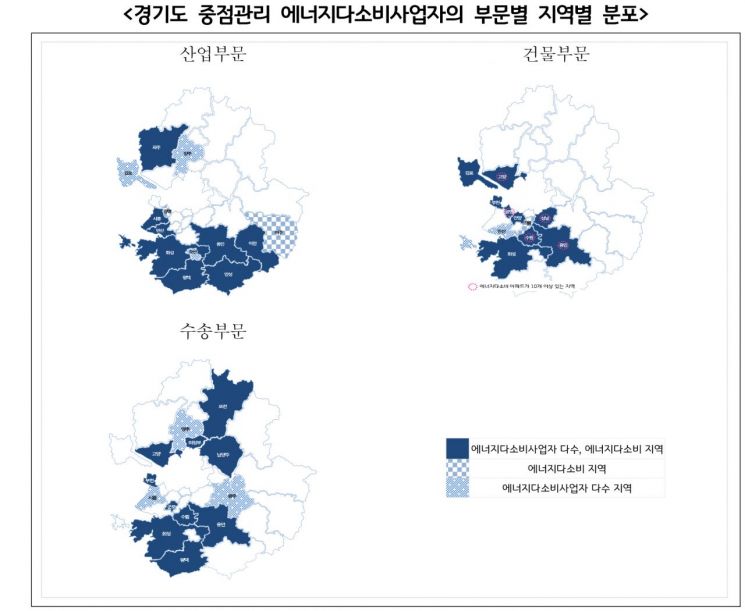
 Distribution Map of Energy-Intensive Businesses by Sector and Region in Gyeonggi Province Data provided by Gyeonggi Research Institute
[Asia Economy (Suwon) = Reporter Lee Young-gyu] Gyeonggi Province has the highest number of energy-intensive businesses nationwide, but their self-production of renewable energy accounts for only 0.23%.
On the 2nd, the Gyeonggi Research Institute released a research report titled "Management Measures for Energy-Intensive Businesses for Carbon Neutrality in Gyeonggi Province," suggesting that the province should actively intervene to support carbon neutrality and greenhouse gas reduction.
Energy-intensive businesses refer to companies or operators whose total annual energy consumption is 2,000 TOE (tons of oil equivalent) or more under the Energy Use Rationalization Act. One TOE corresponds to the amount of gasoline (1,280 liters) consumed by a typical passenger car (fuel efficiency of 14 km/l) making 22 round trips between Seoul and Busan (410 km).
According to the report, as of 2021, there are 1,143 energy-intensive businesses in the province, the highest nationwide (23.5% of the national total). More than half (55.8%) of these are industrial sector companies, and by region, Ansan City has the most (157 companies, 13.7%).
Gyeonggi Province ranks second in energy consumption (17.6% of the national total), following Jeonnam (22.0%). Among these, the energy consumption of 906 key management target businesses accounts for about 20% of the province's final energy consumption.
The number of energy-intensive businesses and their energy consumption have increased faster than the national average, recording an annual average growth of 5.2% and 11.1%, respectively, from 2013 to 2021.
In 2021, energy-intensive businesses in the province invested 198 billion KRW (21.4% of the national total) and reduced energy consumption by 1.39% (national average 1.4%), according to the institute's analysis.
The self-production of renewable energy by these businesses was 15,452 TOE, accounting for only 0.23% of their energy consumption.
Accordingly, the institute proposed five policy measures to the province: ▲ customized management and focused support for key management target businesses ▲ expansion of one-stop support for energy diagnosis and facility improvement for small and medium enterprises ▲ implementation of 'RE100' linking electricity demand reduction and renewable energy supply ▲ energy diagnosis for apartments ▲ disclosure of energy consumption information of energy-intensive businesses and establishment of a database.
© The Asia Business Daily(www.asiae.co.kr). All rights reserved.

















