Only 9 Law Schools Received 'Accredited' Rating
Some Evaluation Criteria Not Reflecting Reality Will Be Revised
[Asia Economy Reporter Choi Seok-jin, Legal Affairs Specialist] In the third evaluation of law schools conducted by the Law School Evaluation Committee of the Korean Bar Association (hereinafter referred to as the Evaluation Committee), three law schools?Kyung Hee University, Sogang University, and Inha University?received the 'Temporary Non-Certification' rating for the first time.
Additionally, 13 law schools, including Seoul National University Law School, received 'Conditional Certification,' resulting in a significant decrease in the number of law schools rated as 'Certified' compared to five years ago.
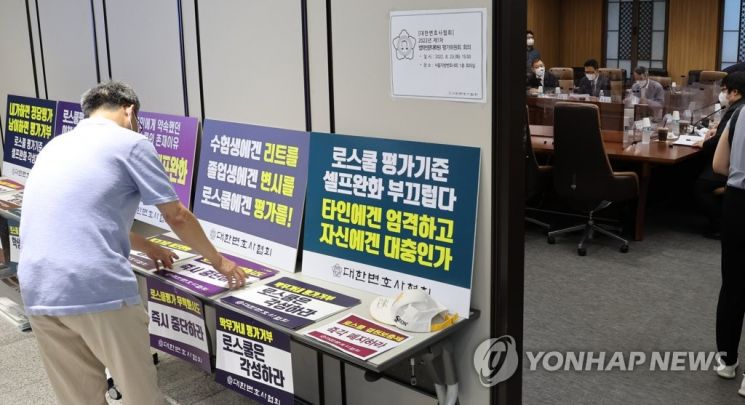 On August 23 last year, a meeting of the Law School Evaluation Committee was held at the Seoul Bar Association Building. In front of the meeting room, a protest sign from the Korean Bar Association regarding the revision of evaluation criteria was placed.
On the 2nd, the Evaluation Committee announced that in the third cycle evaluation (from the first semester of the 2017 academic year to the second semester of the 2021 academic year) conducted on 25 law schools nationwide, Kyung Hee University, Sogang University, and Inha University law schools received the 'Temporary Non-Certification' rating.
Temporary Non-Certification is a rating given when there are two or more non-compliant areas among the five evaluation categories?students, faculty, educational environment, curriculum, and educational outcomes?and improvements can be made within one year, or when there is one non-compliant area that cannot be improved within one year. This is the first time since the introduction of the law school system in 2009 that a law school has received a 'Temporary Non-Certification' rating.
The Evaluation Committee stated that according to Article 18, Paragraph 2, Subparagraph 1 of the Enforcement Decree of the Act on the Establishment and Operation of Law Schools, these law schools will undergo re-evaluation if they apply after addressing the pointed-out issues.
Thirteen law schools?Konkuk University, Korea University, Seoul National University, University of Seoul, Sungkyunkwan University, Ajou University, Wonkwang University, Ewha Womans University, Chonnam National University, Chonbuk National University, Jeju National University, Chung-Ang University, and Chungbuk National University?received 'Conditional Certification.'
Conditional Certification is a rating given when there is one non-compliant area among the five evaluation categories and it can be improved within one year. The Evaluation Committee stated that it will conduct an additional evaluation within one year if these law schools apply.
Among the 25 law schools, only nine?Kangwon National University, Kyungpook National University, Dong-A University, Pusan National University, Yonsei University, Yeungnam University, Chungnam National University, Hankuk University of Foreign Studies, and Hanyang University?received the 'Certification' rating in this third cycle evaluation. This number is significantly lower than the 18 schools in the first cycle evaluation announced in 2012 and the 23 schools in the second cycle evaluation in 2018.
In the second cycle evaluation in 2017, Kyungpook National University Law School received a conditional certification rating due to multiple courses lacking lecture suitability and findings from the Board of Audit and Inspection that attendance and grade management in the first semester of the 2013 and 2014 academic years were neglected, resulting in disciplinary action by the Ministry of Education for improper academic management. Sogang University Law School also received a conditional certification rating because only one female faculty member was among the full-time faculty, failing to meet the 10% female faculty ratio, and two faculty members did not meet the minimum research performance standard of 400%, resulting in a non-compliance judgment in the 'faculty area.'
The Evaluation Committee stated, "In this third cycle evaluation, although there was no particular strengthening of evaluation criteria compared to the first cycle (2012) and second cycle (2017), many faculty members were rated as insufficient in lecture suitability," adding, "Despite most faculty members having verified excellent careers and capabilities, some faculty members did not meet the performance requirements demanded by the evaluation criteria, which was regrettable."
They added, "There were many schools that failed to meet criteria related to unfair cases in admissions and evaluation factors such as the total amount of corporate transfers and donations."
Furthermore, the Evaluation Committee noted, "During the evaluation period, the three years of the COVID-19 pandemic caused difficulties in face-to-face classes and student guidance, but it was regrettable that this could not be sufficiently reflected in the evaluation because it was difficult to quantify this in the evaluation criteria."
Finally, the Evaluation Committee confirmed the need to revise some evaluation criteria that do not align with the realities of law schools while conducting this third cycle evaluation. They stated, "We plan to review the Ministry of Education's 'Implementation Check Items,' the Evaluation Committee's 'Evaluation Criteria,' and suggestions from law schools related to the evaluation, and through consultation with the Ministry of Education, prepare more complete fourth cycle evaluation criteria (applicable from the first semester of the 2022 academic year to the second semester of the 2026 academic year)."
Article 28 (Establishment and Functions of the Evaluation Committee) of the Act on the Establishment and Operation of Law Schools stipulates that "The Law School Evaluation Committee shall be established under the Korean Bar Association pursuant to Article 78 of the Attorney-at-Law Act to perform the following tasks related to the educational evaluation of law schools."
The duties of the Evaluation Committee include: 1) evaluation of education, organization, operation, and facilities of law schools; and 2) development of evaluation techniques and establishment of evaluation criteria for appropriate evaluation.
Article 27 (Evaluation by the Law School Evaluation Committee) of the same Act states, "Universities with law schools must undergo evaluation by the Law School Evaluation Committee pursuant to Article 28 in accordance with the Presidential Decree."
Article 18 (Timing of Law School Evaluation, etc.) Paragraph 1 of the Enforcement Decree of the Act on the Establishment and Operation of Law Schools stipulates that "Universities with law schools must undergo evaluation by the Law School Evaluation Committee pursuant to Article 28 in the year when four years have passed since the first admission of students, and thereafter every five years from the time of the first evaluation."
The Evaluation Committee consists of 11 members, including one chairman appointed by the President of the Korean Bar Association. Members include four law professors or associate professors recommended by the Minister of Education, one judge with more than 10 years of experience recommended by the Chief of the Court Administration, one prosecutor with more than 10 years of experience recommended by the Minister of Justice, one lawyer with more than 10 years of experience, one public official engaged in educational administration with more than 10 years of experience, and three others with academic knowledge and integrity appointed by the President of the Korean Bar Association.
Since 2009, the Evaluation Committee has periodically conducted comprehensive evaluations of law schools' lectures, faculty research achievements, scholarships, and facilities. Evaluation ratings are divided into Certification, Conditional Certification, Temporary Non-Certification, and Non-Certification.
Meanwhile, the Evaluation Committee does not have the authority to approve or cancel the establishment of law schools, abolish or change them, or adjust quotas. Therefore, the 'Certification' rating given by the Evaluation Committee only reflects the evaluation results of the five areas conducted by the committee, and universities that received 'Conditional Certification' or 'Temporary Non-Certification' ratings can still recruit new students and operate academic affairs without hindrance, according to the Evaluation Committee.
© The Asia Business Daily(www.asiae.co.kr). All rights reserved.
![Clutching a Stolen Dior Bag, Saying "I Hate Being Poor but Real"... The Grotesque Con of a "Human Knockoff" [Slate]](https://cwcontent.asiae.co.kr/asiaresize/183/2026021902243444107_1771435474.jpg)
















