[Asia Economy Reporter Kim Daehyun] Consumers filed a lawsuit seeking damages, claiming that Apple deliberately degraded the performance of older iPhone models by updating their software, but the court did not accept the claim. This ruling came 4 years and 10 months after the first lawsuit was filed.
On the morning of the 2nd, the Civil Division 31 of the Seoul Central District Court (Presiding Judge Kim Jisuk) ruled against the plaintiffs in the first trial of a 12.7 billion KRW damages lawsuit filed by about 9,800 iPhone users including Mr. Kim against Apple headquarters and Apple Korea. The court stated, "All claims of the plaintiffs are dismissed. The plaintiffs shall bear the litigation costs." However, the court did not disclose specific reasons for the ruling in the courtroom that day.
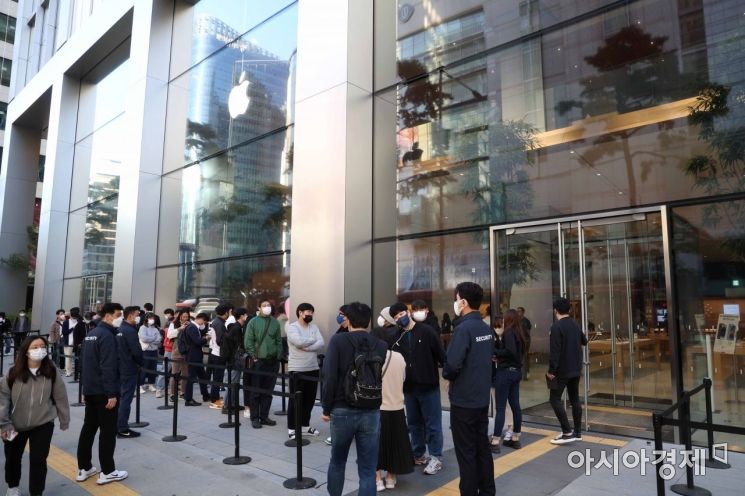 On October 7 last year, when Apple's new iPhone 14 series was officially released in Korea, citizens lined up at the Apple Store in Myeongdong, Jung-gu, Seoul to purchase the product. Photo by Mun Ho-nam munonam@
Immediately after the ruling, Hannuri Law Firm, representing the consumers, stated, "We will review the judgment as soon as we obtain the written ruling and decide on subsequent measures such as whether to appeal," adding, "Regardless of the outcome, this lawsuit revealed significant limitations in remedying collective consumer damages due to the absence of a consumer class action system and discovery procedures."
Earlier, in December 2017, Apple applied software updates to iPhone 6 and 7 models, adding a 'performance management' feature that, in some cases, reduced performance.
Consumers protested, saying, "Isn't this update intentionally degrading performance to sell more new iPhones?" but Apple explained, "It is to prevent the device from shutting down when the battery ages." Related consumer class action lawsuits against Apple were filed consecutively in 2018 and 2019, and the court consolidated and reviewed them.
During the trial, the consumer side argued, "We were not informed at all about the side effects of the update, nor were customers given a choice. This constitutes either an illegal act or breach of contract." They claimed that Apple planned and produced the software update to conceal battery defects, prevent customer churn, and promote sales of subsequent models, distributing it to users without disclosure. They demanded payment of 200,000 KRW per person, totaling 12.7534 billion KRW.
Apple CEO Tim Cook and Apple Korea CEO Daniel D'Souza were also criminally reported for violating the Information and Communications Network Act, but investigative authorities judged, "It is difficult to see that Apple distributed a program that could interfere with the operation of information and communication systems without justifiable reasons."
Meanwhile, similar class action lawsuits have been filed in various countries including the United States, Israel, France, and Canada. Last year in the UK, consumer rights activists filed a lawsuit against Apple demanding compensation of up to 768 million pounds (approximately 1.2156 trillion KRW) for about 25 million consumers in the UK.
There are countries where liability for damages has been recognized. Apple, which faced a class action lawsuit in the United States, agreed in March 2020 to pay 25 dollars (about 29,800 KRW) per user of older iPhones, totaling 500 million dollars (650 billion KRW). In Chile, each user participating in the lawsuit was compensated 50 dollars (about 56,000 KRW).
© The Asia Business Daily(www.asiae.co.kr). All rights reserved.
![Clutching a Stolen Dior Bag, Saying "I Hate Being Poor but Real"... The Grotesque Con of a "Human Knockoff" [Slate]](https://cwcontent.asiae.co.kr/asiaresize/183/2026021902243444107_1771435474.jpg)
















