"Hard to distinguish based on provisional standards"
"Because Tokyo Electric Power has not disclosed the data"
[Asia Economy Reporter Park Hyun-joo] Concerns are growing over the consumption of seafood from the East Sea as it has been confirmed that seawater near the Fukushima nuclear power plant in Japan was discharged domestically. Seo Gyun-ryeol, Emeritus Professor of Nuclear Engineering at Seoul National University, said, "Tokyo Electric Power Company (TEPCO) has not disclosed the data, so expert opinions are divided on whether it is safe to eat seafood from the East Sea," adding, "In such cases, it should be considered practically inedible."
On the 2nd, Professor Seo said on YTN Radio's 'News King with Park Ji-hoon,' "TEPCO is tightly holding onto the data (not disclosing it)," and added, "(To investigate) input data is necessary, but we have neither boundary conditions nor initial conditions."
It was recently confirmed that seawater near the Fukushima nuclear power plant was injected as ballast water into cargo ships traveling between Japan and Korea, then brought to domestic ports and discharged. Professor Seo estimated that nearly 10 million tons of contaminated water have been discharged into the East Sea since March 11, 2011, until now.
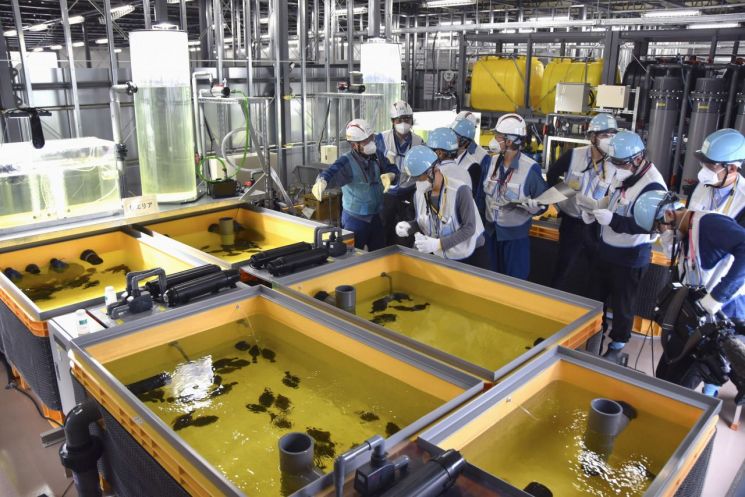 Tokyo Electric Power Company is showcasing flounder being raised in diluted contaminated water at the Fukushima Daiichi Nuclear Power Plant on October 17, 2022.
The bigger problem is that if seafood from Fukushima is processed and labeled based on the place of processing, Korean consumers may find it difficult to recognize its origin. Professor Seo explained, "If seafood caught near Fukushima is processed in Osaka, it is labeled as Osaka product; if processed in Sapporo, it is labeled as Sapporo product," adding, "If it just says 'Made in Japan,' how can we tell? No matter how hard you look, it is difficult to distinguish."
Regarding TEPCO and the Japanese government's announcement that the discharged contaminated water is "safely treated water diluted to one-fortieth," Professor Seo criticized, "That is purely a gag order. It's like covering one's eyes and pretending not to see." He pointed out, "If you discharge it, the ocean dilutes it. To dilute it to one-fortieth, you would need to mix it with 400 million tons of water, which would require a huge amount of electricity. They are mocking the Korean people and citizens worldwide."
Professor Seo continued, "It is not just contaminated liquid but also sticky sludge (sediment generated during sewage treatment or purification processes), which the Japanese government and TEPCO do not talk about," adding, "Even if purified, the total amount of contaminants does not change, so more sludge remains."
He further asserted, "It is appropriate to store (the nuclear power plant contaminated water) domestically. If an artificial lake of about 5 million tons is created, it can store the amount expected to be produced over the next 30 to 50 years."
© The Asia Business Daily(www.asiae.co.kr). All rights reserved.
![Clutching a Stolen Dior Bag, Saying "I Hate Being Poor but Real"... The Grotesque Con of a "Human Knockoff" [Slate]](https://cwcontent.asiae.co.kr/asiaresize/183/2026021902243444107_1771435474.jpg)
















