Despite Decline in Consumer Price Inflation Index
Base Interest Rate Expected to be Cut by 0.5%P
Speed Adjustment Anticipated Only Starting in May
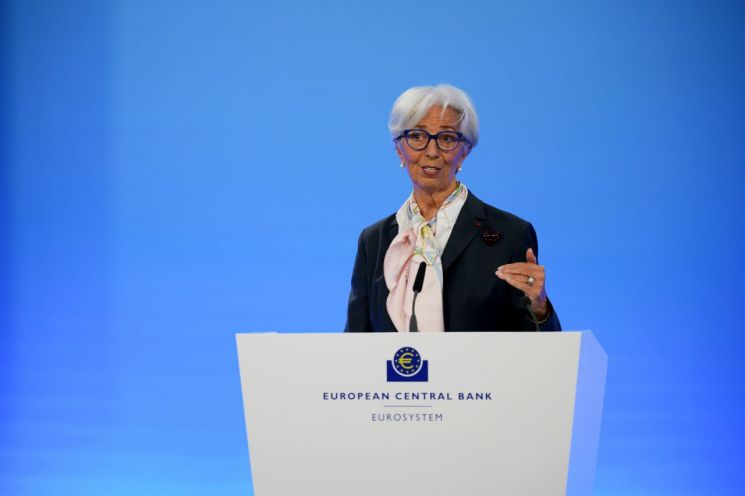
[Asia Economy Reporter Lee Ji-eun] Although the Eurozone consumer price index has recorded a decline for three consecutive months, the European Central Bank (ECB) is expected to implement a big step (0.5 percentage point interest rate hike) for the second consecutive month at this month's monetary policy meeting. While the pace of inflation has slowed, the price level is still considered high. However, market attention is focused on how long the ECB's hawkish stance will continue, given the ongoing trend of slowing inflation.
On the 1st (local time), Eurostat, the statistical office of the European Union (EU), announced that the Eurozone consumer prices rose by 8.5% year-on-year in January. This figure is below the market expectations of 8.9% to 9.0%. The Eurozone inflation rate peaked at 10.6% in October last year, then declined to 10.1% in November, 9.2% in December, and 8.5% in January this year. The GDP for the fourth quarter of last year increased by 0.1% quarter-on-quarter, avoiding a recession contrary to market expectations.
Although the inflation rate has slowed, the prevailing view is that the ECB will take a big step at the monetary policy meeting on the 2nd (local time). The market believes that inflation in the Eurozone still significantly exceeds the ECB's target of 2%, by more than four times, indicating that high inflation has not yet been sufficiently controlled. In particular, excluding energy, which has shown sharp price fluctuations recently, the core inflation rate in January remained at 5.2%, the same as the previous month’s record high. While energy prices fell due to warm weather, Eurozone citizens have not yet felt the lower prices in public utilities and food. In Spain, core inflation excluding energy and food rose to 7.5%, higher than the previous month’s 7%, showing an increase.
Based on these figures, Ken Wattret, head of European analysis at S&P Global Market Intelligence, forecasted, "The ECB is expected to continue raising the benchmark interest rate by 0.5 percentage points at the monetary policy meetings in February and March." Bert Colijn, an economist at ING Bank, also explained, "The rise in core inflation in some major countries such as Spain has reaffirmed the ECB's hawkish stance on tightening."
Experts expect the ECB to begin moderating the pace of rate hikes only in May. According to a Bloomberg survey of 46 economists, the majority predicted that the ECB would slow the rate hike pace to 0.25% in May. Only four respondents expected the ECB to take a 'baby step' (0.25% rate hike) next month.
Veronika Locharova, Eurozone economic analyst at Credit Suisse, said, "The biggest challenge facing the ECB is that while the consumer price index is declining, the core consumer price index excluding energy prices is still rising," adding, "The ECB needs to balance these two, but the latter (rising core CPI) is more important to the ECB."
Meanwhile, the Bank of England (BOE), the central bank of the UK, is widely expected to raise interest rates by 0.5 percentage points this month. However, experts predict that the BOE will moderate the pace of rate hikes to 0.25% starting in March and end the tightening cycle at 4.5% by mid-year.
© The Asia Business Daily(www.asiae.co.kr). All rights reserved.

















