MedPacto, Yonsei University, and Gil Foundation Joint Research
Revealing the Role of Spermatogonial Stem Cells in Regulating Male Sperm Production

[Asia Economy Reporter Myunghwan Lee] Domestic researchers have elucidated the mechanism of action of a protein that plays a key role in regulating spermatogonial stem cells, which are crucial for treating male infertility.
MedPacto announced on the 2nd that through joint research with Yonsei University (Professor Hanseong Jung) and the Gilo Foundation, they discovered that the MAST4 protein is essential for maintaining the 'self-renewal' characteristics of spermatogonial stem cells. The research results were published in the international journal Cell Proliferation.
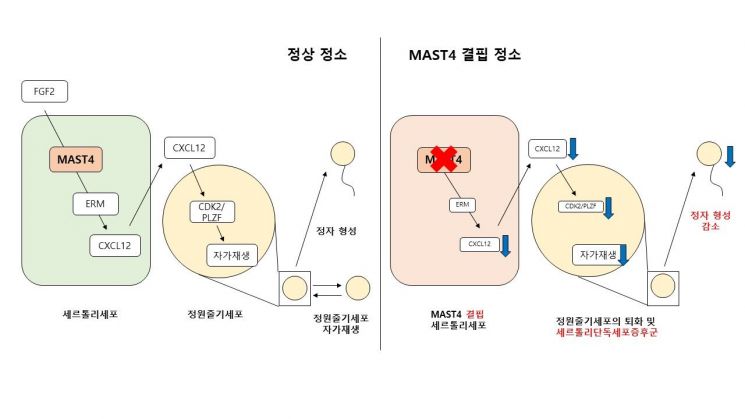
The testes contain spermatogonial stem cells and Sertoli cells. Among these, spermatogonial stem cells maintain a balanced process of 'self-renewal' and 'differentiation into sperm' under normal conditions. However, deficiency of the MAST4 protein in Sertoli cells reduces the self-renewal of spermatogonial stem cells, leading to Sertoli cell-only syndrome, which causes male infertility.
This study opens the possibility for future prevention of male infertility and the development of therapeutics utilizing the mechanism of this protein. It specifically clarifies the interaction between Sertoli cells and spermatogonial stem cells, which are essential for sperm formation, from the perspective of the MAST4 protein.
The research team confirmed that in the testes of mice lacking the MAST4 protein, the expression level of the PLZF protein, known to regulate the cell cycle of spermatogonial stem cells, was significantly decreased. They also found that cell cycle progression was inhibited and self-renewal was reduced in spermatogonial stem cells of MAST4-deficient mice compared to normal mice.
They verified that the MAST4 protein directly induces phosphorylation and activation of the PLZF protein by the CDK2 protein, which in turn regulates genes related to the cell cycle, positively affecting the self-renewal of spermatogonial stem cells.
The researchers explained, "We newly elucidated the specific mechanism of the MAST4 protein regulating spermatogonial stem cells, which play a key role in treating male infertility, from the perspective of cell cycle regulation," adding, "Previous and current studies revealed that the FGF2-MAST4-CXCL12 signaling pathway between Sertoli cells and spermatogonial stem cells regulates the self-renewal of spermatogonial stem cells."
© The Asia Business Daily(www.asiae.co.kr). All rights reserved.


















