US and South Korea Defense Ministers Discuss Strengthening Extended Deterrence
B-1B Bombers Deployed to Korean Peninsula Immediately After Meeting
North Korean Foreign Ministry: "Turning Korean Peninsula into a War Zone"
[Asia Economy Reporter Jang Hee-jun] After the South Korea-U.S. defense ministers put their heads together to strengthen extended deterrence capabilities and deployed U.S. strategic assets on the Korean Peninsula, North Korea immediately reacted with strong opposition. It issued its most intense statement of threats this year, mentioning 'direct confrontation,' leading to speculation that North Korea may soon resume military provocations.
In a statement released on the 2nd through the Korean Central News Agency, a spokesperson for the North Korean Ministry of Foreign Affairs said, "We will respond with overwhelming force according to the principle of 'nuclear for nuclear, direct confrontation for direct confrontation' against any U.S. military attempt," adding, "We have a clear response strategy to counter (the U.S.) and will strongly control and manage it with the most overwhelming nuclear capabilities."
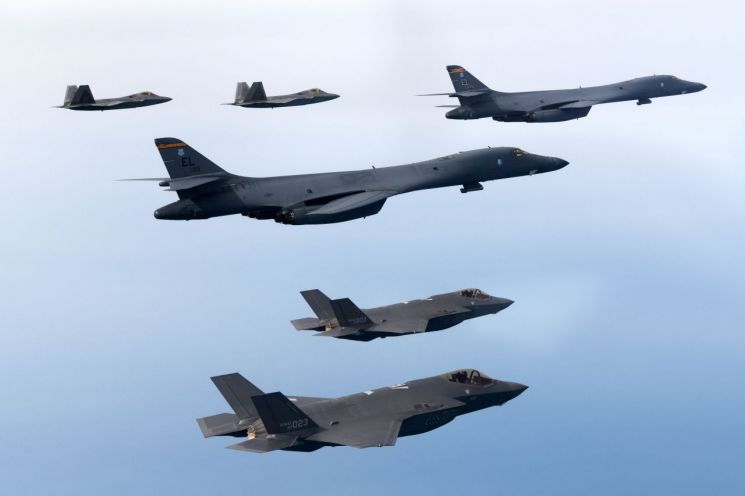 On the 1st, the South Korean and U.S. Air Forces conducted their first joint aerial exercise of the year over the West Sea, with South Korea's F-35A fighter jets and the U.S.'s B-1B strategic bombers, F-22, and F-35B fighter jets deployed.
 [Photo by Ministry of National Defense]
The statement particularly referred to recent remarks by U.S. Secretary of Defense Lloyd Austin about "increasing the frequency of deployment of U.S. strategic assets to the Korean Peninsula," criticizing it as "a concentrated expression of the U.S.'s reckless attempt to turn the Korean Peninsula into a huge powder keg and an even more precarious war zone."
Earlier, on the 31st of last month, Secretary Austin held talks with South Korean Minister of National Defense Lee Jong-sup in Seoul to discuss ways to strengthen the execution of extended deterrence. At that time, Secretary Austin stated, "This includes all categories of U.S. military capabilities such as nuclear, conventional, and missile defense," and added, "We will deploy more strategic assets such as F-22 and F-35 stealth fighters and nuclear-powered aircraft carriers."
Immediately after the talks, the two countries conducted the first joint air exercise of the year using U.S. strategic assets. The exercise was carried out over the Yellow Sea with South Korea's F-35A fighters and the U.S.'s B-1B strategic bombers, F-22, and F-35B fighters participating. The U.S. Air Force's B-1B bomber, known as the 'Death's Swan,' is one of the strategic assets North Korea fears most because it can drop a large number of bombs in a single sortie. North Korea pulled out its 'statement card' less than a day after the exercise was conducted.
The spokesperson also mentioned North Korean human rights issues and sanctions against North Korea, referring to the upcoming South Korea-U.S. extended deterrence operational exercise (DSC TTX) scheduled for this month, saying "It aims to ignite the fuse of full-scale confrontation."
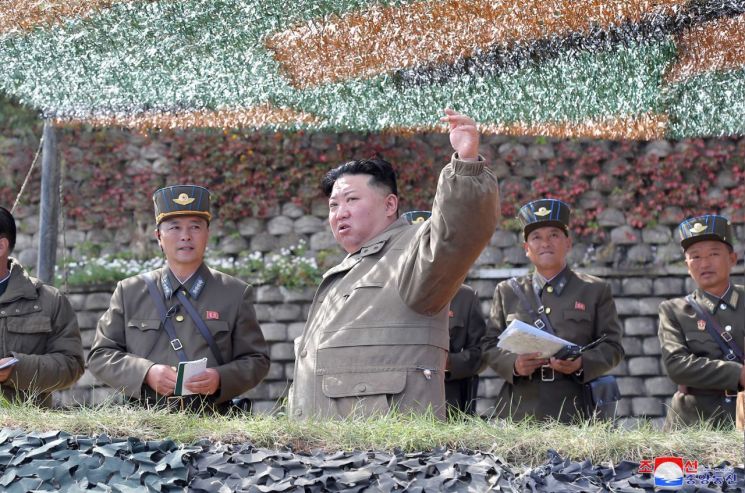 North Korean State Affairs Commission Chairman Kim Jong-un overseeing tactical nuclear operation unit military training
 [Image source=Yonhap News]
The spokesperson stated, "As long as the U.S. pursues hostile policies and confrontation lines, we have no interest in any contact or dialogue," and claimed, "The escalation of tensions on the Korean Peninsula is entirely caused by the U.S., which enforces unilateral disarmament through sanctions and military pressure and pursues military expansion by allied forces."
With North Korea reaffirming its will for a 'strong-for-strong' confrontation, concerns are rising that military tensions surrounding the Korean Peninsula will escalate again. Yang Moo-jin, a professor at the University of North Korean Studies, analyzed, "By blaming the U.S. for the deterioration of the Korean Peninsula situation, North Korea is building justification for nuclear and missile development. Considering past precedents where statements were followed by concrete actions, large-scale strategic weapons development and test launches are expected after February or March."
Professor Lim Eul-chul of the Institute of Far Eastern Studies at Kyungnam University said, "The announcement of an overwhelming response to the deployment of U.S. strategic assets is seriously concerning because if there is a gap in situation and crisis management, it could lead to a nuclear conflict on the Korean Peninsula. However, although the position of 'no interest in dialogue' is repetitive, paradoxically, it suggests that North Korea continues to pay close attention to U.S. proposals for dialogue."
Meanwhile, North Korea is expected to hold a large-scale military parade on the occasion of the 75th anniversary of the founding of the Korean People's Army (Army Foundation Day) on the 8th. Tens of thousands of troops have already gathered around Pyongyang Sunan Airport and Mirim Airfield, and dozens of weapons have been mobilized, with related signs being detected one after another. Military and intelligence authorities are closely monitoring related developments, keeping in mind the possibility that North Korea may launch military provocations starting from the parade.
© The Asia Business Daily(www.asiae.co.kr). All rights reserved.
![Clutching a Stolen Dior Bag, Saying "I Hate Being Poor but Real"... The Grotesque Con of a "Human Knockoff" [Slate]](https://cwcontent.asiae.co.kr/asiaresize/183/2026021902243444107_1771435474.jpg)

















