[Asia Economy (Suwon) = Reporter Lee Young-gyu] Gyeonggi Province is launching a focused crackdown on environmental pollution activities at dental laboratories.
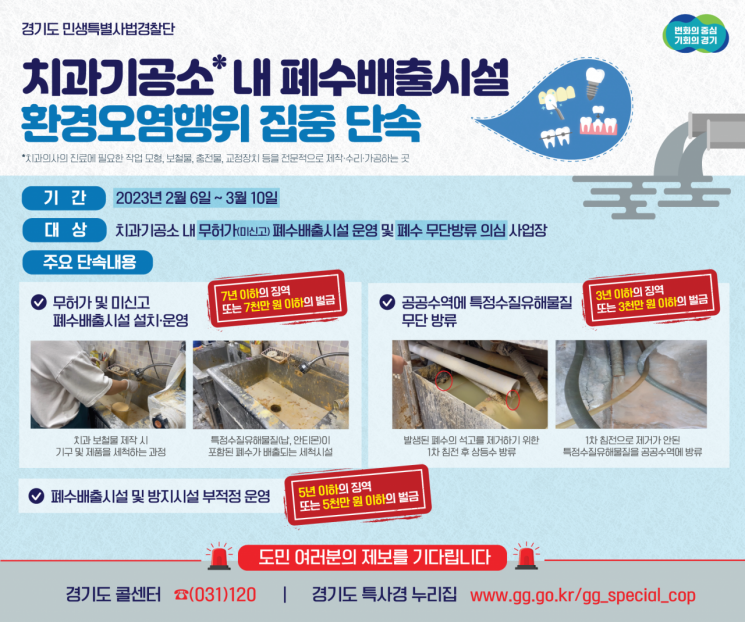
The Gyeonggi Province Special Judicial Police for Public Welfare announced on the 2nd that from the 6th of this month until the 10th of next month, it will select 360 dental laboratories registered in the province based on their operational scale and conduct a focused crackdown on their environmental pollution activities.
Dental laboratories specialize in manufacturing, repairing, and processing working models, prosthetics, fillings, orthodontic devices, etc., necessary for dentists' treatments. Wastewater is generated during the process of washing materials or surface treatment.
Until now, dental laboratories were perceived as not generating water pollutants such as heavy metals because they mainly use materials approved by the Ministry of Food and Drug Safety due to the nature of manufacturing dental-related products. Therefore, they operated without environmental-related permits and were outside the management of administrative agencies.
However, as a result of an investigation into illegal activities at wastewater discharge facilities in knowledge industry centers conducted by the provincial special judicial police last year, water pollutants such as lead and antimony were detected above permitted standards in wastewater from two dental laboratories. The province explained that in a preliminary inspection conducted in January this year, water pollutants exceeding permitted standards were detected in 5 out of 10 places, leading to an expansion of the investigation scope to the entire Gyeonggi Province.
The main crackdown items include ▲ installation and operation of unauthorized or unreported wastewater discharge facilities ▲ unauthorized discharge of specific water pollutants into public waters ▲ proper wastewater treatment ▲ proper waste disposal, etc.
Under the current "Water Environment Conservation Act," installing wastewater discharge facilities without permission or operating using such facilities is punishable by imprisonment of up to 7 years or a fine of up to 70 million KRW; improper operation of wastewater discharge and prevention facilities is punishable by imprisonment of up to 5 years or a fine of up to 50 million KRW; and discharging or dumping specific water pollutants into public waters is punishable by imprisonment of up to 3 years or a fine of up to 30 million KRW.
In particular, this investigation will focus on confirming the presence of water pollutants that may directly or indirectly harm human health, property, or the growth of animals and plants.
Businesses where specific water pollutants are detected in wastewater as a result of pollution tests will be criminally charged for discharging specific water pollutants into public waters, referred to the prosecution, and administrative agencies will be requested to impose administrative measures such as closure orders or suspension of use.
Hong Eun-gi, head of the Gyeonggi Province Special Judicial Police for Public Welfare, emphasized, "Since dental laboratories have been a blind spot in environmental management by administrative agencies, we will thoroughly crack down so that they can operate legally within the framework of environmental laws through this investigation."
© The Asia Business Daily(www.asiae.co.kr). All rights reserved.

















