Package Box Paper, 100% Recycled
Security Updates Guaranteed for 5 Years
[Asia Economy Reporter Lim Hye-seon] The Galaxy S23 series, unveiled by Samsung Electronics on the 2nd, is an eco-friendly smartphone. It embodies the technology and innovation of Samsung Electronics' Mobile Experience (MX) Division, which cares for the Earth and the environment.
Since 2017, Samsung Electronics has been reducing the use of single-use plastics in the packaging of its Galaxy flagship smartphones. This effort is part of the vision of Everyday Sustainability, aimed at minimizing the environmental impact on the planet. The goal is to completely eliminate single-use plastics from the packaging of all Galaxy products by 2025.
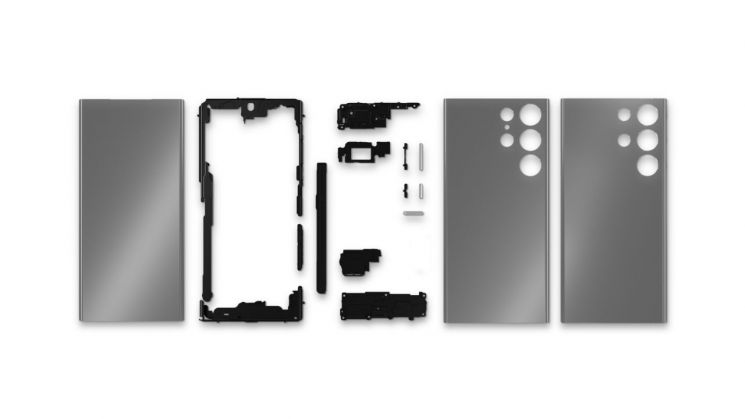
Expanded Use of Recycled Materials
Samsung Electronics applied a total of 12 recycled material components to the Galaxy S23 Ultra model. The S23 Plus and the base S23 models each include 11 recycled materials. This is the first time recycled materials have been used in the exterior parts of a Galaxy flagship smartphone.
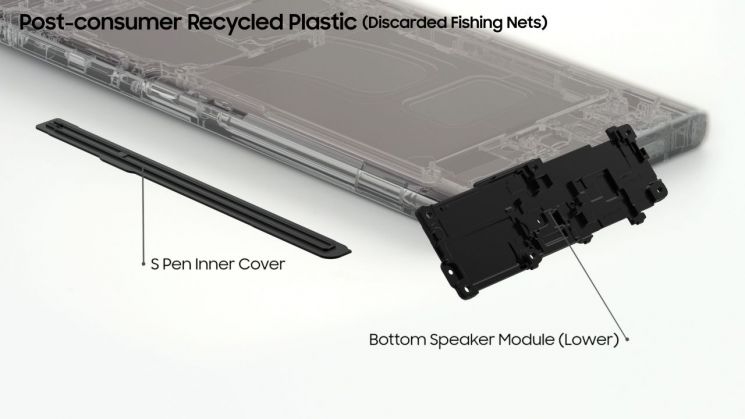
In the Galaxy S22 released last year, recycled plastics were used in six internal components. Notably, Samsung developed a plastic material recycled from discarded fishing nets and applied it to the Galaxy S22 series.
The Galaxy S23 Ultra incorporates not only recycled plastics from discarded fishing nets and used water bottles, as in its predecessor, but also plastics recycled from waste PET bottles, aluminum recycled from by-products generated during manufacturing processes, and glass recycled from cullet produced during manufacturing.
Recycled plastic made with 20% recycled fishing net material was used in the internal S Pen cover and the bottom speaker module. Through this, Samsung expects to collect more than 15 tons of discarded fishing nets this year. Recycled plastic made with 20% recycled used water bottle material was applied to the top and bottom speaker modules, side keys, and volume keys. Recycled plastic made with 10% recycled PET bottle material was used on the front of the external case. A film made with 80% of the same material was placed inside the rear glass of the product. Recycled aluminum made with 28% aluminum by-products from the manufacturing process was applied to the side keys, volume keys, and SIM card tray on the product’s side. Glass containing an average of 22% recycled glass by-products from the manufacturing process was used for the front and rear exterior glass of the product. This glass is Corning’s latest Gorilla Glass product with excellent durability, applied for the first time in the Galaxy S23 series.
Samsung Electronics operates a thorough pre-inspection and post-management system for parts and raw materials and strictly controls hazardous substances within the products.
Package Box Paper is 100% Recycled
The paper used to make the package boxes for the Galaxy S23 series is 100% recycled paper. The plastic film previously attached to the front and back of the product has been replaced with 100% recycled paper.
Samsung Electronics plans to provide a total of four operating system (OS) upgrades and five years of security updates following the launch of the Galaxy S23.
The Galaxy S23 series has obtained the ECOLOGO certification from the U.S. environmental certification body UL. This eco-friendly certification is granted by comprehensively considering the environmental and human health impacts of the product’s lifecycle, from manufacturing to disposal. Additionally, it has received carbon footprint certification from the UK’s nonprofit certification organization Carbon Trust. This certifies that the carbon emissions generated throughout the entire product lifecycle?from production, distribution, and use to disposal?have been calculated according to the international standard for carbon footprint assessment (PAS 2050).
© The Asia Business Daily(www.asiae.co.kr). All rights reserved.
![Clutching a Stolen Dior Bag, Saying "I Hate Being Poor but Real"... The Grotesque Con of a "Human Knockoff" [Slate]](https://cwcontent.asiae.co.kr/asiaresize/183/2026021902243444107_1771435474.jpg)

















