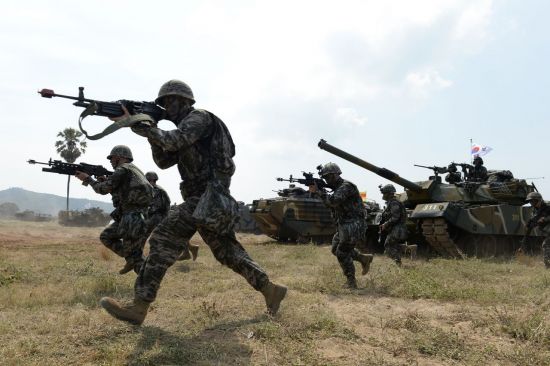
 The ROK-US Marine Corps are conducting the Cobra training held in Thailand.
[Asia Economy Reporter Chunhee Lee] As the possibility of a Chinese threat escalates, the U.S. Marine Corps is undergoing a major reorganization, sparking internal debates over the methodology.
According to a report by the British BBC on the 1st (local time), the recent high-level U.S.-Japan talks mainly discussed U.S. military operations, with the reorganization of the main force, the Marine Corps, emerging as a key issue.
Particularly controversial is the 'Force Design 2030' plan to restructure the Marine Corps in response to the potential threat from China. Proposed by David Berger, Commandant of the U.S. Marine Corps, in March 2020, this plan shifts the focus of the Marine Corps from regions like Iraq and Afghanistan to preparing for potential conflicts with China in the Indo-Pacific region.
Since operations in this region require agile, dispersed maneuvers across various islands, the plan reportedly includes reducing infantry personnel and eliminating the use of tanks. To this end, the infantry will be cut back, three-quarters of the artillery units will be replaced with long-range rocket systems, helicopter squadrons will be reduced, and all tanks will be removed. The $15.8 billion (approximately 19.4261 trillion KRW) budget for this will be secured by cutting existing budgets.
However, if this reorganization materializes, large-scale amphibious operations traditionally conducted by the U.S. military will become impossible. Retired officers have strongly opposed the plan, calling it a "disaster for the future of the Marine Corps." Jim Webb, a former senator and Marine Corps officer who served in the Vietnam War, criticized Force Design 2030 as "insufficiently tested" and "fundamentally flawed." He also warned that "there is a risk of drastically reducing the unit's force structure, weapons systems, and personnel levels, which could result in continuous casualties in most combat scenarios."
For the extensive dispersed deployment of the U.S. Marine Corps in the Indo-Pacific region, smooth logistical support is essential, but concerns have been raised that this may be difficult. Nick Childs, Senior Research Fellow for Naval and Maritime Security at the UK’s International Institute for Strategic Studies (IISS), said, "To operate in a more agile and dispersed manner, the Marine Corps will need many more new types of small vessels." However, it is expected to be challenging to build such a large number of ships quickly enough to meet the timing requirements.
© The Asia Business Daily(www.asiae.co.kr). All rights reserved.
![Clutching a Stolen Dior Bag, Saying "I Hate Being Poor but Real"... The Grotesque Con of a "Human Knockoff" [Slate]](https://cwcontent.asiae.co.kr/asiaresize/183/2026021902243444107_1771435474.jpg)















