Yoon's Remarks on 'Absorptive Unification' Controversy: Kwon Young-se "Tipping Point"
"North Korea Unlikely to Cause Disturbances"
"This Year, Marked by Epidemics and Economic Hardship, Is a Turning Point"
[Asia Economy Reporter Jang Hee-jun] Debates continue over the possibility of the collapse of the North Korean regime. Following President Yoon Suk-yeol's remarks on 'South Korea-centered unification,' which sparked controversy over absorption unification, Minister of Unification Kwon Young-se also hinted at the possibility of regime change considering North Korea's economic difficulties.
While the general consensus is that the likelihood of unrest is low because North Korean residents have not experienced civic consciousness due to strong surveillance and control, some argue that food shortages and the continuous influx of external culture could act as significant variables.
Jung Sung-jang, head of the Unification Strategy Research Office at the Sejong Institute, said in a phone interview with Asia Economy on the 1st, "The view that the North Korean regime will collapse is one of the typical errors of South Korea-centered thinking." He forecasted that unless the economic crisis spreads to a large-scale famine, it would be difficult for the regime to collapse. Jung analyzed, "Unless there is resistance from the powerful military, regime collapse is virtually impossible at this point."
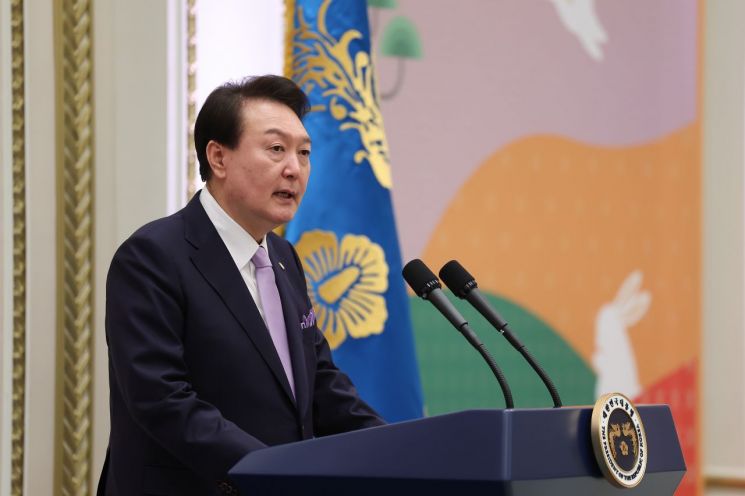
Earlier, on the 27th of last month, President Yoon Suk-yeol stated during the Ministry of Unification's work report, "Unification can come suddenly," adding, "If the South is much better off, it is common sense that unification would be centered on the South's system and regime." Although hypothetical, this remark was widely interpreted as implying 'absorption unification,' which conflicts with the gradual and phased unification approach upheld by previous administrations.
Minister Kwon Young-se attempted to clarify on KBS Radio on the 30th of last month that absorption unification is absolutely not the case. However, his subsequent remarks have led to interpretations that he might be expecting the collapse of the North Korean regime again. He said, "If it reaches a tipping point, North Korea will also need to worry about its people," adding, "(Appeasing them) can only be done once or twice; if there is a shortage of food, clothing, and shelter, unrest is inevitable."
However, the consensus is that the possibility of unrest among residents is slim. Since the era of dynasties through the Japanese colonial period and directly into a dictatorship, North Korean residents have not developed civic consciousness regarding freedom and rights. In particular, the North Korean authorities have strengthened surveillance and control over residents in recent years under the pretext of preventing the spread of COVID-19.
Low Possibility of Unrest but... "Economic Hardship and External Culture Are Variables"
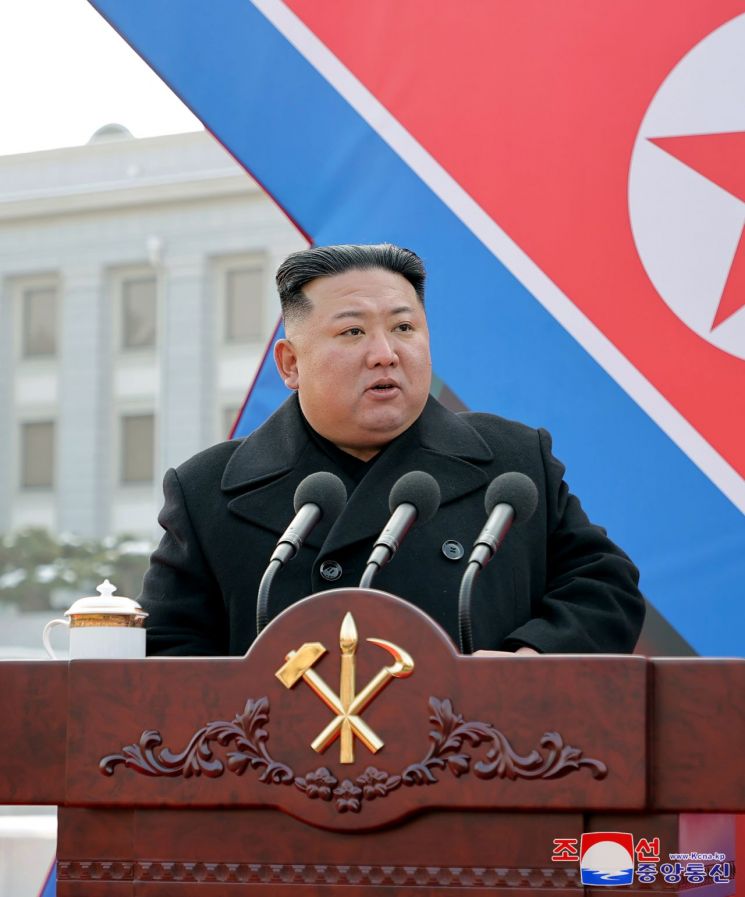
However, as Minister Kwon mentioned, there is a view that North Korea's economic difficulties, surpassing the 'Arduous March,' could be a variable. Park Won-gon, a professor in the Department of North Korean Studies at Ewha Womans University, said, "According to various scenario studies, the only possible condition for collapse is when a very severe economic crisis coincides with an epidemic, and now is exactly that time," forecasting, "In this respect, this year will be an important turning point."
Professor Park also said, "It is difficult to predict when the tipping point due to economic hardship will appear," but analyzed, "When North Korea reaches its limit, it is expected to try to achieve its goals in two major ways: either by creating a justification to shift to a dialogue phase or by employing so-called 'brinkmanship' tactics that increase tensions on the Korean Peninsula."
There are also claims that the possibility of the North Korean regime's collapse should not be completely ruled out. Moon Sung-mook, head of the Unification Strategy Center at the Korea Institute for National Strategy, said, "It is difficult to definitively assess the possibility of collapse, but it is clear that the durability of the North Korean regime has limits," and pointed out, "There is a need for unification preparedness measures that consider not only the mid- to long-term three-stage unification plan inherited by previous governments but also sudden changes in the situation."
Moon especially cited the 'influx of external culture' as an important variable following economic hardship. He said, "Although North Korea maintains its regime through oppression, control, and thorough indoctrination, it is difficult to completely block the inflow of information," adding, "The enactment of the Anti-Reactionary Thought and Culture Rejection Act, which executes those who distribute South Korean videos, and the enactment of the Pyongyang Dialect Protection Act to regulate South Korean speech patterns are evidence of this."
Meanwhile, North Korea is expected to hold a large-scale military parade on the 8th to commemorate the 75th anniversary of the founding of the Korean People's Army (Founding Day). As this is an occasion to demonstrate military power domestically and internationally, the emergence of new strategic weapons or the resumption of provocations is also being discussed. In particular, according to satellite images of North Korea released the previous day by the U.S. James Martin Center for Nonproliferation Studies, it is observed that North Korea is accelerating the development of solid-fuel-based intercontinental ballistic missiles (ICBMs).
© The Asia Business Daily(www.asiae.co.kr). All rights reserved.


















