Bank of Korea and Korea Chamber of Commerce and Industry Seminar
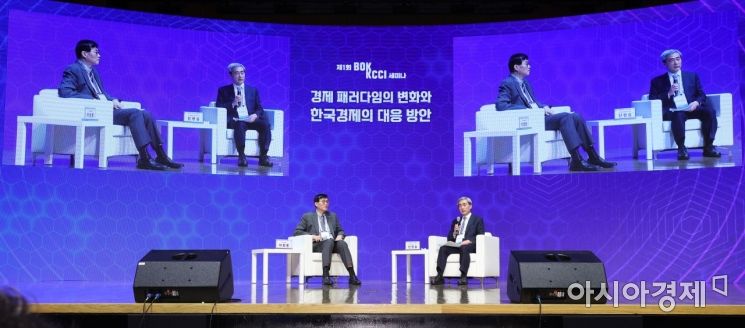 Bank of Korea Governor Lee Chang-yong and BIS Economic Advisor and Head of Research Shin Hyun-song are having a discussion on the topic "Changes in the Economic Paradigm and Response Measures of the Korean Economy" at the 1st Bank of Korea-Korea Chamber of Commerce and Industry Joint Seminar held on the 1st at the Korea Chamber of Commerce and Industry in Jung-gu, Seoul. Photo by Hyunmin Kim kimhyun81@
[Asia Economy Reporter Seo So-jeong] Amid the recent trend of a weakening dollar, Shin Hyun-song, Head of the Research Department at the Bank for International Settlements (BIS), forecasted that the won-dollar exchange rate will continue to decline on a trend basis this year. He also predicted that if commodity prices stabilize and the dollar's value steadies, a positive scenario is possible where the European and U.S. economies avoid entering a recession phase and achieve a soft landing.
On the 1st, at the 1st Bank of Korea (BOK)-Korea Chamber of Commerce and Industry (KCCI) seminar held at the International Conference Hall of the Korea Chamber of Commerce and Industry in Jung-gu, Seoul, Shin stated in a dialogue with Lee Chang-yong, Governor of the Bank of Korea, "The announcement of the U.S. Federal Open Market Committee (FOMC) meeting results scheduled for the early morning of the 2nd Korean time is imminent, and monetary policy plays a significant role in determining the exchange rate." He added, "If U.S. inflation peaks and stabilizes, there may be no need for further financial tightening."
Regarding this year's exchange rate outlook, Shin said, "The won-dollar exchange rate peaked around October last year, and there will likely not be many large spikes going forward." He cautiously predicted, "Unless there are changes in current inflation forecasts, the exchange rate will stabilize to some extent."
◆ U.S.-China Conflict Could Be an Opportunity for Korea = When Governor Lee mentioned that concerns are growing about how small and medium-sized export companies supplying Chinese firms should approach the Chinese market amid ongoing U.S.-China tensions, Shin responded, "Diversifying trading partners is important, but since China's share is so large and it accounts for a significant portion of intermediate goods trade, excluding China is impossible." He added, "From the perspective of Korean companies, except for some strategic items, there may be doubts about whether U.S.-China conflicts will significantly impact trade." He explained that despite U.S.-China frictions, there could be some opportunities for Korea.
In response, Governor Lee diagnosed, "China's exports face issues related to U.S.-China conflicts, but with rising wages in China and increased competitiveness, the Bank of Korea views that Korea, which has enjoyed preferential treatment from China over the past 20 years, ultimately needs to reduce its dependence on China." He also noted, "Yesterday, the International Monetary Fund (IMF) significantly raised China's economic growth forecast for this year from 4.4% to 5.2%. I am curious whether Korea can benefit from China's economic recovery and asked how BIS forecasts China's economic growth this year."
Shin replied, "BIS's view is similar to the IMF's, and the final consumers will benefit greatly from China's economic growth." He added, "If China's economic growth rate is high, the trade relationship between Korea and China, which involves intermediate goods exports and imports, and as two important countries in the global value chain, will depend heavily on how the global economy moves."
Governor Lee said, "Last fall, the outlook was pessimistic due to China's lockdowns, but with this year's growth rate expected to exceed 5%, the mood has changed. The Bank of Korea's interest lies in how much we can effectively benefit from China's economic recovery. If many Chinese tourists visit, it will help improve the current account balance," he forecasted.
Regarding the possibility that China's economic recovery could increase crude oil demand and push oil prices up again, Shin said, "During the first oil shock in 1973, the crude oil dependency relative to GDP was very high domestically, but the dependency on crude oil has steadily decreased." He added, "While rising oil prices would cause some shocks, it is not something to be overly concerned about."
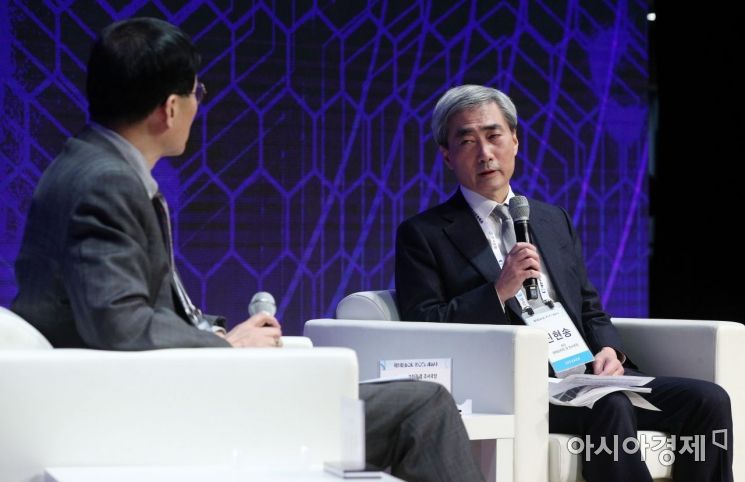 Bank of Korea Governor Lee Chang-yong and BIS Economic Advisor and Head of Research Shin Hyun-song are having a discussion on the topic "Changes in the Economic Paradigm and Response Measures of the Korean Economy" at the 1st Bank of Korea-Korea Chamber of Commerce and Industry Joint Seminar held on the 1st at the Korea Chamber of Commerce and Industry in Jung-gu, Seoul. Photo by Hyunmin Kim kimhyun81@
Additionally, Shin predicted that with the recent easing of the dollar's strength and stabilization of commodity prices, the economies of Europe and the U.S. may avoid entering a recession phase. He said, "Last year, commodity prices rose while the dollar strengthened, causing commodity prices calculated in euros or yen to increase sharply." He assessed, "The rise in commodity prices caused a significant inflation shock, and economic recession and cooling are happening quickly." However, he added, "Although there is still a possibility of recession in Europe, with the recent stabilization of the dollar's value and commodity prices, a soft landing, which was previously unexpected, is cautiously anticipated. If the U.S. regains balance in areas like the labor market, a soft landing is also possible."
◆ With High Interest Rates, Government Spending Will Be the Next Focus = Governor Lee said, "The financial market was pessimistic in November last year but the mood changed in December and January. It is uncertain how things will change depending on this month's U.S. FOMC, but the U.S. financial market is already pricing this in more in advance." In response, Shin said, "Financial markets always reflect pessimism in asset prices (sentiment), and when sentiment turns, they tend to overreact." He emphasized, "The central bank's role is to appropriately consider these market reactions and ensure that finance moves in line with the real economy."
When asked whether Korea's high household and real estate debt could escalate into an economic crisis amid globally high interest rates, he said, "Debt issues vary by country, and household debt directly affects not only financial stability but also the real economy." He added, "If interest burdens rise, consumption decreases, impacting real economic indicators, so household debt is a critical issue, and if high interest rates persist, corporate debt must also be considered."
Shin emphasized that government debt will be the next key issue. He said, "Government debt, which has not been a major concern so far, is gradually emerging as an issue." He noted, "Korea has strong fiscal soundness, so it is not a concern domestically, but globally, government finances have played a role in driving the world economy, making this important." He added, "In a high interest rate environment, how government spending and fiscal management are handled is expected to become a new theme."
© The Asia Business Daily(www.asiae.co.kr). All rights reserved.
![Clutching a Stolen Dior Bag, Saying "I Hate Being Poor but Real"... The Grotesque Con of a "Human Knockoff" [Slate]](https://cwcontent.asiae.co.kr/asiaresize/183/2026021902243444107_1771435474.jpg)

















