 Norovirus bacteria causing food poisoning
 [Photo by Korea Disease Control and Prevention Agency]
[Asia Economy Reporter Byeon Seon-jin] In the future, when food poisoning occurs in school cafeterias, a system will be established to prevent widespread outbreaks by notifying all schools nationwide through the Comprehensive Education Administration Information System 'NEIS'.
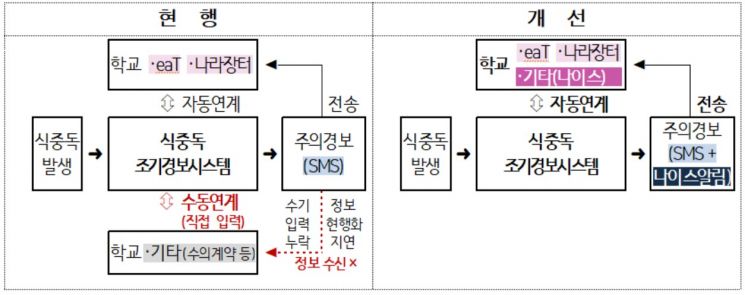
On the 1st, the Ministry of Food and Drug Safety announced that it held an intergovernmental food poisoning countermeasure council meeting with 34 related agencies including the Ministry of Education to discuss the 'Intergovernmental Response Plan to Strengthen Food Poisoning Prevention and Management' containing these details.
Currently, when food poisoning occurs at one cafeteria, there is a system (Food Poisoning Early Warning System) that sends caution alerts to other cafeterias receiving the same ingredients, but due to the limitations of manual input, some cafeterias do not receive timely notifications of food poisoning occurrences. Once the Food Poisoning Early Warning System is linked with NEIS, food poisoning occurrence information can be shared with all schools nationwide not only through SMS caution alerts but also via NEIS notifications.
Additionally, the Ministry of Food and Drug Safety will produce and distribute standard guides for food poisoning prevention education targeting school meal workers and educational content on prevention methods for major food poisoning bacteria to raise awareness of the importance of prior food poisoning prevention.
The Ministry of Education will provide on-site customized education and consulting for meal workers to improve hygiene management levels in school meals, and the Ministry of Health and Welfare will continuously conduct hygiene management and safety inspections of daycare center meals to prevent food poisoning accidents. The Ministry of Agriculture, Food and Rural Affairs will conduct contamination surveys on raw vegetables at the production stage to manage food poisoning bacteria and norovirus, and will promote microbial testing of meat and edible eggs as well as hygiene monitoring of slaughterhouses and milk collection centers.
Last year, the number of food poisoning cases increased by 19% (279 cases→333 cases) compared to the five-year average from 2017 to 2021, but the number of food poisoning patients decreased by 10% (5,784 people→5,193 people). Regarding this, the Ministry of Food and Drug Safety explained that norovirus food poisoning has continuously occurred in group meal facilities such as daycare centers and kindergartens, and reports of food poisoning cases have increased in small restaurants such as pubs, but due to improved hygiene management levels, the number of group food poisoning patients in school meals has significantly decreased.
The Ministry of Food and Drug Safety emphasized that it will continue to actively engage in food poisoning prevention management to create a safe dietary environment for the public and reduce the socioeconomic losses incurred by individuals and businesses due to food poisoning occurrences.
© The Asia Business Daily(www.asiae.co.kr). All rights reserved.

















