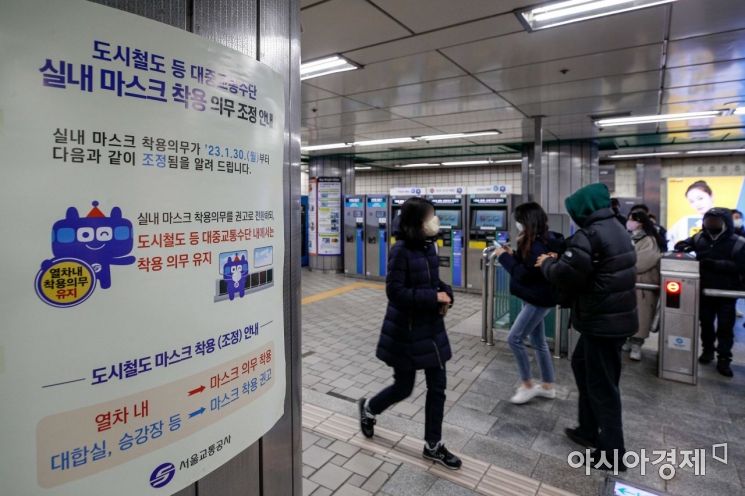
 On the 30th, at Sinchon Station on Subway Line 2 in Seodaemun-gu, Seoul, where indoor mask-wearing has been changed from mandatory to recommended except in some facilities, a notice about the adjustment of the indoor mask-wearing mandate on public transportation is posted. Photo by Jinhyung Kang aymsdream@
[Asia Economy Reporter Lee Gwan-ju] As the indoor mask mandate has been lifted except for some facilities, the weekly COVID-19 risk level nationwide, including the metropolitan area and non-metropolitan areas, remained 'low' for two consecutive weeks. The BN.1 variant has overtaken the previously prevalent BA.5 lineage to become the dominant strain in South Korea.
According to the Central Disease Control Headquarters (CDCH) on the 1st, the number of new weekly confirmed cases in the fourth week of last month (January 22?28) was 148,020, a 29.0% decrease compared to the previous week. The infection reproduction number was 0.75, maintaining below '1' for four consecutive weeks. An infection reproduction number below 1 indicates suppression of the outbreak.
The average daily number of severe and critical patients hospitalized was 463, a 3.3% decrease from the previous week. The average daily deaths were 25, down 35.8%. The health authorities stated that overall indicators such as new confirmed cases, severe patients, deaths, and hospital bed occupancy rates are improving, maintaining the weekly COVID-19 risk level as 'low' nationwide, including both metropolitan and non-metropolitan areas, following last week.
Additionally, in the third week of last month (January 15?21), the proportion of suspected reinfection cases among weekly confirmed cases was 22.0%, an increase from 21.5% the previous week. The proportion of reinfections among weekly confirmed cases is steadily rising. The health authorities emphasized the importance of receiving vaccinations during the recommended period in winter, as vaccination reduces reinfection and progression to severe illness.
Regarding the weekly variant detection rate, BN.1 increased by 2.6 percentage points from 46.3% the previous week to 48.9%. Particularly, the detection rate of domestic infection cases reached 50.4%, establishing BN.1 as the dominant strain. The BA.5 sublineages, including BA.5 (18.2%), BQ.1 (9.0%), and BQ.1.1 (4.2%), which were previously dominant, have continued to decline to 35.5%. The XBB.1.5 variant, which is increasing in the United States, was detected 11 additional times, bringing the cumulative domestic cases to 50.
Regarding arrivals from China, between January 22 and 28, 7,399 people entered the country, 7,272 were tested, and 146 (2.0%) tested positive. Compared to the previous week, the overall positivity rate among arrivals decreased by 0.9 percentage points. Analysis of confirmed cases among arrivals from China showed that 94.8% were BA.5 sublineages.
© The Asia Business Daily(www.asiae.co.kr). All rights reserved.
![Clutching a Stolen Dior Bag, Saying "I Hate Being Poor but Real"... The Grotesque Con of a "Human Knockoff" [Slate]](https://cwcontent.asiae.co.kr/asiaresize/183/2026021902243444107_1771435474.jpg)
















