Bank of Korea-KCCI 'Measures to Address the Korean Economy' Seminar
Rapid Improvement in Trade Balance Possible if Dollar Weakness Continues
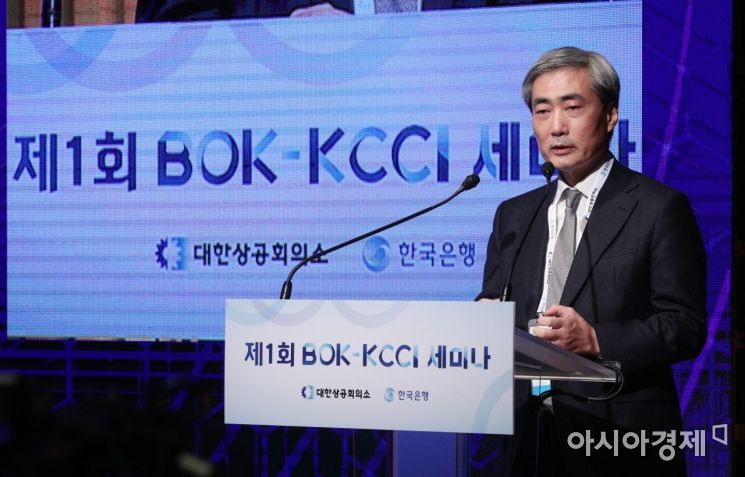 Shin Hyun-song, BIS Economic Advisor and Director of the Research Department, is delivering the keynote speech at the 1st Bank of Korea-Korea Chamber of Commerce and Industry Joint Seminar held on the 1st at the Korea Chamber of Commerce and Industry in Jung-gu, Seoul, on the theme of "Changes in the Economic Paradigm and Korea's Economic Response Measures." Photo by Kim Hyun-min kimhyun81@
Shin Hyun-song, Economic Advisor and Head of Research at the Bank for International Settlements (BIS), stated that if the trend of a weaker dollar continues, the burden of working capital on companies could decrease and investment might increase. He noted that although South Korea's trade balance has significantly deteriorated since last year, there is a possibility of a faster-than-expected improvement. Typically, when the dollar weakens and the Korean won strengthens, textbook theory suggests that South Korea's export price competitiveness worsens, leading to reduced exports and increased imports. However, he argued the opposite.
On the 1st, at the Korea Chamber of Commerce and Industry's international conference hall during the seminar titled "Changes in the Economic Paradigm and Korea's Economic Response Measures," Shin delivered the keynote speech and made these remarks. He explained that globalization and the deepening of global supply chains have greatly expanded the scale of companies' working capital financing, and that the burden of this financing varies with dollar flows, which can also impact South Korea's export situation.
Shin emphasized, "Manufacturing is an industry where supply chains and intermediate goods play a major role, and operating this requires working capital. The proportion of working capital in the total assets of manufacturing companies is about 35-50%, and trade finance plays a very significant role in managing working capital."
Considering that a substantial portion of global trade is settled in dollars, Shin explained that dollar flows affect trade finance and working capital, which ultimately impacts manufacturing exports. For example, when the dollar is strong, it worsens companies' conditions for raising dollar funds, suppresses production activities, and eventually reduces exports. Conversely, when the dollar weakens, financing conditions improve, potentially increasing exports.
Conventionally, it is widely believed that when the dollar strengthens and a country's currency depreciates relatively, export competitiveness improves, benefiting the current account balance. However, Shin's analysis suggests that a strong dollar can increase the burden of working capital and negatively affect exports.
Shin stated, "Textbooks tell us that when a country's currency depreciates, export competitiveness improves and exports increase, but in reality, exports tend to perform better when the domestic currency is strong relative to the dollar. Ultimately, trade grows rapidly when dollar financial conditions are favorable."
According to Shin, historically, global trade volume decreases when the dollar is strong and increases when the dollar is weak. He said, "When the dollar is weak, financial conditions are expansionary, and the manufacturing-centered global value chain operates actively. Conversely, when the dollar is strong, financial conditions tighten and trade naturally declines."
Applying this trend to the Korean economy shows a similar pattern. He pointed out, "In 2020, as the COVID-19 pandemic spread, the dollar strengthened and South Korea's trade volume decreased. In 2021, despite severe supply chain disruptions, Korean exports performed very well. However, since last fall, as the dollar strengthened again, exports declined." This suggests that dollar strength has a more significant negative impact on South Korean exports than supply chain disruptions.
Shin emphasized that if the dollar weakens going forward, South Korean exports could improve. He said, "If the trend shifts from a strong dollar to a weak dollar, it will benefit the real economy and working capital, and risk appetite and investment may increase. Of course, uncertainties remain high due to the Ukraine war and various countries' monetary policies, but exports could improve faster than expected due to a weaker dollar."
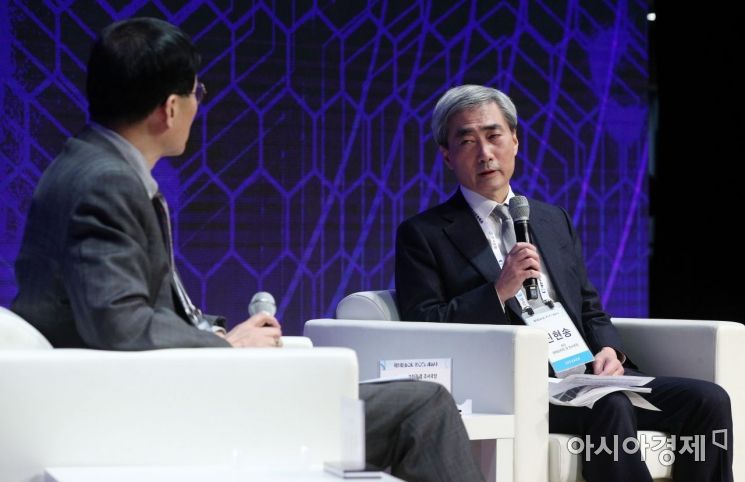 Bank of Korea Governor Lee Chang-yong and BIS Economic Advisor and Head of Research Shin Hyun-song are having a discussion on the topic "Changes in the Economic Paradigm and Response Measures of the Korean Economy" at the 1st Bank of Korea-Korea Chamber of Commerce and Industry Joint Seminar held on the 1st at the Korea Chamber of Commerce and Industry in Jung-gu, Seoul. Photo by Hyunmin Kim kimhyun81@
© The Asia Business Daily(www.asiae.co.kr). All rights reserved.
![Clutching a Stolen Dior Bag, Saying "I Hate Being Poor but Real"... The Grotesque Con of a "Human Knockoff" [Slate]](https://cwcontent.asiae.co.kr/asiaresize/183/2026021902243444107_1771435474.jpg)

















