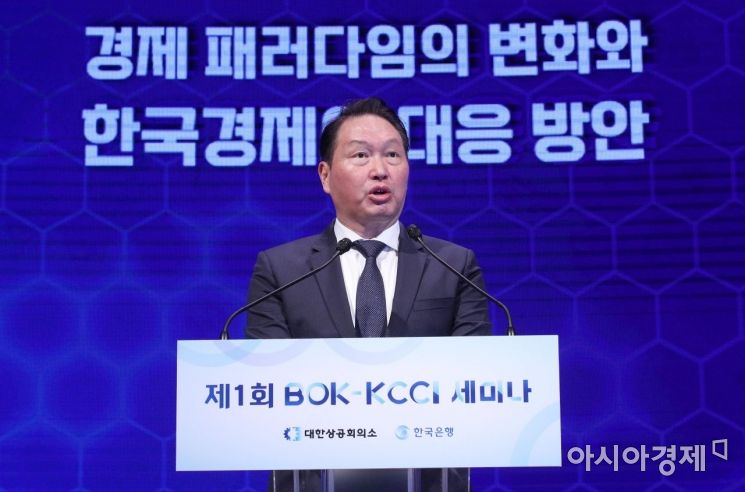
 Choi Tae-won, Chairman of the Korea Chamber of Commerce and Industry, is delivering a welcome speech at the 1st Bank of Korea-KCCI Joint Seminar held on the theme of "Changes in the Economic Paradigm and Response Measures of the Korean Economy" at the Korea Chamber of Commerce and Industry in Jung-gu, Seoul, on the 1st. Photo by Kim Hyun-min kimhyun81@
[Asia Economy Reporter Jeong Dong-hoon] Choi Tae-won, Chairman of the Korea Chamber of Commerce and Industry (KCCI), focused on the paradigm shift in the global economy. On the 1st, at the 'KCCI-Bank of Korea Seminar' held at the KCCI Hall in Jung-gu, Seoul, Chairman Choi stated, "The global economy is facing a major paradigm shift," adding, "If we strengthen the competitiveness of our key industries, which are the backbone of our economy, it will become a new growth opportunity."
On the same day, Chairman Choi explained, "The decoupling between the U.S. and China is continuing," and "Since the launch of the WTO in 1995, the existing single supply chain that pursued low cost and high efficiency is weakening." He continued, "A low-carbon new economic order is taking root," emphasizing, "Economic security is being highlighted around our major industries such as semiconductors and batteries." He also stressed the need to strengthen competitiveness in new growth industries. Chairman Choi said, "We must focus on developing new technologies directly linked to future competitiveness, such as eco-friendly and bio sectors. In the mid to long term, we need to establish a solid growth foundation."
He added, "The growth rate of the Korean economy is expected to be significantly lower than the previous year," and "The capabilities and creativity of the members are essential elements to overcome the Korean economic crisis."
The Korea Chamber of Commerce and Industry and the Bank of Korea agreed last year to activate joint research and hold joint seminars to prepare sustainable growth strategies. This seminar is the first event where both organizations present their achievements so far.
At the keynote speech, Shin Hyun-song, Economic Advisor and Head of the Research Department at the Bank for International Settlements (BIS), stated in his presentation on 'Global Economic Outlook and Global Trade,' "The growth rate of Korean goods exports has recently slowed," adding, "Although a strong dollar is thought to enhance Korea's relative trade competitiveness and aid exports, in reality, a strong dollar acts as a factor that suppresses Korea's exports."
Shin further explained, "Korean companies in the global supply chain mostly raise trade funds in U.S. dollars, so funding costs are inevitably sensitive to the won/dollar exchange rate. The period when the dollar strengthens is closely related to the time when credit conditions for companies outside the U.S. become difficult."
At the event, Lee Chang-yong, Governor of the Bank of Korea, personally served as the moderator and took questions from attendees. Given the recent difficult economic situation, questions from participants continued on various topics such as U.S.-China trade conflicts, foreign exchange volatility, and supply chain issues.
To Achieve Growth and Carbon Emission Reduction Simultaneously, Compensation and Financial Incentives Must Be Strengthened
Yeon Jeong-in, Research Fellow of the KCCI's SGI (Sustainable Growth Initiative), who was the first session presenter, argued in his presentation, "Since the pandemic, the low-carbon transition has rapidly emerged not only as a response to the climate crisis but also as a means to rebuild global growth engines."
According to the KCCI's analysis of the relationship between income levels and carbon emissions by country, "Currently, high-income countries are continuing economic growth through technological advancement and industrial structural changes while transitioning to a low-carbon economic structure to reduce emissions."
Additionally, Research Fellow Yeon stated, "In Korea's case, although the trend of carbon emissions increase has become more gradual than before, the structural characteristic of having higher carbon emissions relative to income levels than the average of major countries makes it difficult to achieve economic growth and low-carbon economic transition simultaneously," emphasizing, "Considering that the low-carbon transition has become an unavoidable global paradigm, it is time for an active strategy that strengthens compensation and financial incentives in the market rather than regulatory approaches, realizing Korea's eco-friendly innovation capabilities into new production methods and new industries."
China's Reopening and Economic-Geopolitical Fragmentation Are Major Risks to Global Supply Chains
In the second session, Kim Woong, Head of the Research Department at the Bank of Korea, evaluated, "After the pandemic, continued quarantine measures and the Ukraine war caused global supply disruptions, which expanded inflation risks in major countries and constrained economic activities."
Regarding China, Korea's largest trading partner, Kim said, "Supply chain disruptions due to China's zero-COVID policy have caused constraints in intermediate goods supply and cost increases, acting as factors for global trade contraction and inflationary pressures in major countries," adding, "If China's reopening accelerates, it is expected to have a significant stimulative effect on the global economy. From a price perspective, supply chain disruptions will ease, but pent-up demand expansion and rising international raw material prices could also pose risks."
Meanwhile, Kim mentioned fragmentation due to U.S.-China conflicts and geopolitical tensions as another global supply chain risk. He analyzed that Korea, which heavily depends on trade of key items with the U.S. and China and has a high dependence on imports of major raw materials, would be significantly affected if fragmentation intensifies.
KCCI and Bank of Korea to Regularize Joint Seminars Twice Annually, Once Each in First and Second Half of the Year
The final session was moderated by Professor Jang Yong-sung of Seoul National University, who serves as the head of the Macroeconomic and Financial Subcommittee of the National Economic Advisory Council. Vice President Lee Yong-seok of SK Management & Economic Research Institute, Professor Kim Jin-il of Korea University’s Department of Economics, Chief Economist Park Seok-gil of JP Morgan, and Head of Macroeconomic Modeling Division Kang Tae-soo of the Bank of Korea engaged in a heated discussion under the theme "Korean Economy in a Great Transition: Overcoming the Current Crisis and Seeking New Paths."
Presenting the corporate perspective in the discussion, Vice President Lee identified key risk factors such as decarbonization, deglobalization and supply chain bloc formation, increased geopolitical uncertainty, and a high-interest-rate environment. He said, "Companies must overcome difficulties through transitioning to eco-friendly business structures via technology and human capability investments, actively participating in supply chain construction in the U.S. and EU, preparing contingency plans to respond to geopolitical risks, and managing cash flow considering financial volatility."
The seminar was attended by over 200 key figures from various sectors including companies and academia, including Choi Tae-won, Chairman of the KCCI, and Lee Chang-yong, Governor of the Bank of Korea.
Woo Tae-hee, Executive Vice Chairman of the KCCI, stated, "The Korea Chamber of Commerce and Industry and the Bank of Korea will regularize joint seminars twice a year, once in the first half and once in the second half, for a total of two times annually," adding, "Both organizations will closely cooperate going forward to develop sustainable growth strategies for the Korean economy and to discover 'national agendas' that can fundamentally innovate the national economy."
© The Asia Business Daily(www.asiae.co.kr). All rights reserved.

















