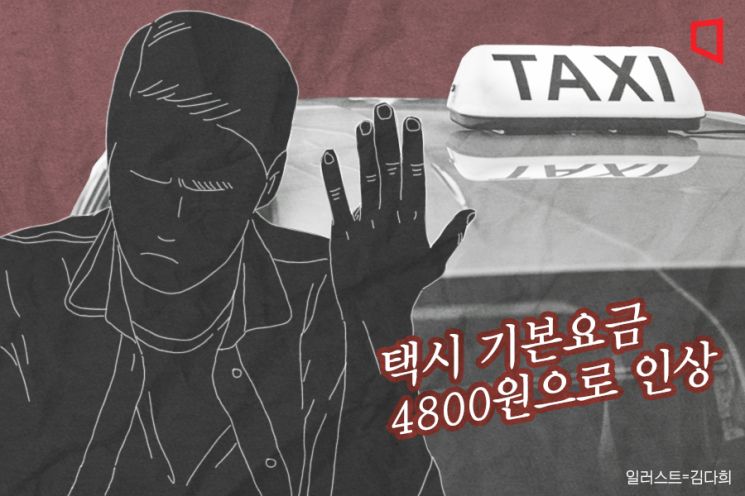
Taxi Base Fare Raised by 1,000 Won to 4,800 Won
Citizens Say "Burden Is Heavy, Will Barely Use"
Taxi Drivers Say "Not Much Help", "Economy Needs to Improve"
[Asia Economy reporters Choi Taewon and Hwang Seoyul] Around 8 a.m. on the 1st, when Seoul taxi fares were significantly increased, the taxi stand in front of Seoul Station in Jung-gu, Seoul was bustling with about 20 taxis and a dozen passengers as usual. However, by around 8:15 a.m., the passengers had disappeared, leaving only a dozen taxis lined up waiting for customers. While waiting for passengers, taxi drivers occasionally got out to stretch or opened the hoods for a quick check, but overall their expressions were gloomy. Taxi driver Park (60) who was waiting for passengers said, “Although the fares have increased, the number of passengers has decreased, so I don’t think income will increase much. The drivers remain the same, but only the passengers will suffer.”
At the same time, the situation was similar at the taxi stand in front of Yeongdeungpo Station in Yeongdeungpo-gu, Seoul. As the morning rush hour queue disappeared, only taxis were lined up waiting for passengers. Wang (36), who was about to take a taxi, said, “Since taxi fares have gone up, I think I will hardly use taxis anymore,” adding, “Today I took the train and am taking a taxi only because I have no choice.”
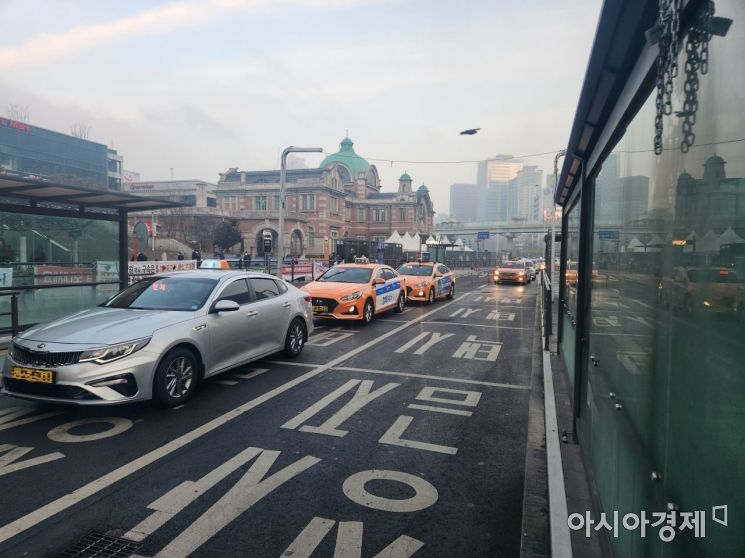 Around 7:50 a.m. on the 1st, after the taxi fare increase, taxis lined up at the taxi stand in front of Seoul Station, waiting for passengers.
 Photo by Tae-won Choi skking@
Both taxi drivers and passengers expressed doubts about the effectiveness and appeared confused.
According to Seoul City, from 4 a.m. that day, the basic fare for medium-sized taxis in Seoul increased by 1,000 won (26.3%) from the previous 3,800 won to 4,800 won. This is the first increase in taxi basic fares in four years since February 2019. Overall operating costs also rose. The basic distance was reduced from the current 2 km to 1.6 km, and the distance fare standard was shortened from 100 won per 132 meters to 100 won per 131 meters. The time fare also became more expensive, changing from 100 won per 31 seconds to 100 won per 30 seconds.
Passengers voiced that the fare increase would be a heavy burden and said they would reduce their taxi usage. University student Gu (23), met at the Seoul Station taxi stand, said, “I used to spend about 50,000 won a week on taxi fares, but with the fare increase, I think I will spend about 70,000 won,” adding, “I don’t think it will be easier to catch a taxi at night, so I plan to reduce the number of times I use taxis as much as possible.”
Kim (30), met at the Yeongdeungpo Station taxi stand, also said, “The late-night surcharge was recently raised, and I never expected fares to increase again,” adding, “I think I will reduce my taxi usage. I’m even thinking it might be better to buy a car.”
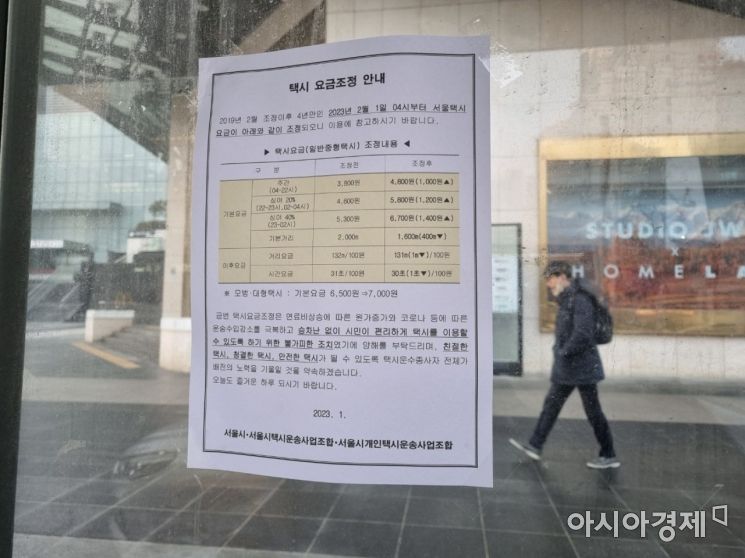 A notice about taxi fare increase is posted at the taxi stand of Yeongdeungpo Station in Seoul. Photo by Hwang Seoyul chestnut@
Among taxi drivers, there were also criticisms that the fare increase would not significantly help their income.
Taxi driver Kim (76) said, “I have been driving a taxi for 16 years, and the fare increase seems like a theoretical discussion that doesn’t really help,” criticizing the policy. He added, “Just look at the late-night surcharge increase. Recently, customers have sharply dropped during surcharge hours. When there are fewer passengers, income is mostly the same or even lower,” and emphasized, “We need to listen to voices from the field and discuss truly effective plans.”
Another taxi driver Park (56) said, “I have been working since the basic fare was 1,900 won, and the more the fares increased, the worse it was for drivers,” pointing out, “Drivers dislike fare increases even more.”
There were also taxi drivers who expected their earnings to improve due to the fare increase.
Jeon Byungseon (66) said, “A fellow driver who went to deliver parcels said that the taxi fare increase helped him return this time,” adding, “The fare increase might help to some extent, but ultimately the economy needs to improve and the number of passengers must increase.” Another taxi driver argued, “The reason the number of drivers has decreased is because the income is not sufficient,” and insisted, “There needs to be institutional improvements such as promoting taxi tours, where taxis serve tourists and act as guides.”
© The Asia Business Daily(www.asiae.co.kr). All rights reserved.



















