"Fostering Science and Technology Talent" Directive Followed by Direct Leadership of Talent Development Strategy Meeting
Expanding Financial Investment through Establishment of Regional Innovation-Centered University Support System
Customized Talent Development in Five Core Areas via Government, Corporate, and Local Government Collaboration
[Asia Economy Reporters Baek Kyunghwan and Lee Gimin] President Yoon Suk-yeol stated on the 1st, "The driving force of national development is science and technology, and nurturing talent in this field is the most important." President Yoon believes that "in the midst of the 4th Industrial Revolution and global technological hegemony competition, the only way for the country to survive is to cultivate a large number of outstanding science and technology talents." To this end, the government has decided to select key sectors such as semiconductors and space, and focus on financial investment and legislative enactment. The core idea is to nurture local talent through deregulation such as academic autonomy at universities and to cultivate customized talents through company-led education. This is a follow-up measure following President Yoon's directive after his recent visit to the United Arab Emirates (UAE) to "prioritize science and technology policies above all else and focus on nurturing science and technology talents in all future policies."
On the morning of the 1st, President Yoon held the 1st Talent Nurturing Strategy Meeting at Kumoh National Institute of Technology located in Gumi, Gyeongbuk. The Talent Nurturing Strategy Meeting is a cross-ministerial public-private cooperation system established last year under the president’s chairmanship to cultivate specialized talents in the semiconductor field. The meeting, held under the slogan "Talent that revitalizes regions, Korea that grows with talent," was attended by central government ministries, local governments, and private experts related to nurturing talents in core advanced fields such as science and technology.
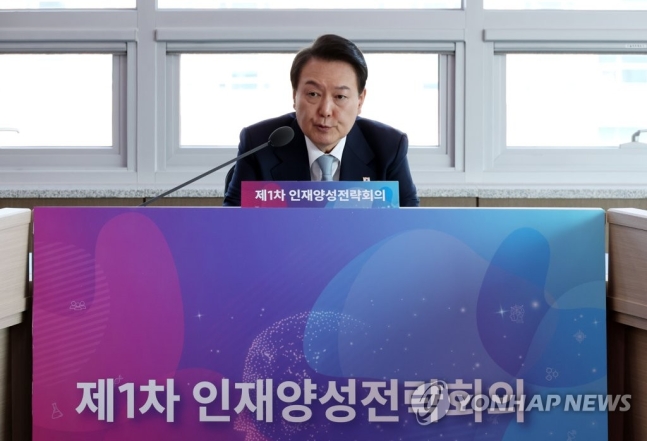 President Yoon Suk-yeol is attending and speaking at the 1st Talent Development Strategy Meeting held at Kumoh National Institute of Technology in Gumi-si, Gyeongsangbuk-do on the 1st.
 [Photo by Yonhap News]
The Ministry of Education and others reported to President Yoon that they will select five key sectors (▲Aerospace and Future Mobility ▲Biohealth ▲Advanced Components and Materials ▲Digital ▲Environment and Energy) through the 'Advanced Field Talent Nurturing Strategy Plan.' This reflects the urgency and importance of talent supply and demand in advanced fields, and detailed tasks related to this will be discussed jointly by the government, companies, and local governments.
Efforts will also be accelerated to establish the 'Regional Innovation-Centered University Support System' (RISE), which grants authority to local governments to build a virtuous cycle development ecosystem for local universities and regions in crisis. The core is to delegate and transfer budgets and authority and to promote expansion of financial investment led by local governments. Regulatory innovations such as academic autonomy at universities, as well as policies to strengthen lifelong and vocational education through company-led education and training, will also be pursued in connection.
This reflects President Yoon’s determination to emphasize talent nurturing to achieve a technological gap from the early days of his term. Given the lack of natural resources, he believes that securing national competitiveness in the upcoming 4th Industrial Revolution era requires talents who can lead new fields. The establishment of the 'National Science and Technology Advisory Council,' the highest decision-making body for science and technology policies chaired by the president, and the derivation of 12 national strategic technologies after his inauguration are in the same context.
In particular, semiconductors, which are national security assets and account for 20% of the country’s total exports, have been a field President Yoon has personally overseen since the early days of his administration. At the Cabinet meeting held in June last year, he instructed all ministries to prepare semiconductor talent nurturing plans, saying, "We must do this with our lives on the line." The government announced a plan the following month to cultivate 150,000 semiconductor talents by 2031.
The Ministry of Education started by increasing the quota for semiconductor-related departments (semiconductor, electronics, new materials, materials, mechanical engineering, etc.) by 5,700 students in July last year and plans to produce 45,000 semiconductor personnel by 2031. The Ministry of Trade, Industry and Energy and the Ministry of Science and ICT will also nurture an additional 105,000 personnel at vocational high schools and bachelor’s, master’s, and doctoral levels through financial support projects.
According to the Ministry of Education’s 2023 work report, in higher education, a semiconductor-specialized university project will be newly established, designating eight universities this year with concentrated financial investment. A new advanced industry talent nurturing boot camp project will be launched, where universities operate short-term intensive courses in advanced fields utilizing private sector know-how. Regional semiconductor joint research institutes will be designated to handle semiconductor research, education, and practice. Vocational education at the high school level will also be strengthened to nurture highly skilled practical talents early. Support will be provided to vocational high schools to reorganize departments in new industries and new technology fields such as semiconductors and digital, and ‘Meister High School 2.0’ will be promoted in the first half of the year to intensively nurture highly skilled practical talents.
President Yoon’s advanced talent nurturing policy is expected to expand to the fields of artificial intelligence (AI), which is a concentration of semiconductors, and quantum technology, which is called the future beyond semiconductors. During his recent trip, President Yoon visited Switzerland to attend the World Economic Forum (WEF, Davos Forum) and met with quantum scholars at the Swiss Federal Institute of Technology Zurich to discuss technology acquisition and talent nurturing plans. Upon returning to Korea, he immediately invited young scientists to the Yongsan Presidential Office to encourage them.
A presidential office official said, "In the domestic situation facing triple hardships such as high inflation and high interest rates, securing science and technology talent nurturing will be the driving force of Korea’s dynamism," adding, "We will share and coordinate roles among ministries for talent nurturing policies and devote all our capabilities to ensure related policies are implemented quickly."
© The Asia Business Daily(www.asiae.co.kr). All rights reserved.

















