Two Pilots Required for Emergency Situations So Far
US Military Successfully Tested Autonomous Helicopter Flight Last Year
[Asia Economy Reporter Hyunwoo Lee] David Calhoun, CEO of the major American aircraft manufacturer Boeing, announced that fully autonomous flight technology will soon be introduced in civilian aircraft, signaling a major change in the future aircraft market. Until now, fully autonomous flight technology has mainly been researched by the U.S. military and has rapidly advanced, including successful test flights of combat helicopters last year.
On the 31st (local time), CEO Calhoun attended the final delivery ceremony of the Boeing 747 held at Boeing’s Everett plant in Washington DC. This delivery ceremony marked the last delivery of the 747-8 model to Atlas Air, a U.S. cargo and leasing airline, and commemorated the complete shutdown of the Boeing 747 production line, officially retiring the Boeing 747 from active passenger service.
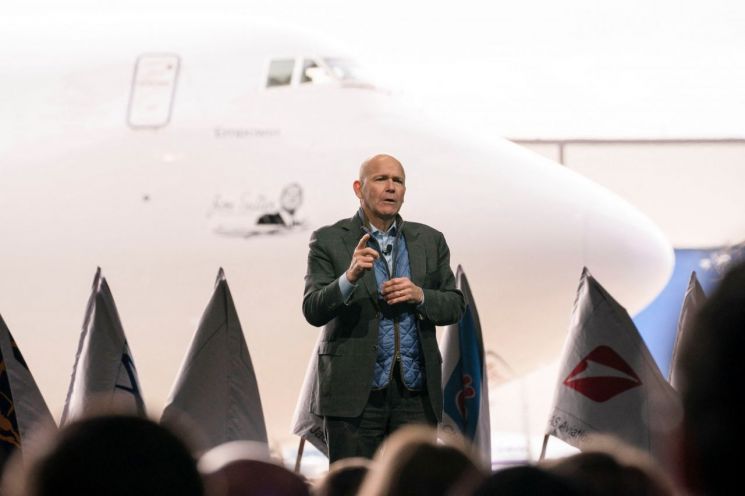 On the 31st (local time), David Calhoun, CEO of Boeing, attended the final delivery ceremony of the Boeing 747 held at Boeing's Everett factory in Washington DC and held a press conference. Washington DC=Photo by Reuters and Yonhap News
CEO Calhoun emphasized a new future, stating that civilian aircraft will soon adopt autonomous flight technology. He explained, "It is only a matter of time before autonomous flight technology developed for military use is introduced into civilian aircraft," adding, "Eventually, all aircraft will incorporate autonomous flight technology."
He continued, "Now we need to commercialize and prove these technologies," emphasizing, "We want to demonstrate that this kind of technology can enter the market." Currently, not only Boeing but also Airbus and various civilian aircraft manufacturers are independently researching autonomous flight technology.
However, it is still evaluated that the U.S. military is leading the development of autonomous flight technology. According to the U.S. Department of Defense, in February last year, a test flight of a UH-60A Black Hawk helicopter equipped with the autonomous flight system 'ALIAS' program was successfully conducted on the runway at Fort Campbell Army Base in Kentucky. The helicopter flew autonomously for 30 minutes and completed the assigned tasks.
Until now, two pilots have been required in the cockpits of both military and civilian aircraft. Although aircraft are equipped with automatic pilot systems, these systems require pilots to input all courses and variables, and pilots must manually adjust for sudden unexpected variables. However, a fully autonomous flight system uses artificial intelligence (AI) to independently make decisions according to each situation and can prepare for unexpected circumstances.
If fully autonomous flight systems are commercialized with safety ensured, a major upheaval is expected not only in aircraft manufacturing but across the entire aviation industry. Costs related to training and maintaining pilots will be reduced, which is expected to significantly lower airfare. According to Swiss bank UBS, if the two essential pilots are reduced from the approximately 40,000 currently available aircraft, airlines could save $30 billion (about 37 trillion won) annually.
© The Asia Business Daily(www.asiae.co.kr). All rights reserved.
![User Who Sold Erroneously Deposited Bitcoins to Repay Debt and Fund Entertainment... What Did the Supreme Court Decide in 2021? [Legal Issue Check]](https://cwcontent.asiae.co.kr/asiaresize/183/2026020910431234020_1770601391.png)















