Last Year's Q4 Employment Cost Index Rises 1.0%...0.2%P Drop from Previous Quarter
Inflation Slowdown Signal...Bloomberg "Fed May Pause Rate Hike in May"
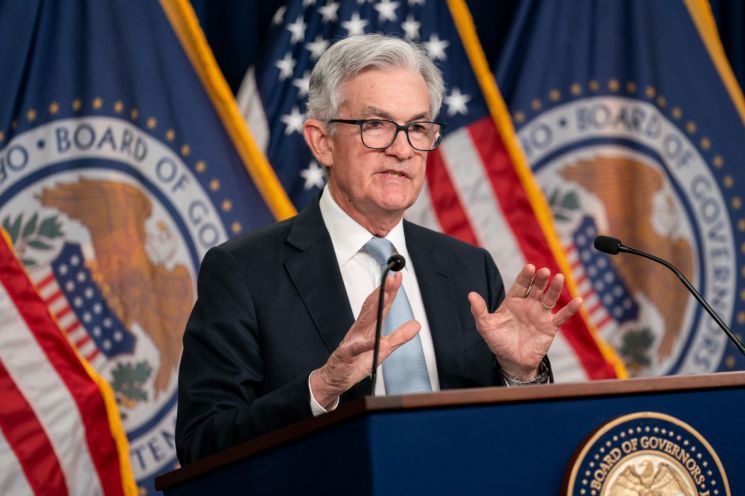
[Asia Economy Reporter Haeyoung Kwon] As the results of the first U.S. Federal Open Market Committee (FOMC) meeting of the new year are scheduled to be announced on the 1st (local time), employment indicators also suggest a slowdown in inflation. With the Federal Reserve (Fed) expected to take a 'baby step' (a 0.25% point increase in the benchmark interest rate) at this FOMC, market attention is focused on where the upper limit of the final interest rate will be set. In particular, attention is concentrated on the remarks of Fed Chair Jerome Powell following the FOMC meeting.
Inflation Indicators Gradually Slow Down
According to the U.S. Department of Labor on the day, the Employment Cost Index (ECI) for the fourth quarter of last year rose 1.0% compared to the previous quarter. This is 0.2 percentage points lower than the third quarter (1.2%) and also below Bloomberg's forecast (1.1%). This signals a weakening of inflation driven by wage increases, which could be another reason for the Fed to slow down the pace of rate hikes. The ECI is an indicator of employment costs such as wages and benefits paid by companies to U.S. workers, and is one of the indicators closely watched by the Fed.
In addition to the ECI, the consumer price inflation rate for December last year recorded 6.5% year-on-year, marking six consecutive months of slowdown. Retail sales in the same month also fell 1.1% from the previous month, declining for the second consecutive month. On the same day, Whole Foods, a U.S. premium grocery chain, requested food suppliers to lower wholesale prices for products to retail stores, citing the easing of inflation.
When Will the Rate Hikes Stop?
As signs emerge that the Fed is gaining the upper hand in the fight against inflation, the market is increasingly confident that the Fed will raise the benchmark interest rate by 0.25 percentage points to 4.5?4.75% on the 1st. Last year, after four rounds of giant steps (0.75 percentage point hikes), a big step (0.5 percentage point hike) followed, and it is now expected that the pace of tightening will slow down by one step again.
Moreover, the market is focusing on the timing of the pause in rate hikes. The Wall Street Journal (WSJ) analyzed that "the slowdown in employment costs will ignite discussions about when the Fed will stop raising rates." Bloomberg suggested that after the Fed raises rates by 0.25 percentage points this week, it could pause rate hikes in May after confirming inflation slowdown indicators over the next three months. This analysis follows Fed Governor Christopher Waller's statement on the 20th of last month that "we need to look at three or six months of data to discuss whether to pause rate hikes." Since indicators for January to March of this year can be checked before the May FOMC meeting, Bloomberg explains that the Fed could find grounds to pause rate hikes.
Brett Ryan, Senior Economist at Deutsche Bank, said, "(The Fed's) message changes," adding, "Now, the speed is not important. Ultimately, the key is where the upper limit of the terminal rate is." The Fed viewed the terminal rate upper limit as above 5% at the end of last year, but some in the market expect it to be lower.
Optimism That 'Inflation Is Over' May 'Fuel Inflation'
Some voices caution against market optimism. The U.S. unemployment rate last month was at a full employment level of 3.5%, and since indicators are still mixed, more time is needed to confirm the easing of inflation.
There is also speculation that Powell will dampen market expectations with hawkish messages. Paul Krugman, Nobel laureate and professor at the City University of New York, appeared on Bloomberg TV the day before and said, "I am worried that the market is getting ahead of itself," adding, "The market is pricing in the assumption that inflation is over. But this could become a self-defeating prophecy." Joe Brusuelas, Chief Economist at RSM US, analyzed, "Labor market resilience remains strong, and China's reopening could increase global inflationary pressures. While the Fed may strategically pause rate hikes, that does not mean the peak of the rate hike cycle."
© The Asia Business Daily(www.asiae.co.kr). All rights reserved.

















