400 Billion Won Paclitaxel Market
Boryung Drives Samyang's 'Genexol' to No.1
Original 'Taxol' Sales Start This Year
Samyang Partners with HK Innoen
Same for 80 Billion Won Neutropenia Market
Boryung Leads Rapid Growth of 'Nulapec'
Handles Original 'Neulasta' to Widen Gap Again
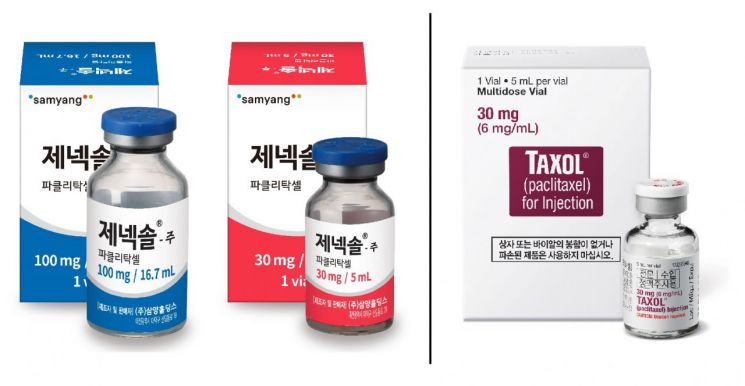 Samyang Holdings' 'Genexol Injection' and Boryung's 'Taxol', anticancer drugs containing paclitaxel (from left)
 [Photo by each company]
[Asia Economy Reporter Lee Chun-hee] A significant shift is anticipated in the domestic anticancer drug market featuring the active ingredient paclitaxel, valued at approximately 40 billion KRW. As alliances and realignments occur between manufacturers and distributors, competition to increase market share is expected to intensify.
According to industry sources on the 2nd, paclitaxel is an anticancer agent used to treat ovarian, breast, lung, and stomach cancers. It belongs to the alkaloid class of anticancer drugs and works by inhibiting cell division, thereby inducing cancer cell death. The original drug, "Taxol," was developed by Bristol-Myers Squibb (BMS). However, the domestic paclitaxel market is dominated by Samyang Holdings' biopharmaceutical group product "Genexol." Since rising to the top in 2017, Genexol currently boasts about a 60% market share with annual sales of approximately 22 billion KRW. In contrast, the original Taxol has seen its sales decline by an average of 10% annually, shrinking to around 9 billion KRW.
The rapid growth of Genexol is largely attributed to the strong sales capabilities of Boryung. From 2016 through last year, Genexol was co-marketed by Samyang Holdings and Boryung. After Boryung joined, Genexol's sales in 2017 surged by 52% compared to 2016, reaching 17.5 billion KRW. Beyond paclitaxel, Boryung has a diverse portfolio ranging from synthetic drugs to biosimilars and anticancer adjuvants, and operates a dedicated oncology division called "Onco," highlighting its strengths in anticancer drugs.
However, this situation is expected to change starting this year as Boryung begins marketing Taxol. In March last year, German company Cheplapharm acquired the global rights to Taxol from BMS, necessitating a reset of the Korean rights previously held by Korea BMS Pharmaceutical. Boryung swiftly switched its focus to Taxol. Recently, Boryung signed an exclusive domestic sales contract with Cheplapharm and also acquired the domestic marketing authorization for Taxol from Korea BMS Pharmaceutical. A Boryung representative stated, "After generics, we are now embracing the original drug again," adding, "We plan to expand prescriptions and market share by leveraging customer loyalty and product strength unique to the original drug, combined with Boryung's anticancer sales and marketing capabilities."
In response, Samyang Holdings is partnering with HK Innoen to defend Genexol's market share. HK Innoen previously co-managed sales and marketing for Genexol from 2001 to 2013. Given this prior experience, they aim to achieve more positive results. Joint marketing and sales efforts will target major tertiary hospitals in the Seoul metropolitan area, while HK Innoen will handle marketing, sales, domestic distribution, and sales in other regions.
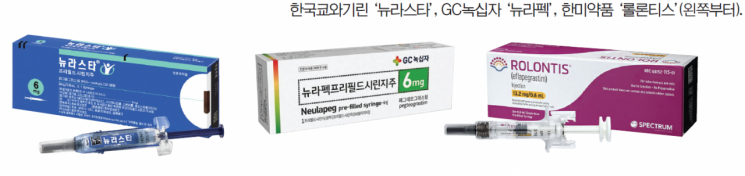
The pattern of mergers and realignments between manufacturers and suppliers is not limited to paclitaxel in the anticancer drug market. A similar situation occurred last year in the domestic market for neutropenia treatments, valued at about 90 billion KRW. Neutrophils play a role in defending against bacterial and fungal infections within white blood cells, but cancer patients frequently experience neutropenia?a reduction in neutrophils?during anticancer treatment. To prevent this, patients must receive periodic injections of treatment drugs aligned with their chemotherapy cycles.
In the domestic neutropenia treatment market, Korea Kyowa Kirin's "Neulasta" has maintained a solid number one position for several years with annual sales exceeding 25 billion KRW. However, recently, GC Green Cross's biosimilar "Neulapeg" has rapidly closed the gap, increasing sales from 4 billion KRW in 2018 to 22.8 billion KRW in 2021?nearly sixfold growth in three years. In the fourth quarter of 2021, Neulapeg's sales reached 6.3 billion KRW, surpassing Neulasta's 5.6 billion KRW to claim the top sales spot.
Here too, Boryung was a key player. After its 2015 launch, Neulapeg showed little presence until 2018, when Boryung became a co-marketing partner, which is credited as a major factor in its rapid growth. However, the situation reversed last year when Boryung took on co-marketing for Neulasta, which Korea Kyowa Kirin had been selling directly. Neulasta's cumulative sales from the first to third quarters of last year grew 21.5% year-on-year to 22.9 billion KRW, while Neulapeg's sales during the same period declined 14.3% to 16.2 billion KRW. Additionally, Hanmi Pharmaceutical's new drug "Rolontis" has joined the market, with third-quarter sales surpassing 100 billion KRW last year, further intensifying competition in the neutropenia treatment market.
An industry insider commented, "Following neutropenia treatments, fierce competition for market share is expected in paclitaxel this year," adding, "There will be significant challenges in how to maintain and expand existing sales capabilities."
© The Asia Business Daily(www.asiae.co.kr). All rights reserved.


















