Delicate Issues Including Medical School Quota Increase Discussed in Medical-Government Talks
Legislative Discussions Needed to Alleviate Healthcare Professionals' Burden
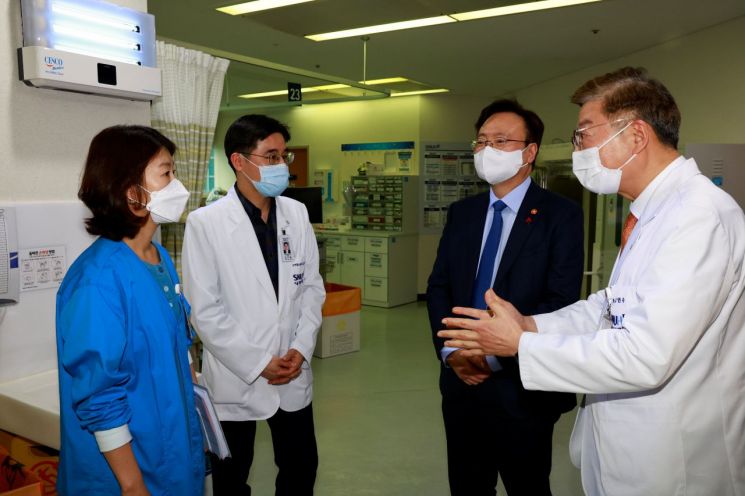 Minister of Health and Welfare Cho Kyu-hong (third from the left) is visiting Seoul National University Children's Hospital on the 31st to listen to on-site opinions after announcing the essential medical support measures.
 [Photo by Ministry of Health and Welfare]
[Asia Economy Reporter Lee Gwan-joo] The "Essential Medical Care Support Measures" announced by the Ministry of Health and Welfare on the 31st focused on strengthening the foundation of essential medical care in the fields of severe emergency care, childbirth, and pediatric treatment, which have long been identified as urgent issues. The measures include strengthening compensation for essential medical personnel through the introduction of public policy medical fees and implementing a rotational on-call system among hospitals within regions to prevent emergency patients from wandering between hospitals without receiving care.
However, sensitive issues such as increasing medical school quotas and establishing public medical schools were set to be discussed through consultations with the medical community, so the current measures only present a basic direction for expanding specialized medical personnel. There are also criticisms that the measures cannot be seen as fundamental solutions because they fail to improve the distribution of medical personnel, such as the shortage of essential medical residents.
In this plan, the Ministry of Health and Welfare stated that it will prepare specific implementation plans through consultations with the medical community to ensure the appropriate expansion of medical personnel to address the shortage of regional doctors and the imbalance in the supply and demand of doctors in essential fields. The "Medical Issues Consultative Body" between the Ministry and the Korean Medical Association held its first meeting on the 30th of last month and began full-scale discussions on major medical issues. Lim In-taek, Director of the Health and Medical Policy Office at the Ministry, explained, "There are tasks that were agreed to be revisited during the COVID-19 stabilization period in 2020, and the Medical Issues Consultative Body is basically thinking of discussing those previously agreed topics again." Since the tasks agreed upon at that time included increasing medical school quotas and establishing public medical schools, it is highly likely that these will be central topics in the current consultative body as well.
However, at present, it seems difficult for the medical community and the government to narrow their differences. The medical community has consistently opposed the issue of increasing medical school quotas. Recently, when the Citizens' Coalition for Economic Justice (CCEJ) released a report on regional medical disparities advocating for increasing medical school quotas and establishing public medical schools, the Korean Medical Association responded by stating, "It is absurd to claim that our country, which boasts world-class medical services and accessibility, lacks doctors," and argued, "The problem is not simply a shortage of doctors in Korea, but rather the severe lack of environments and conditions that allow doctors to work in rural areas."
The medical community emphasizes that to prevent the collapse of essential medical care and resolve regional medical disparities, infrastructure must be built in vulnerable areas and undesirable fields, and incentive mechanisms such as sufficient compensation and improved treatment should be established to create an environment where doctors voluntarily choose to work. Specifically, the Korean Medical Association proposed ▲ the enactment of a Medical Dispute Special Act ▲ strengthening support for personnel in essential and public medical fields, including residents and specialists ▲ improving working conditions for essential and public medical personnel ▲ and raising medical fees in essential and public medical fields through full financial investment and the introduction of public policy medical fees.
In this context, attention is also focused on how the government will find a breakthrough. Since the current essential medical care support measures reflect the government's intention to strengthen compensation for medical personnel, including partially incorporating public policy medical fees demanded by the medical community, there are expectations that additional fee improvement plans will be discussed alongside medical school quotas and public medical schools.
Furthermore, the government plans to review measures to alleviate the burden on medical personnel regarding unavoidable medical accidents and to strengthen relief for victims of medical accidents. Since this requires legal amendments, heated debates are expected in the future regarding specific applicable acts and subjects. Director Lim stated, "This was considered from the perspective that the issue of undesirable fields can be resolved only if medical personnel can provide care in a safe and appropriate environment," and added, "We plan to proceed after consultations with relevant ministries regarding legislative methods and schedules."
© The Asia Business Daily(www.asiae.co.kr). All rights reserved.
![Clutching a Stolen Dior Bag, Saying "I Hate Being Poor but Real"... The Grotesque Con of a "Human Knockoff" [Slate]](https://cwcontent.asiae.co.kr/asiaresize/183/2026021902243444107_1771435474.jpg)
















