Chairman Go Jin Holds First Meeting Since Committee Launch
"It's Time to Fundamentally Change Government Operation Methods"
"Must Overcome Inter-Ministerial Silos to Achieve One Government"
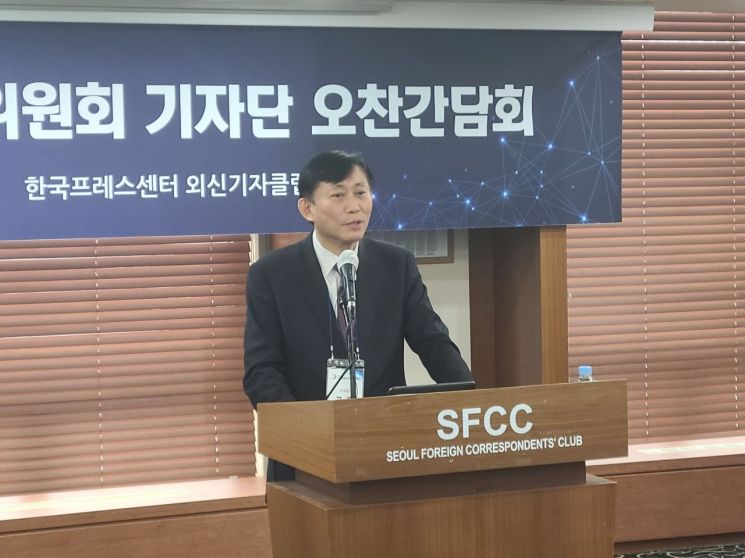
[Asia Economy Reporter Kang Nahum] "The success of e-government over the past 20 years does not guarantee success for the next 20 years. It is time to fundamentally change the way the government operates by utilizing digital innovation technologies."
The Presidential Digital Platform Government Committee presented a comprehensive blueprint for the first time since its launch. The goal is for citizens, businesses, and the government to solve social problems and create new value together on a digital platform where all data is connected. A detailed roadmap will be disclosed in March.
On the 31st, Ko Jin, chairman of the Digital Platform Government Committee, held a luncheon press briefing at the Korea Press Center to explain the achievements so far and the progress in establishing a roadmap for promoting the Digital Platform Government.
Chairman Ko said, "Digital technologies such as AI (artificial intelligence), represented recently by ChatGPT, are developing so rapidly that it is hard to keep up with the speed, and the digital deepening era, which fundamentally changes not only the economy and industry but also the daily lives of citizens, is beginning in earnest. In this situation, major global countries and companies have intensified competition to establish themselves as global hegemonic powers by actively utilizing digital technologies. Our government must also fundamentally change the way it operates by utilizing digital innovation technologies such as artificial intelligence and big data."
He added, "Unlike previous committees, our committee has been working thoroughly with a focus on private sector members to create the roadmap. This is because, to become a government for and toward the people, it is necessary to fundamentally redesign the system from the perspective of the users rather than from the viewpoint of public officials."
The Digital Platform Government Committee consists of 19 private experts and 4 ministers from related ministries. To conduct professional reviews, six subcommittees have been established, and 71 experts from industry, academia, and research institutes have been appointed as professional members in each subcommittee. They are currently selecting tasks based on the feasibility of about 140 tasks derived at the early stage of the committee’s launch. Since its inception, more than 100 meetings have been held in each subcommittee.
Chairman Ko pointed out the limitations of the current e-government as the siloed data and systems by ministry. He said, "So far, informatization has proceeded by enhancing systems operated individually based on the expertise of each ministry and agency. As a result, the barriers between ministries have increased, and the linkage of systems and data has become more difficult, creating a paradoxical situation."
He continued, "The committee aims to implement a unified government that overcomes silos between ministries. Through this, citizens will use integrated and proactive services, and the government will facilitate collaboration and data sharing between ministries. We will actively introduce the latest digital technologies such as artificial intelligence and data to realize a scientific and transparent government."
The committee will cooperate not only with the executive branch but also with the judiciary and local governments to provide convenient services for citizens and businesses. Recently, they visited the Court Administration Office and reached a consensus to provide public services as one government encompassing both the executive and judiciary. They are also reviewing ways to utilize data held by local governments.
In addition, to foster related domestic industries such as artificial intelligence and cloud computing, the government plans to fully open the data it holds and open government services to provide an environment where they can be integrated with private services.
The committee is currently striving to lead changes in work methods, such as publishing the full minutes and press releases of plenary meetings in ODT (Open Document Text) format, adopting enterprise-wide private collaboration tools, and applying the standard model of the open OS laptop "Onbook." Chairman Ko said, "We are creating a smart work environment starting with the committee with a pioneering spirit," and explained, "We are publishing meeting materials and press releases not only in Hangul and PDF files but also in machine-readable ODT format."
The committee also plans to pursue legal amendments to activate information sharing between ministries. Chairman Ko said, "Looking at the individual laws of each ministry, there are provisions that prohibit the use of collected data for purposes other than the intended projects, with exception clauses attached to avoid this. Since there are strong penalties for data leakage, it seems possible to apply the exception clauses more broadly. Improving the legal and institutional aspects is a priority."
After the roadmap announcement in March, the committee will establish an organizational system to promote tasks. They plan to create a management system for each task and operate a task force to reflect new issues and social agendas. Chairman Ko said, "To meet the new digital environment and the expectations of the people, I ask for continuous interest and support for the government operation philosophy of the ‘Digital Platform Government’ that will lead the next 20 years."
© The Asia Business Daily(www.asiae.co.kr). All rights reserved.

















