The depletion point of Dongbok Dam delayed due to active citizen water-saving campaigns
[Asia Economy Honam Reporting Headquarters, Reporter Yoon Jamin] The announcement of restricted water supply for tap water in the Gwangju area has been delayed slightly.
This is because recent winter rains have greatly helped alleviate the drought, along with citizens' water-saving campaigns and Gwangju City's emergency water source supply measures proving effective.
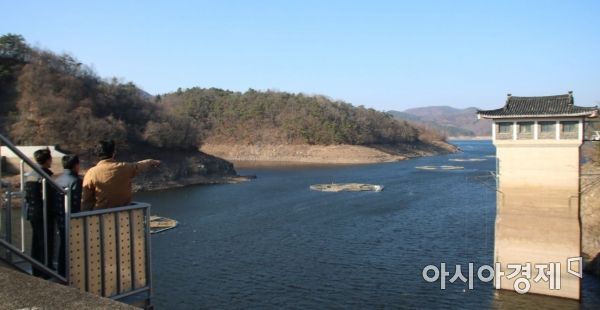
Gwangju Metropolitan City (Mayor Kang Gijeong) announced on the 31st that although it had predicted restricted water supply in early March due to the Dongbok Dam depletion expected in mid-May as of December 13 last year, the depletion point has been delayed to early June thanks to active water-saving efforts by citizens, thus postponing the restricted water supply notice by two months.
However, officials explained that since the drought has not been completely resolved, continuous water-saving practices are urgently needed even if it is somewhat painful.
The delay in the restricted water supply timing is attributed to the combination of citizens' water-saving campaigns, proactive administrative responses, and unusual winter rainfall conditions.
Since November last year, Gwangju City has reduced tap water leakage rates through pressure adjustments at reservoirs and households, intensive leak detection, and maintenance.
Additionally, with citizens joining water-saving efforts, water usage decreased by up to 9%. Furthermore, heavy rainfall exceeding average levels in January delayed the Dongbok Dam depletion from mid-May to early June.
Unlike last year when there was almost no rain, January this year recorded 34mm of precipitation, resulting in an inflow of 3.59 million cubic meters into Dongbok Dam. Considering the daily intake of Dongbok Dam is 170,000 cubic meters, the supply period was extended by about 21 days.
Citizens' water-saving campaigns also contributed significantly. Compared to the previous year, tap water usage reduction rates were 4.7% in November last year, 8.1% in December, and 6.7% in January this year, with a total reduction volume of 2.85 million cubic meters so far.
Along with this, Gwangju City's emergency water source supply efforts also stood out. The city implemented water pressure control in the water supply network, intensive leak detection and maintenance, and extended Dongbok Dam usage days through additional water supply from Juam Dam.
In particular, the acceptance of the Ministry of Environment's proposal to split the supply of Juam Dam water to Deoknam and Yongyeon Water Purification Plants allowed the water-saving effects of citizens to be concentrated on Dongbok Dam, which is also seen as contributing to the extension of Dongbok Dam depletion timing.
Gwangju City is not stopping there and is pursuing long-term water source supply measures in response to the climate crisis.
First is the emergency supply project to provide Yeongsan River water to the water purification plant. By installing a booster station, 20,000 tons per day will be supplied from the end of February, increasing to 50,000 tons per day by the end of April.
Development of upstream wells of Dongbok Dam is also underway. Currently, 38 wells are under construction, and from the end of April, 10,000 to 20,000 tons per day are expected to be secured.
Gwangju City emphasized that due to predictions of chronic drought caused by climate change, citizens' habitual water-saving lifestyle is required. Especially since the daily water usage per person in Gwangju was 305 liters in 2021, the highest among special and metropolitan cities except for Incheon.
Lee Jeongsam, head of the Waterworks Business Headquarters, said, “We thank the citizens who participated in the water-saving campaign. However, since there is still a possibility of Dongbok Dam depletion and restricted water supply, we ask for active participation in the 20% water-saving campaign in daily life until the Dongbok Dam water level fully recovers with heavy rain.”
© The Asia Business Daily(www.asiae.co.kr). All rights reserved.

















