KIST Research Team Develops Energy Harvesting Technology
[Asia Economy Reporter Kim Bong-su] Domestic researchers have developed energy harvesting technology that absorbs vibrations and converts them into electrical energy, which can be used as power for wireless sensors.
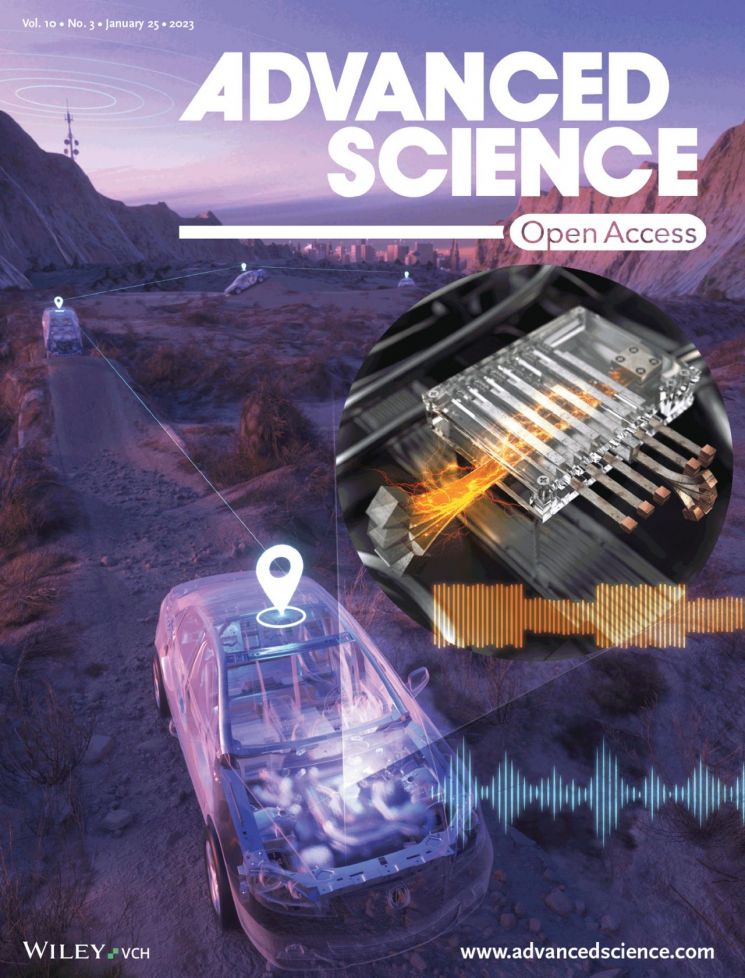
The Korea Institute of Science and Technology (KIST) announced on the 31st that Dr. Song Hyun-cheol's research team at the Center for Electronic Materials developed an Autonomous Resonance Tuning (ART) piezoelectric energy harvester that automatically adjusts its resonance according to the surrounding environment. The developed energy harvester can self-tune its resonance within a broadband frequency range above 30Hz and convert absorbed vibration energy into electrical energy.
Internet of Things (IoT) technology requires independent power sources that are not constrained by batteries or power lines because devices must be installed regardless of time and space. By using energy harvesting technology that collects wasted energy such as vibrations, heat, light, and electromagnetic waves from everyday environments like cars, buildings, and home appliances and converts it into electrical energy, it is possible to generate enough electricity to operate small electronic devices solely by harvesting ambient energy sources without external power supplies.
In the process of converting vibrations into electrical energy through energy harvesting technology, unavoidable mechanical energy losses occur, resulting in low energy conversion efficiency. To solve this, the resonance phenomenon, where large vibrations occur when the natural frequency of an object matches the frequency of the vibration, is utilized. However, while the natural frequency of an energy harvester is fixed, the various vibrations experienced in daily life are distributed across different frequency ranges. Therefore, it has been difficult to commercialize energy harvesters because the natural frequency must be adjusted each time to match the usage environment and induce resonance.
The research team developed a special structure of energy harvester that can self-tune to the surrounding vibration frequency without any additional electrical devices. By attaching an adaptive clamping system (tuning system) inside the energy harvester that moves according to frequency, when the energy harvester senses ambient vibrations, the tuning system reaches the resonance frequency, allowing it to resonate with vibrations of the same frequency as the external vibrations. As a result, rapid resonance frequency tuning within 2 seconds enables continuous electricity generation over a broadband frequency range above 30Hz.
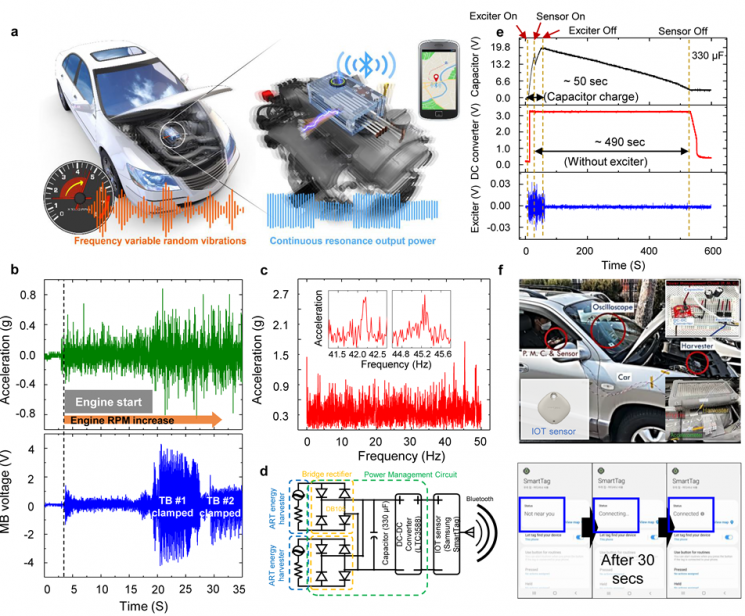 It demonstrates the practical potential of a self-tuning energy harvester that successfully powers a location tracking device by utilizing the vibration energy of a car engine. Image provided by KIST
In this study, unlike previously reported piezoelectric vibration-type energy harvesters, the energy harvester equipped with the tuning system was attached to an actual running car engine. It successfully operated a wireless location tracking device without a battery in an environment where vibration frequencies continuously change, using Autonomous Resonance Tuning (ART). Dr. Song Hyun-cheol, principal researcher at KIST, said, "This research result suggests that vibration-based energy harvesters can soon be applied in our daily lives," adding, "It is expected to be used as an independent power source for wireless sensors including those in the Internet of Things."
The research results were published as the front cover article in the latest issue of the international energy journal 'Advanced Science' (IF: 17.521, JCR 5.942%).
© The Asia Business Daily(www.asiae.co.kr). All rights reserved.


















