KAIST Research Team Develops Electromagnetic Wave Attack Technology to Counter Swarm Drones
[Asia Economy Reporter Kim Bong-su] Domestic researchers have developed anti-drone technology that disables drones in urban areas using electromagnetic waves.
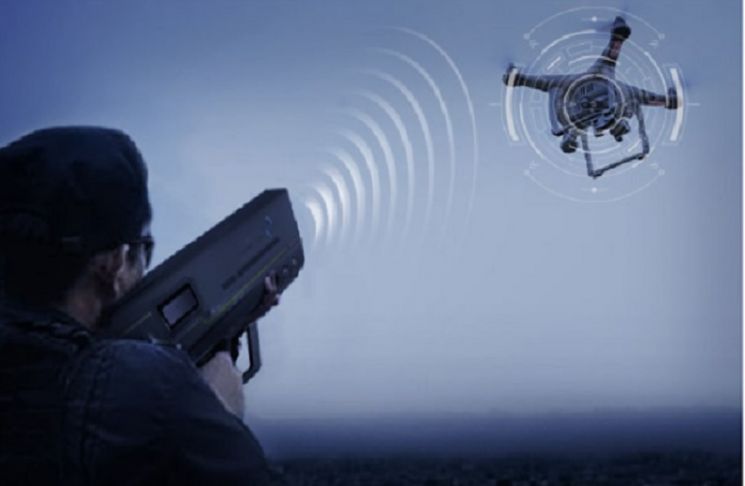
The Korea Advanced Institute of Science and Technology (KAIST) announced on the 31st that a research team led by Professor Kim Yong-dae of the Department of Electrical Engineering has developed anti-drone technology that remotely injects narrowband electromagnetic waves into a drone’s circuitry to immediately disable it, applicable for use in urban environments.
Recently, governments around the world have been establishing various anti-drone systems to prevent terrorism using unmanned aerial vehicles at airports and critical national facilities. Anti-drone technologies that cause drones to crash or control them in desired directions can be implemented by exploiting various security vulnerabilities of drones. The Ukraine-Russia war has become a testing ground for anti-drone technologies.
Existing anti-drone technologies using broadband electromagnetic waves cause damage to surrounding electronic and electrical devices, making them difficult to use in urban areas. On the other hand, anti-drone technologies using very narrowband electromagnetic waves are effective only against specific drone models.
The research team discovered that the control unit boards of drone manufacturers have different sensitivities to electromagnetic wave injection. They analyzed frequencies that maximize the sensitivities collected for each manufacturer. Through this, they demonstrated that even when injecting very narrowband electromagnetic waves, drones can be remotely and immediately disabled.
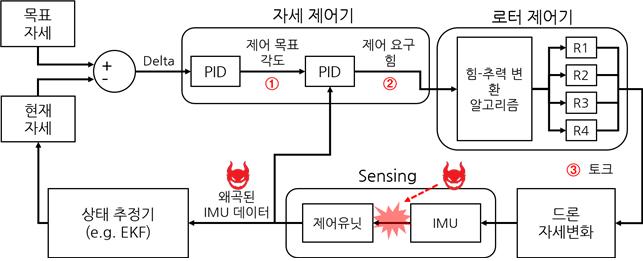 Attack Principle of Urban Swarm Drone Neutralization Technology Developed by KAIST: Communication channel distortion severely distorts the entire sensor data of the IMU, causing serious divergence in attitude control and rotor commands, leading to a crash. Image provided by KAIST
The feature of this technology is that when electromagnetic waves are injected at a specific frequency within such a narrow band, unlike existing anti-drone technologies, it minimizes the impact on surrounding electronic devices, making it applicable in urban areas. Furthermore, during swarm drone attacks using drones with the same control unit board, it can simultaneously cause these drones to crash. In other words, when 100 enemy drones using model A and 100 friendly drones using model B are flying simultaneously, this technology can shoot down all 100 enemy drones without affecting the friendly drones at all.
The inertial measurement unit (IMU) used to operate drones transmits various sensor values to the control unit board. The control unit board applies these sensor values to control algorithms to calculate the drone’s next movements, such as rotor speed and drone posture. The core idea of this research is that if communication between the inertial measurement unit and the control unit board is disrupted, accurate sensor values cannot be received, making it impossible to control the drone’s next movements. To interfere with this communication, the research team chose to inject electromagnetic waves into control unit boards vulnerable to electromagnetic interference (EMI). Experiments revealed that control unit boards of the same type are sensitive to electromagnetic waves of the same frequency. By utilizing this, they found that injecting narrowband electromagnetic waves not only avoids affecting surrounding electronic devices but also effectively counters swarm drone attacks.
Previously, in 2015, the research team developed technology that could bring down drones by injecting sound into the gyroscope sensor, a balance sensor included in the inertial measurement unit. This was based on a principle similar to how humans have difficulty maintaining balance when there is a problem with the cochlea (specifically the semicircular canals).
This study is based on a principle similar to humans having difficulty maintaining balance when the neural network connecting the cochlea to the brain is temporarily blocked, rather than causing problems in the cochlea itself. The research team confirmed that they could immediately bring down a drone hovering at a distance of 10 meters using an indoor electromagnetic wave shielding facility. They also confirmed through simulations that it is possible at distances beyond 10 meters.
The results of this research were accepted at the 'NDSS (Network and Distributed System Security)' Symposium 2023, one of the top security conferences.
© The Asia Business Daily(www.asiae.co.kr). All rights reserved.
![Clutching a Stolen Dior Bag, Saying "I Hate Being Poor but Real"... The Grotesque Con of a "Human Knockoff" [Slate]](https://cwcontent.asiae.co.kr/asiaresize/183/2026021902243444107_1771435474.jpg)

















