Lowering Market Entry Barriers with Step-by-Step Customized Support
Announcement of Q2 Allocation Plan... Q4 Business Operator Selection
[Asia Economy Reporter Oh Su-yeon] The Ministry of Science and ICT is promoting the entry of new 5G 28GHz operators. By reducing investment burdens, it aims to lower the market entry barriers and provide customized support policies at each stage. The plan is to announce the 28GHz frequency allocation plan in the second quarter and select operators in the fourth quarter.
On the 31st, the Ministry of Science and ICT announced the '5G (28GHz) New Operator Entry Support Plan.'
This plan involves promoting the entry of new operators into one of the two 28GHz bands that were canceled in December 2022. It was prepared to enhance consumer benefits by promoting competition in the telecommunications market through new operators offering differentiated 5G 28GHz services, to revitalize the equipment and terminal ecosystem, and to secure future network competitiveness.
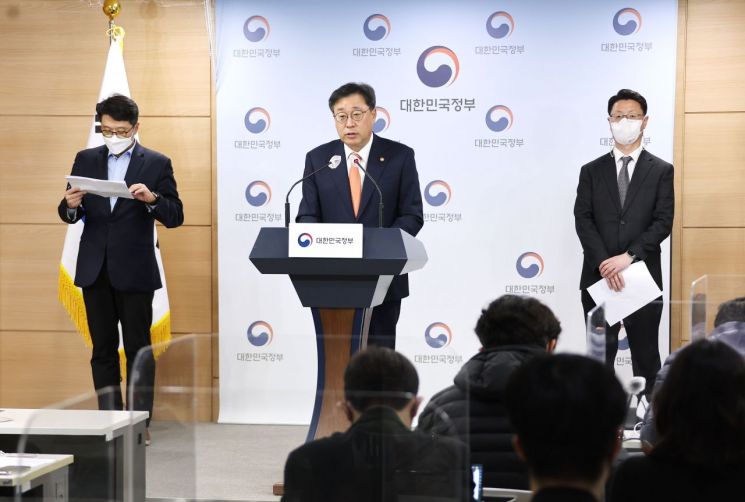 Park Yoon-kyu, Vice Minister of the Ministry of Science and ICT, is announcing the results of the 5G frequency allocation condition compliance inspection and future plans at the briefing room of the Government Seoul Office. [Image source=Yonhap News]
The 5G 28GHz band, unlike the 3.5GHz band currently used nationwide in Korea, has a narrower coverage but allows for fast speeds through wide bandwidth. It can provide stable and fast transmission speeds by distributing traffic even in environments with dense users such as subways, stadiums, and concert halls, and is expected to be used for ultra-high-speed and low-latency services such as metaverse, augmented reality (AR), and virtual reality (VR).
Several countries overseas are also promoting the use of the 28GHz frequency in hotspots requiring high performance. The United States, Japan, and others already provide services, and a total of 33 countries including India, Brazil, and Spain are preparing 28GHz services.
The Ministry of Science and ICT plans to stimulate competition by introducing new operators to activate the 28GHz band. One of the two previously reclaimed bands will be preferentially allocated to new operators, and the remaining band will be considered for allocation with a time lag. Through this, the government aims to provide differentiated services to consumers, strengthen the domestic equipment and terminal ecosystem, and create an opportunity to lead future network competition such as 6G.
Considering the uncertain domestic and international economic conditions, it may be difficult for new operators to invest in the 5G 28GHz band in the short term, so the government plans to provide market entry opportunities over a sufficient period.
To help new operators gain competitiveness, customized support policies covering all stages from frequency allocation that lowers market entry barriers, initial network construction support, to service operation support such as terminal procurement and distribution are being prepared.
First, the Ministry of Science and ICT will allocate 800MHz of the canceled 28GHz band to new operators. In particular, this band will be supplied as an exclusive band where only new operators can participate for at least three years, allowing new operators wishing to provide 28GHz services sufficient time to consider market participation.
The anchor frequency (a frequency used for signal control and billing, requiring a minimum bandwidth of 20MHz or more), which is essential for new operators to provide 28GHz services, will be reviewed with candidate bands such as the 700MHz and 1.8GHz bands, which have high usability in terms of equipment and terminal procurement. The final band will be decided comprehensively considering the opinions of potential new operators later.
Next, new operators can choose the frequency allocation unit between nationwide and regional, reducing investment burdens and enhancing competitiveness. However, considering that smaller allocation units may face difficulties in equipment and terminal procurement due to economies of scale, if new operators wish for regional allocation units, allocation units at the level of metropolitan areas (Capital area, Gangwon area, Chungcheong area, Daegu-Gyeongbuk area, Honam area, Southeast area, Jeju area) will be applied.
Regarding the allocation fee, it will be calculated considering the economic value of the frequency according to Article 11 of the Radio Waves Act, comprehensively taking into account ▲ increased market uncertainty due to delayed activation of the domestic 28GHz ecosystem ▲ characteristics of high-frequency bands that are highly usable in densely populated areas such as hotspots ▲ and frequency supply volume.
For the anchor frequency, the fee will be calculated considering its auxiliary nature for 28GHz services such as control and billing. However, if new operators wish to use the anchor frequency directly for service purposes, the high economic value will be considered.
Since the existing allocation fee payment method, which requires payment of one-quarter of the total amount immediately upon allocation, may raise the perceived entry barrier for new operators, a payment method will be devised so that the payment amount gradually increases after the business matures.
If new operators also wish to build a 5G nationwide network using additional mid- and low-band frequencies, the supply plan for the 3.7GHz band will also be considered.
As a follow-up to this support plan, the Ministry of Science and ICT will actively resolve difficulties of potential operators through the '5G (28GHz) New Operator Entry Support Task Force (TF).' From February, a research group discussing the frequency allocation plan will be operated. Subsequently, continuous meetings to gather opinions from potential operator groups will be held, and the frequency allocation plan will be announced in the second quarter, with new operators selected in the fourth quarter.
Park Yoon-gyu, the 2nd Vice Minister of the Ministry of Science and ICT, said, “The current telecommunications market is fixed around the three major telecom companies, and competition among operators in terms of quality and rates is stagnant. Through this new operator entry support, we expect it to be an opportunity to introduce differentiated 5G services in the telecommunications market and activate competition. We will strive to enhance user benefits and continuously develop network competitiveness such as equipment and terminals.”
© The Asia Business Daily(www.asiae.co.kr). All rights reserved.

















