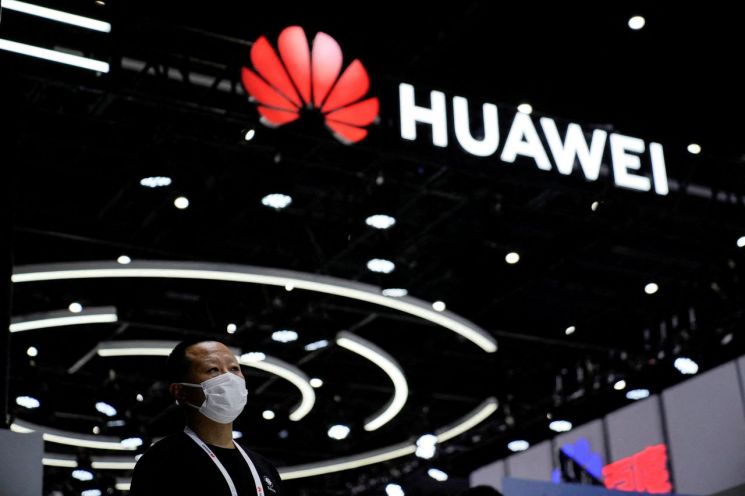
[Asia Economy Reporter Jo Yoo-jin] The U.S. government is pushing to completely block the supply of components from American companies such as Intel and Qualcomm to the Chinese technology company Huawei. Following the formation of a joint anti-China front by leading Japan and the Netherlands, which have established a global triad system with the U.S., by securing their participation in semiconductor export controls to China, the U.S. is tightening sanctions against China day by day. Due to repeated U.S. sanctions, a difficult path is expected for China's semiconductor technology self-reliance, a strategic goal of Xi Jinping's third term.
Bloomberg News reported on the 30th (local time), citing sources within the Biden administration, that the U.S. Department of Commerce has notified some companies that it will not grant licenses to export U.S. technology to Huawei. The Department of Commerce has raised the level of sanctions by completely stopping some export permits to Huawei that had been allowed on a limited basis until now.
Sources familiar with the matter said that the plan to completely ban the supply of components to Huawei is still in the early stages of discussion, and it is uncertain when the U.S. administration's policy change will take place. Some sources believe that the full export ban on Huawei is likely to be introduced in May, marking the fourth anniversary of the Trump administration placing Huawei on the export control list.
Previously, in May 2019, the U.S. under the Trump administration considered Huawei a national security threat and placed it on the 'entity list' related to major semiconductor component transactions. Since then, limited exports have been allowed for some items not related to core 5G products.
If this measure is implemented, the sales channels of U.S. companies to Huawei will be blocked, but the impact is expected to be minimal. According to Bloomberg's own analysis, Huawei accounts for less than 1% of the total sales of Qualcomm, Intel, and AMD, a negligible level.
The Biden administration is continuing a tougher stance on China in advanced technology sectors than the previous Trump administration. Following the announcement last October of comprehensive export controls on semiconductors used in artificial intelligence (AI) and supercomputers, two months later in December, 36 Chinese companies including YMTC (Yangtze Memory Technologies), a leading Chinese memory semiconductor company that supplied semiconductors to Huawei, were added to the export control list, tightening sanctions across the entire Chinese semiconductor industry.
Foreign media reported that this series of regulatory measures aims to slow down the development of semiconductor technology used comprehensively in artificial intelligence technology, nuclear weapons, and hypersonic missile development, as well as the progress of China's military programs. Allen Estevez, Deputy Assistant Secretary for Industry and Security at the U.S. Department of Commerce, said, "We will strictly limit the ability to use advanced technologies such as semiconductors for military modernization in the interest of national security."
Recently, Japan and the Netherlands have also joined in export controls against China. As a result, a united anti-China front has been formed among the world's top five semiconductor equipment companies, including U.S. Applied Materials, Lam Research, KLA, the Netherlands' ASML, and Japan's Tokyo Electron, creating a pressure structure against China.
China is the world's largest semiconductor market, accounting for 36% of global demand. According to market research firm IC Insights, as of the end of 2021, the global semiconductor chip market size was $510 billion, with the Chinese market size at about $186.5 billion. Semiconductors produced in China account for about 17% of the total Chinese semiconductor market, but excluding semiconductors produced by global semiconductor companies with production bases in China, the self-sufficiency rate is in the single digits. The Chinese government has set a goal of achieving 70% semiconductor self-sufficiency by 2025, but due to the impact of U.S. sanctions and other factors, the likelihood of achieving this goal is considered low.
© The Asia Business Daily(www.asiae.co.kr). All rights reserved.
!["The Woman Who Threw Herself into the Water Clutching a Stolen Dior Bag"...A Grotesque Success Story That Shakes the Korean Psyche [Slate]](https://cwcontent.asiae.co.kr/asiaresize/183/2026021902243444107_1771435474.jpg)
















