Nobel Economics Prize Winner Paul Krugman's Stern Warning
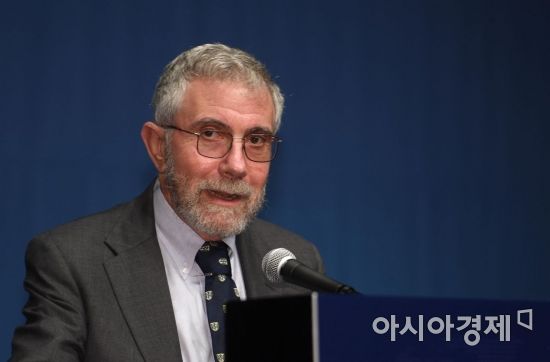 Paul Krugman, Professor at the City University of New York
[Asia Economy Reporter Lee Ji-eun] Paul Krugman, Nobel laureate in Economics and professor at the City University of New York, recently issued a warning regarding the market's premature optimism about inflation. As inflation eases, expectations have grown that central banks around the world might shift from their tightening stance, leading to capital flowing into risk asset markets such as stocks. However, he cautioned that such movements could, in turn, drive inflation higher again.
On the 30th (local time), Professor Krugman appeared on Bloomberg TV's program "Balance of Power" and predicted, "Inflation is falling quite rapidly and will continue to slow down."
Consistent with his analysis, the market is spreading expectations that the intensity of inflation has weakened. Investors are betting on the possibility that central banks worldwide will ease the aggressive tightening policies they maintained last year. Last year, the U.S. Federal Reserve (Fed), the equivalent of the central bank, implemented four consecutive giant steps (raising rates by 0.75 percentage points at once) before reducing the rate hike to 0.5 percentage points at the end of the year. Fueled by these expectations, the S&P 500 index has risen 5.06% this year, while the Nasdaq 100 and Dow Jones indices have increased by 9.6% and 1.75%, respectively.
In particular, speculation is spreading that the Fed will conclude its rate hike cycle after March. It is anticipated that the Fed will raise the benchmark interest rate by 0.25 percentage points at the Federal Open Market Committee (FOMC) regular meeting on the 1st of next month, raise it once more in March, and then halt further increases.
However, Professor Krugman warned, "Investors in the market are overly confident that the risk has ended." He explained that if expectations for a policy shift by central banks worldwide grow and capital floods into the market, stock prices could rise and the dollar could weaken, which would increase import costs and put upward pressure on inflation.
Another risk factor is that inflationary pressures have not yet sufficiently subsided. Bloomberg explained, "While energy costs have declined (within the U.S. Consumer Price Index), food prices are still rising," adding, "Low unemployment also means that the U.S. labor market remains tight." Currently, as labor demand exceeds supply in the U.S., employers are raising wages to retain workers. Rising labor costs could again push prices higher.
Krugman stated, "Many data indicate that the U.S. economy will experience severe crosscurrents," adding, "We are going through a very confusing period with many unknowns lurking."
© The Asia Business Daily(www.asiae.co.kr). All rights reserved.
![Clutching a Stolen Dior Bag, Saying "I Hate Being Poor but Real"... The Grotesque Con of a "Human Knockoff" [Slate]](https://cwcontent.asiae.co.kr/asiaresize/183/2026021902243444107_1771435474.jpg)















