Start of Electoral System Reform Begins with Discussion on Adjusting Number of Lawmakers
19th National Assembly in 2012 Marked Era of 300 Lawmakers
Is Expanding Number of Lawmakers Reasonable? Public Opinion Opposes
[Asia Economy Reporter Ryu Jeong-min] The number of members of the National Assembly, 300, is familiar but not a given figure. In the recent general election, the 21st National Assembly election in 2020, 300 members were elected. The 19th National Assembly in 2016 also had 300 members.
For the younger generation who started voting in general elections within the last 10 years, 'number of members = 300' may seem familiar, but the era of 300 members in South Korea is not that old. It was first in the 19th general election in 2012 that 300 members were elected.
Looking at the number of members of the National Assembly since the 1980s, the number 299 was more common than 300. In the 13th general election in 1988, the 14th in 1992, the 15th in 1996, the 17th in 2004, and the 18th in 2008, the number of members was 299.
Except for the 16th general election in 2000, when the number of members was reduced to 273, the most common number of members in recent general elections was 299, followed by 300.
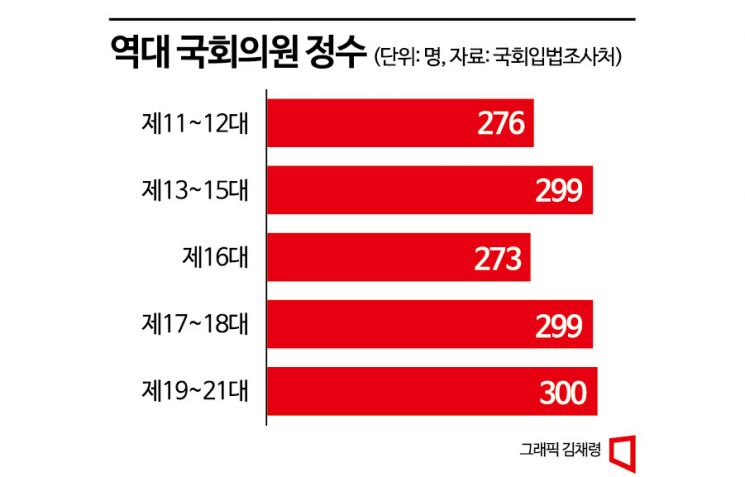
The number of members is stipulated in Article 21 of the Public Official Election Act.
Adjusting the number of members to 300 is not something that ruling and opposition lawmakers can decide through a few discussions; it requires a plenary session law amendment.
The reason why attention must be paid to the issue of the number of members is that it forms the foundation of all discussions surrounding electoral system reform, including the core task of the 'Bipartisan Political Reform Lawmakers' Group' formed by ruling and opposition parties.
The clash between reasonable measures for political reform and populist politics marks the dividing line on the issue of adjusting the number of members.
Political scientists argue that the current number of 300 members should be increased considering South Korea's population size and economic capacity. Comparing with foreign cases, the general consensus among political scientists is that South Korea's number of members should be increased.
This was also mentioned at the National Assembly's Political Reform Special Committee meeting on the 26th. Kim Young-bae, a member of the Democratic Party of Korea, said, "We should choose methods such as expanding proportional representation, reducing the number of constituencies, or increasing the number of members," adding, "It is now time to discuss the number of members of the National Assembly."
Currently, there are bills to amend the Public Official Election Act proposing to increase the number of members to 330 or 360.
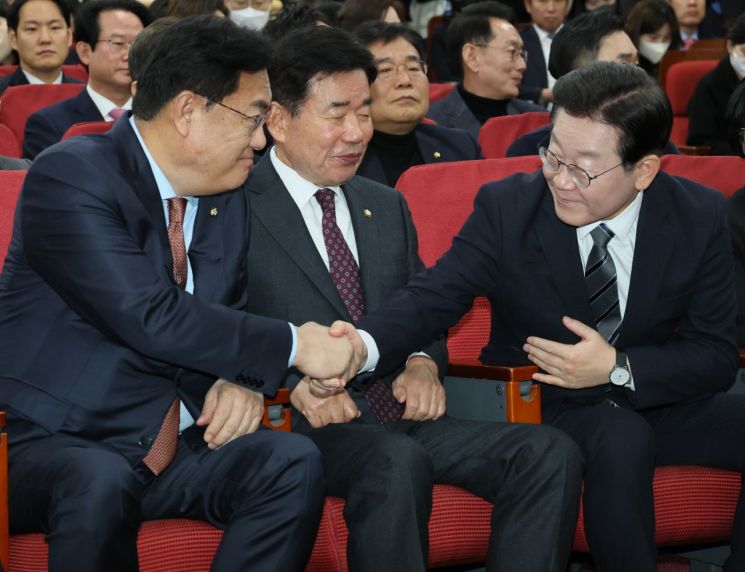 On the morning of the 30th, at the launch ceremony of the bipartisan political reform lawmakers' group held at the National Assembly Members' Office Building in Yeouido, Seoul, Jeong Jin-seok, Emergency Response Committee Chairman of the People Power Party, left first and shook hands with Lee Jae-myung, leader of the Democratic Party of Korea.
 [Photo by Yonhap News]
The problem is that expanding the number of members is as difficult as "putting a bell on a cat." Especially, public opinion strongly opposes it. Every time the number of members has been discussed historically, public opinion has opposed expansion. This has been the case now, 10 years ago, and 20 years ago; public opinion is not favorable to increasing the number of lawmakers. This is where the temptation of populist politics advocating for reducing the number of members arises.
The opposition in public opinion is a complex mix of distrust in politics and concerns about increased budget due to expanding the number of members.
Surprisingly, there are not many lawmakers who openly advocate increasing the number of members. The Justice Party also does not highlight the issue of increasing the number of members as a prerequisite discussion topic. The Democratic Party and the People Power Party mostly take a cautious stance. Some lawmakers even advocate reducing the number of members.
On the 30th, Cho Kyung-tae of the People Power Party said on MBC Radio's 'Kim Jong-bae's Focus' that "the number of lawmakers in our country is too many," and argued, "If the proportional representation system is abolished, about 150 billion won in budget could be saved over approximately four years from taxpayers' money."
He proposed abolishing the proportional representation system as a solution while advocating for reducing the number of members. Currently, out of 300 members, 253 are constituency members and 47 are proportional representatives. Abolishing proportional representation would reduce the number of members to 253.
What is noteworthy here is that although there are calls to abolish proportional representation, there are not many who talk about drastically reducing constituencies. Reducing constituencies means lawmakers giving up their vested interests.
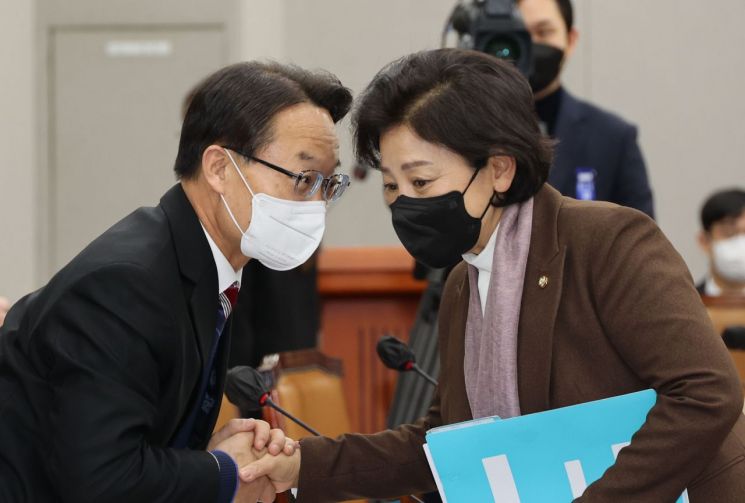 Nam In-soon, Chairperson of the Political Reform Special Committee, is attending the full meeting of the Political Reform Special Committee held at the National Assembly in Yeouido, Seoul, on the afternoon of the 26th, and is conversing with Jo Hae-jin, a member of the People Power Party.
 [Image source=Yonhap News]
This is also the difficulty in adjusting the number of members from 300. Although ruling and opposition parties smile for photos and shout for electoral reform on the surface, they react sensitively to discussions such as reducing constituencies. Even when adjusting the number of members, the solution has been to protect constituencies as much as possible and reduce proportional representation.
Will the current number of 300 members be maintained in the 22nd general election in 2024? What hurdles must be overcome to adjust this number?
If the number 300 is to be reduced, the difficult issue of reducing constituencies must be solved. This is a proposal that may not pass the plenary session due to opposition from individual lawmakers.
Attempts to significantly increase the number of members from 300 to 330 or 360 are likely to face strong resistance from public opinion. Considering the political disgust among the public, how many lawmakers will have the courage to "put a bell on a cat"?
© The Asia Business Daily(www.asiae.co.kr). All rights reserved.
![Clutching a Stolen Dior Bag, Saying "I Hate Being Poor but Real"... The Grotesque Con of a "Human Knockoff" [Slate]](https://cwcontent.asiae.co.kr/asiaresize/183/2026021902243444107_1771435474.jpg)


















