Priority Still on Quarantine Over Sales Recovery Expectations
Concerns Over Rising Food Ingredient Costs and Public Utility Charges
Although indoor 'no-mask' policy started from the 30th, the dining industry is cautiously responding by maintaining the policy of wearing masks and sanitary gloves to prepare for possible infections within stores. Internally, rather than expecting a recovery in sales, the industry is struggling with increasing pressures from rising food ingredient costs, electricity bills, and other public utility charges, as well as concerns about a resurgence of COVID-19.
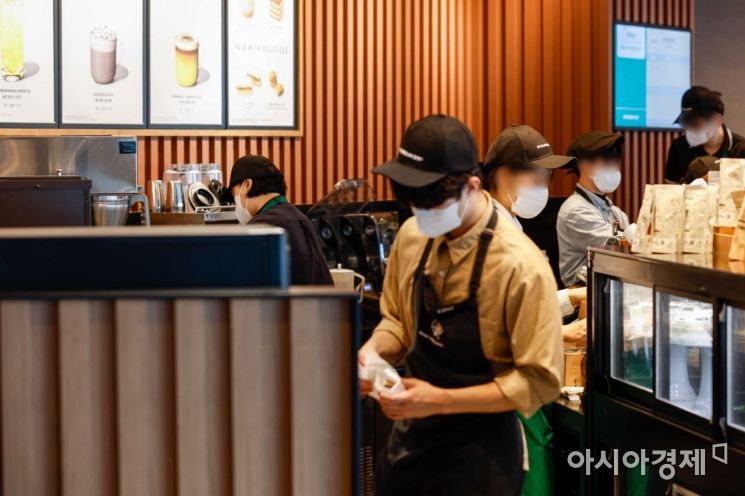 On the 31st, when the indoor mask mandate was lifted, an employee at a cafe in Seoul is wearing a mask. Photo by Jinhyung Kang aymsdream@
According to the dining industry on the 31st, CJ Foodville's Vips is maintaining current quarantine rules such as employees wearing masks and sanitary gloves and refraining from conversations. Customers are allowed to decide voluntarily. However, due to the nature of buffets where many customers move around and serve themselves, it is expected that many customers will voluntarily wear masks for the time being.
Non-buffet businesses also plan to continue their existing mask-wearing policies for the time being. The Born Korea has been guiding franchise stores and in-store employees to continue wearing masks as before after the 30th, considering customer safety.
Gyocun Chicken, Outback, Domino's Pizza, and others are also continuing their existing mask-wearing policies as there have been no newly changed guidelines.
Starbucks is also currently requiring employees to continue wearing masks. In particular, they prioritize safety at locations where employees interact face-to-face with customers, such as beverage pickup counters and cash registers.
The dining industry's voluntary continuation of mask-wearing mandates is interpreted as a concern that the indoor no-mask policy could trigger another COVID-19 pandemic. On the other hand, contrary to expectations that the no-mask policy would increase consumer outings and dining out, leading to higher sales for the dining industry, dining businesses view it as 'premature.' This is due to the increasing pressure from rising food ingredient costs and public utility charges such as electricity and gas.
According to the Korea Agro-Fisheries & Food Trade Corporation (aT)'s '4th Quarter 2022 Dining Industry Business Condition Index' report, the dining industry business outlook index for the first quarter of this year was 85.76, a sharp drop of 9.22 points from the previous quarter's outlook index of 94.85. The report forecasted that the business recovery trend in the dining industry would slow down for the time being, as the outlook index showed a decline for two consecutive quarters.
The dining industry business condition index is a quantified measure based on a survey of sales and business sentiment in the dining industry over the past three months compared to the same period last year. A figure above 100 indicates more companies expect business improvement, while below 100 indicates the opposite. This survey was conducted from the 14th to the 28th of last month, targeting 3,000 dining businesses.
Professor Choi Cheol of the Department of Consumer Economics at Sookmyung Women's University diagnosed, "The recovery in the dining industry's sales index last year was because the dining demand, which had been restricted for a long time due to COVID-19, temporarily recovered after the social distancing measures were lifted. However, the decline again in the fourth quarter was due to high inflation becoming a new factor. When inflation rises and consumers' real income decreases, they reduce spending, and dining out is one of the easiest consumption items to control, leading to a decrease in sales."
© The Asia Business Daily(www.asiae.co.kr). All rights reserved.
![Clutching a Stolen Dior Bag, Saying "I Hate Being Poor but Real"... The Grotesque Con of a "Human Knockoff" [Slate]](https://cwcontent.asiae.co.kr/asiaresize/183/2026021902243444107_1771435474.jpg)











