"Exposure to Investor Protection Issues Due to Lack of Evaluation and Disclosure"
Daksa Discussing Common Delisting Guidelines
Virtual Asset Alert System Underway
[Asia Economy Reporter Lee Jung-yoon] In the virtual asset market, there have been calls for proper evaluation and disclosure to address market confusion, protect investors, and resolve information asymmetry.
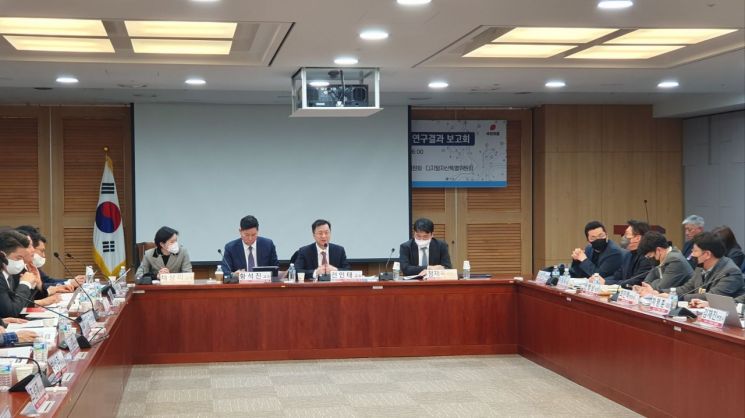
On the 30th, at the "Future of Digital Assets - New Industry and Regulatory Innovation TF Research Results Report" hosted by the People Power Party Policy Committee and the Digital Asset Special Committee, Professor Jeon In-tae of the Catholic University Department of Mathematics explained, "Disclosure information should be regarded as an obligation of digital asset issuers to enhance market efficiency and protect investors, but there are currently no mandatory provisions or regulations."
He continued, "Most digital asset evaluation agencies lack established qualification requirements for experts and have not secured sufficient professional personnel," adding, "Evaluation agencies should be composed of at least three independent institutions to prevent market domination through monopolies or collusion with exchanges, and a continuous monitoring system by relevant authorities should be established for proper management and supervision."
Professor Jeon pointed out that inadequate evaluation and disclosure by exchanges and evaluation agencies have exposed problems in investor protection.
He further stated, "It is necessary to introduce a mandatory disclosure system to systematize the scope and process of issuer disclosures and to build an integrated system that consolidates disclosure content from multiple exchanges," adding, "Since it is difficult to establish an efficient disclosure system domestically in a short period, it is necessary to implement investor protection and issuer responsibility through self-regulation, in line with existing Capital Markets Act provisions."
Additionally, as policy improvement directions, he proposed ▲allowing existing financial companies to enter the digital asset industry ▲considering permitting virtual asset investments by corporations ▲abolishing the existing administrative guidance limiting one bank per exchange ▲expanding the number of banks issuing real-name verification certificates to exchanges.
On the same day, Cha Myung-hoon, CEO of Coinone, attended representing the Digital Asset Exchange Joint Council (DAXA), composed of Korea's five major virtual asset exchanges: Gopax, Bithumb, Upbit, Korbit, and Coinone, stating that measures to protect investors are being prepared.
Specifically, he explained that they are enhancing the common guidelines for trading support reviews this year and are in discussions to establish common guidelines for trading support termination (delisting). He added, "We plan to establish internal standards for the virtual asset alert system and provide alert-type notifications for relevant items this year," but noted, "However, since each member company's system differs, it is taking time, and we are currently focusing on developing the logic."
Currently, DAXA requires at least two or more than 30% external experts to participate in trading support reviews and has established common review guidelines that set mandatory evaluation items for each member company during the review process. Previously, when Wemade decided to delist the virtual asset 'Wemix,' there were claims of confusion due to the lack of clear disclosure of listing and delisting criteria.
The financial authorities also emphasized the urgency of establishing a regulatory framework. Ahn Byung-nam, head of the Digital Asset Research Team at the Financial Supervisory Service, said, "Public regulation should be introduced to establish discipline in the digital asset market and protect users, but it must be designed minimally to foster a blockchain technology-based market."
He stated that a comprehensive regulatory system and system should be established for virtual asset issuance, listing, and disclosure overall, and a disclosure system should be built to prevent and regulate information asymmetry and unfair trading practices.
He also mentioned the need to institutionalize mandatory disclosure of key contents in whitepapers from the issuance and listing perspective, and to institutionalize continuous disclosure obligations regarding significant changes related to digital assets from the distribution perspective. He suggested considering the establishment of an integrated disclosure system.
The Financial Intelligence Unit (FIU) of the Financial Services Commission announced that its inspection plan for virtual asset service providers this year includes checking the establishment and operation status of anti-money laundering (AML) systems for coin market operators and wallet operators. Lee Dong-wook, head of the FIU Virtual Asset Inspection Division, explained, "We plan to select and conduct inspections based on a comprehensive consideration of the number of users, transaction amounts, etc.," adding, "We will prioritize inspecting the AML systems of coin market operators transitioning to the Korean won market."
He added, "For Korean won market operators, we will conduct thematic inspections on the actual AML operation status, and if urgent money laundering issues or multiple complaints arise, on-site inspections will be conducted as needed," and "We will continuously share cases of violations and unfair practices identified during inspections to guide other operators in properly establishing and implementing AML systems."
Meanwhile, the event also included discussions on regulations for non-fungible tokens (NFTs), permitting virtual asset corporate account issuance, and initial coin offerings (ICO) and initial exchange offerings (IEO) by virtual asset exchanges.
Furthermore, Lee Ji-eun, representative lawyer of Liberty Law Office, introduced the regulatory situations of virtual assets overseas in the US, Europe, and Japan, urging that when enacting the Digital Asset Act, policy considerations are needed regarding governance systems for crypto asset operators, extraterritorial application and international cooperation among supervisory agencies to ensure the effectiveness of unfair trade regulations, applicable laws and dispute resolution methods for investor protection, and jurisdiction.
© The Asia Business Daily(www.asiae.co.kr). All rights reserved.
![Clutching a Stolen Dior Bag, Saying "I Hate Being Poor but Real"... The Grotesque Con of a "Human Knockoff" [Slate]](https://cwcontent.asiae.co.kr/asiaresize/183/2026021902243444107_1771435474.jpg)
















