[Asia Economy Reporter Byeon Seon-jin] The adjustment of the mandatory isolation for confirmed COVID-19 cases, the last remaining quarantine measure in South Korea, is expected to be considered after May. This follows the decision to maintain the World Health Organization (WHO)'s declaration of the COVID-19 Public Health Emergency of International Concern (PHEIC), which serves as a turning point for global quarantine measures. The WHO's Emergency Committee on COVID-19, which advises on the maintenance of the PHEIC, meets quarterly.
According to the Korea Disease Control and Prevention Agency (KDCA) on the 31st, the WHO decided to maintain the PHEIC, citing reasons such as high global immunity against COVID-19 due to vaccination, but ▲a higher mortality rate compared to other respiratory infectious diseases, ▲insufficient vaccination coverage in low-income countries and high-risk groups, and ▲uncertainty regarding the emergence of new variants.
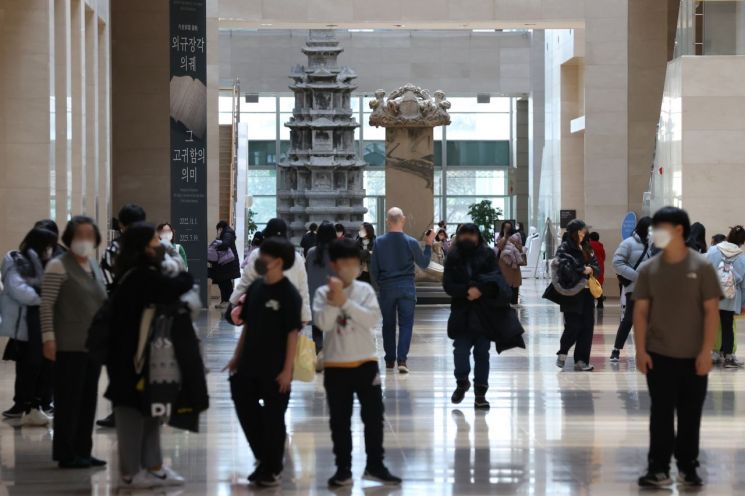
WHO Maintains PHEIC; Adjustment of Mandatory Isolation for Confirmed Cases Likely to Be Considered Only After May
The health authorities have stated that discussions on shortening the isolation period can only be considered after the WHO lifts the public health emergency declared in January 2020 and downgrades the COVID-19 crisis level from 'serious' to 'alert' or 'caution.' The matter has now been passed to the WHO COVID-19 Emergency Committee meeting scheduled three months later.
On the 30th, adjustments were made to the indoor mask mandate, excluding some facilities such as public transportation, hospitals, and pharmacies. The only remaining quarantine measure in South Korea is the mandatory 7-day isolation for confirmed cases. The mandatory isolation was introduced as a 14-day period when the first domestic case was confirmed on January 20, 2020, shortened to 10 days on November 1, 2021, under the 'gradual recovery to daily life' policy. Since the Omicron variant, which spreads rapidly but mostly causes mild symptoms, became dominant, the isolation period was further shortened to 7 days starting February 9 last year. There have been calls in the National Assembly to reduce the isolation period to 3 days.
In June last year, the government set conditions for adjusting the isolation obligation, including ▲an average daily death toll of 10 to 20 or fewer, weekly deaths of 50 to 100 or fewer, and ▲a fatality rate of 0.05 to 0.1%. Recently, the fatality rate has dropped to 0.08% as the public acquired antibodies, but the weekly death toll (January 24?30) was 185, far exceeding the criteria.
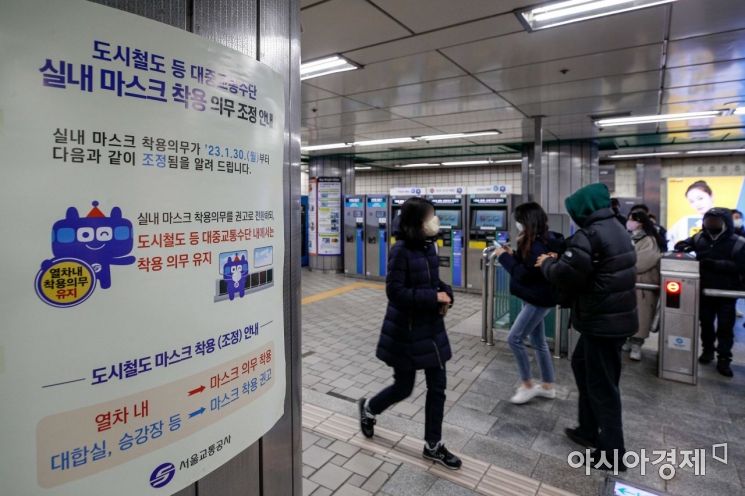 On the 30th, at Sinchon Station on Subway Line 2 in Seodaemun-gu, Seoul, where indoor mask-wearing has been changed from mandatory to recommended except for some facilities, a notice about the adjustment of the indoor mask-wearing mandate on public transportation is posted. Photo by Jinhyung Kang aymsdream@
Experts: “There Must Be Evidence That Virus Is Not Spread After Isolation Period”
Experts emphasize that for the 7-day mandatory isolation to be shortened, sufficient evidence must be presented showing that COVID-19 does not spread after the isolation period.
Jung Ki-seok, head of the COVID-19 Special Response Team and chair of the National Infectious Disease Crisis Response Advisory Committee, said at a regular briefing, “Among 502 cases tested with the BA.1.1 virus, 1 in 10 infected individuals was still capable of transmitting the virus on the 8th day, and for BA.5, 4 out of 10 could infect others on the 5th day. This is not a level at which we can feel safe.” Professor Eom Jung-sik of Gil Hospital’s Infectious Diseases Department stated, “The health authorities shortened the isolation period to 7 days based on research showing no viral shedding after 7 days from confirmation. If there is evidence that viral shedding ceases even with a 3-day isolation due to weakened transmissibility, then shortening to 3 days would be possible.”
If the isolation obligation is adjusted, the final stage would be integrating COVID-19 into the general healthcare system. Until now, a separate government budget has been allocated for COVID-19, and dedicated hospital beds have been prepared for patients. Compensation for losses due to COVID-19 is also paid monthly in estimated lump sums to medical institutions such as hospitals, clinics, and pharmacies. Once COVID-19 is managed within the general healthcare system, patients will receive treatment at hospitals or clinics as they do for the flu. The legal infectious disease classification of COVID-19, which was level 1, is currently level 2, requiring reporting within 24 hours and mandatory isolation. If downgraded to level 4 like the flu, reporting within 7 days and recommended isolation would apply.
© The Asia Business Daily(www.asiae.co.kr). All rights reserved.
![Clutching a Stolen Dior Bag, Saying "I Hate Being Poor but Real"... The Grotesque Con of a "Human Knockoff" [Slate]](https://cwcontent.asiae.co.kr/asiaresize/183/2026021902243444107_1771435474.jpg)

















