Excessive Artificial Satellites and Artificial Lighting, Hindering Stargazing
"By 2030, we may never be able to see the stars in the night sky again."
There is a forecast that 'artificial satellites' launched competitively from countries such as the United States and the United Kingdom could block the stars. This is because sunlight reflected by satellites and electromagnetic waves interfere with astronomical observations. In a few years, humanity might never be able to see stars in their lifetime.
Satellites Filling Earth's Orbit... Blocking the Stars
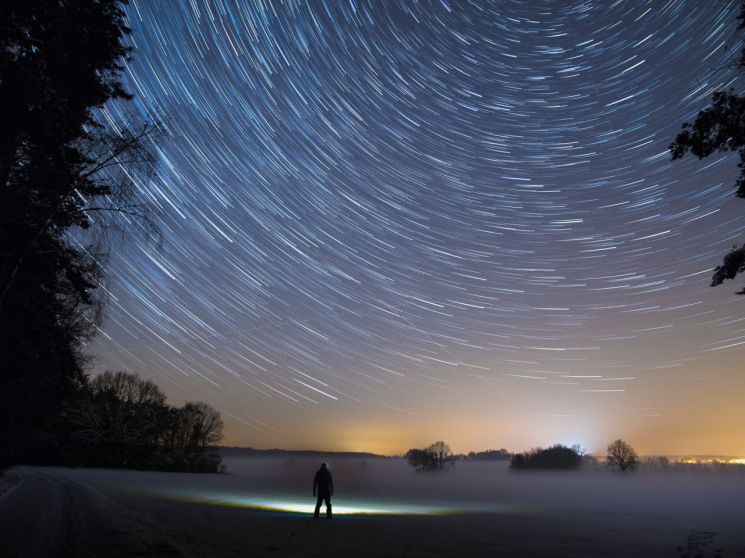
The British daily Telegraph reported on the 30th (local time), citing research results from the astrophysics community, that astronomical observations may become impossible in the 2030s due to artificial satellites.
According to the media, the current number of artificial satellites orbiting Earth reaches 8,000. This is a fourfold increase compared to 2019, four years ago, due to low Earth orbit (LEO) satellites from space communication companies building internet satellite networks such as the US-based Starlink and the UK-based OneWeb.

In particular, Elon Musk, CEO of Starlink, plans to build a total of 44,000 satellite networks to complete the internet network, and approximately 400,000 LEO satellites have been approved worldwide.
Artificial satellites reflect sunlight back to Earth, making star observation difficult, and the radio waves emitted by communication satellites negatively affect the function of 'radio telescopes' that observe stars using electromagnetic waves.
Tony Tyson, a professor of astronomy at the University of California, Davis (UC Davis), expressed concern, saying, "By 2030, when looking up at the sky from dark places, it will be filled with moving artificial satellites instead of stars, and there will be very few stars visible to the naked eye even in the darkest skies."
'Light Pollution' Is Already a Serious Problem
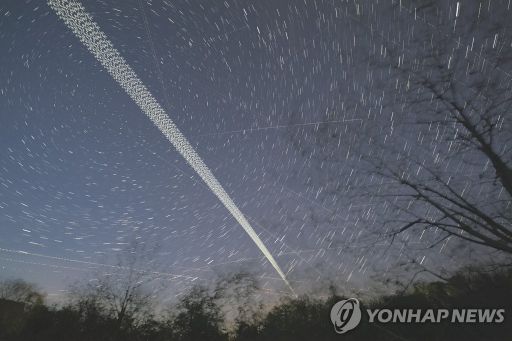 Flight trajectory of StarlinkX satellite leaving light traces in the night sky / Photo by Yonhap News
Observing stars in the night sky is already becoming increasingly difficult due to the rapidly growing 'light pollution' over the past few decades. On the 20th, a research team from Germany's GeoForschungsZentrum (GFZ) published a paper in the scientific journal Science presenting research results using star observation data submitted by scientists worldwide, showing that the number of stars visible to the naked eye is rapidly decreasing.
According to the research team, about 30% of the world's population and 80% of Americans have been deprived of the opportunity to see galaxies due to light pollution. Stars are easier to observe when the brightness of the night sky is low, but as materials that emit light at night, such as artificial lighting, increase on Earth, the night sky is becoming increasingly bright.
The research team's data shows that the brightness of Earth's night sky is increasing by 9.6% annually. The team stated, "At the current rate, a child born in a place where 250 stars are visible will only be able to see about 100 stars by the time they turn 18."
© The Asia Business Daily(www.asiae.co.kr). All rights reserved.



















