Ministry of Education Unveils Blueprint for Integrating Kindergarten and Childcare
Pilot Operation in 3-4 Leading Education Offices in Second Half of This Year
Phase 1: 2023-2024, Phase 2: 2025
Significant Expansion of Education and Childcare Fee Support Starting Next Year
[Asia Economy Reporter Yoo Byung-don] Starting in 2025, preschool children will attend newly launched integrated kindergarten and daycare centers, and in the second half of this year, 3 to 4 leading education offices will pilot programs to prioritize narrowing the gap between kindergartens and daycare centers.
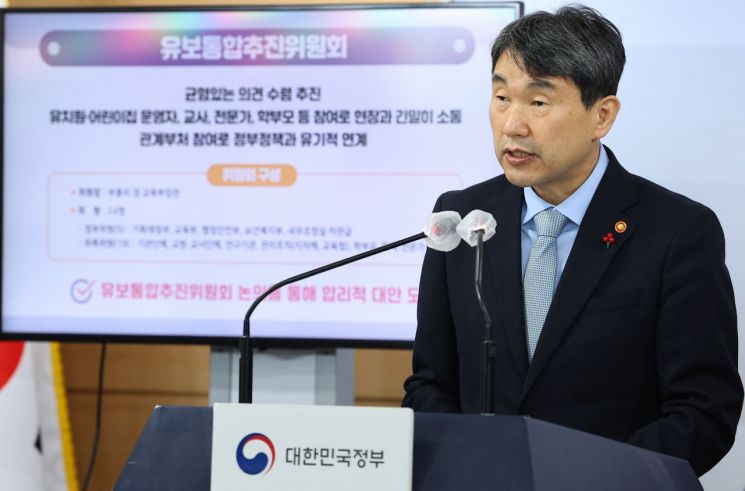
On the 30th, the Ministry of Education announced the 'Plan for Promoting Kindergarten-Daycare Integration' containing these details and revealed a concrete blueprint.
First, the Ministry of Education plans to focus on laying the foundation for integration during the first phase of 2023?2024.
Depending on regional conditions, education offices will be able to reduce the gap between kindergartens and daycare centers by selecting and operating 3 to 4 leading education offices for integration starting in the second half of this year. These leading education offices will independently work to resolve disparities between kindergartens and daycare centers through balanced support for meal costs, additional support beyond the Nuri Curriculum, and extended care hours.
Additionally, to reduce the gap between kindergartens and daycare centers and ease parental burdens, the Ministry of Education will expand education and childcare fee support annually: for 5-year-olds in 2024, 4-year-olds in 2025, and 3-year-olds in 2026, separate from the Nuri Curriculum subsidies.
Currently, free childcare is provided for children aged 0 to 2, but children aged 3 to 5 receive up to 280,000 KRW per child through the Nuri Curriculum subsidy. Depending on the institution used, parents bear more than 200,000 KRW in some cases, with a national average of 135,000 KRW. The specific support scale will be discussed soon by the soon-to-be-launched Kindergarten-Daycare Integration Promotion Committee (Promotion Committee).
Furthermore, the Ministry of Education plans to update kindergarten after-school program fees, which have been frozen since 2013, starting next year to expand kindergarten care functions, and will continuously strengthen nighttime extended care and holiday childcare at daycare centers. Specific details will be disclosed in the 'Service Gap Reduction Plan' in the second half of this year.
The Ministry is also considering establishing a separate special account for financial integration, assuming the transfer of existing childcare budgets. This special account will include the previously separately executed budgets for kindergarten and daycare center support, as well as additional funds needed for integration.
Currently, daycare centers receive about 10 trillion KRW through local governments, and kindergartens receive about 5 trillion KRW through the Ministry of Education and education offices, totaling approximately 15 trillion KRW in support.
On top of this, the Ministry estimates that from 2026, an additional 600 billion KRW annually for teacher treatment improvement and about 800 billion KRW for resolving facility disparities will be required, totaling approximately 2.1 to 2.6 trillion KRW annually after integration.
The Ministry plans to release a draft of the new integrated institution model by the end of this year and finalize it by the end of next year, centered around discussions by the Promotion Committee.
Measures to strengthen teacher professionalism and improve working conditions, revisions to the curriculum to enhance linkage between the standard childcare course (ages 0?2), the Nuri Curriculum (ages 3?5), and lower elementary school grades, as well as facility and establishment standards, will be presented alongside the new integrated institution model.
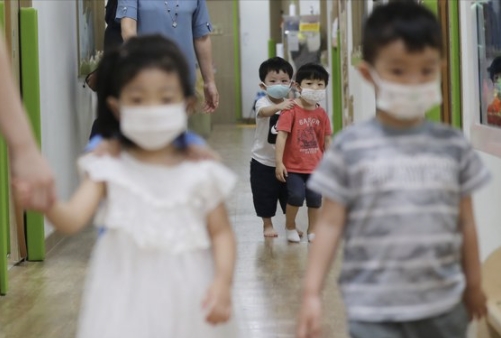
The Ministry of Education announced that the second phase of integration will begin in 2025, marking the full-scale implementation of kindergarten-daycare integration.
First, existing kindergartens and daycare centers will transition into new integrated institutions based on the results of the first phase discussions. The name and legal status of the new integrated institutions will be further discussed later.
An official from the Ministry of Education explained, "The third integrated institution does not mean a unilateral single institution based on physical integration," adding, "We plan to present a model as a high-quality early childhood care institution."
The core elements of the new integrated institutions?teachers, curriculum, and facility and establishment standards?will be gradually applied starting in 2025. The Ministry expects full implementation by 2026.
The age group of children attending the new integrated institutions will be determined by each institution. Although the integration policy targets ages 0 to 5, the new integrated institutions will be able to operate various integration models depending on regional conditions, such as only for ages 4 to 5 or only for ages 0 to 2.
Meanwhile, to promote integration, the Ministry will establish and operate the Promotion Committee and the Kindergarten-Daycare Integration Promotion Team (Promotion Team).
The Promotion Committee is an organization that formulates and deliberates key policies such as service gap reduction, integration model direction, and teacher qualification and training systems. It is chaired by the Deputy Prime Minister and Minister of Education and composed of government members, teacher organizations, research institutions, local governments and education offices, parents, academia, and experts.
The Promotion Team is a working body supporting the efficient operation of the Promotion Committee. The team leader is from the Ministry of Health and Welfare, and the planning support officer is a civil servant from the Ministry of Education. It consists of about 30 members, including civil servants from various ministries such as the Ministry of Education, Ministry of Health and Welfare, Ministry of Economy and Finance, Ministry of the Interior and Safety, the Office for Government Policy Coordination, as well as dispatched personnel from education offices and local governments.
© The Asia Business Daily(www.asiae.co.kr). All rights reserved.


















