[Asia Economy Yang Nak-gyu, Military Specialist Reporter] The Ministry of National Defense neither confirmed nor denied the assessment that North Korea could equip short-range ballistic missiles (SRBMs) such as the KN-23 (Iskander) with nuclear warheads.
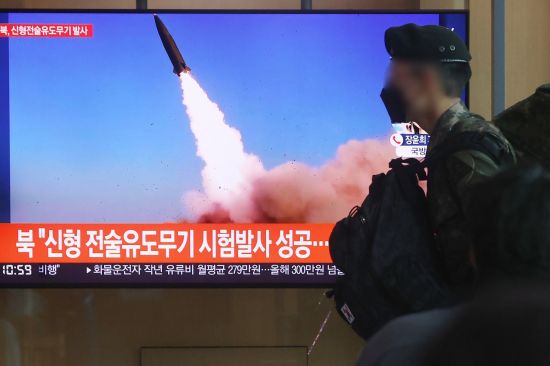
At a regular briefing on the 30th, Ministry of National Defense spokesperson Jeon Ha-gyu responded to related questions by saying, "(The Ministry of National Defense) is analyzing the relevant information, but there is nothing to respond to at this time," adding, "The Republic of Korea and the United States are closely monitoring North Korea's nuclear and missile development trends through mutual cooperation."
Earlier, on the 27th, the U.S. Congressional Research Service (CRS) reported in its 'North Korea's Nuclear Weapons and Missile Programs' that some of North Korea's short-range ballistic missiles (SRBMs) and medium-range ballistic missiles (MRBMs) are evaluated as dual-capable weapon systems, capable of carrying either nuclear or conventional warheads. The KN-23, which is believed to be capable of unconventional maneuvers to evade the ROK-US missile interception network, is considered even more threatening due to assessments that it can carry nuclear warheads.
Regarding the KN-23, known as the 'North Korean Iskander,' the report stated that it "can strike all targets on the Korean Peninsula" and is capable of carrying either nuclear or conventional warheads. North Korea has previously claimed that its new ballistic missiles can carry tactical nuclear warheads, and various speculations about the feasibility have been raised, but it is notable that the U.S. Congress publicly mentioned this in the report.
CRS Report: “KN-24 and KN-25 Can Carry Conventional Warheads”
.
The CRS stated regarding the North Korean version of the ATACMS (KN-24), "External experts believe North Korea plans to develop the KN-24 as a system capable of carrying nuclear or conventional warheads," but maintained a cautious stance on the possibility of nuclear armament. The super-large multiple rocket launcher (KN-25) was described as "capable of carrying conventional warheads," and the report evaluated it as "a weapon blurring the line between rockets and missiles, producing effects similar to traditional SRBMs while being a more economical system."
The report evaluated the MRBM Pukkuksong-2 (KN-15) as "a solid-fuel missile capable of striking the Japanese mainland and capable of carrying nuclear or conventional warheads." Regarding submarine-launched ballistic missiles (SLBMs), it analyzed that "since they are launched from waters outside the THAAD radar range, they appear to be a countermeasure against ground-based THAAD," adding, "Of course, the Aegis BMD system may track them." A 2021 U.S. Defense Intelligence Agency (DIA) document cited by the report assessed that North Korea's SLBM Pukkuksong-3 would carry nuclear warheads.
North Korea's latest intercontinental ballistic missile (ICBM), the Hwasong-17, was estimated by the DIA to be designed for multiple warheads.
Regarding the ground static test of the solid-fuel rocket for ICBMs revealed by North Korea last month, the report stated, "It is presumed to be for ground launch or submarine launch," but judged that "its reliability is uncertain. Without additional tests, no one can know if it will operate as designed."
The report assessed that North Korea is currently operating uranium enrichment centrifuges at the Yongbyon nuclear facility and at Kangson. However, it cited an International Atomic Energy Agency (IAEA) report indicating no signs of operation at the 'radiochemical laboratory' for weapons-grade plutonium extraction since February to July 2021.
The CRS stated, "External experts estimate that North Korea has produced fissile material sufficient for 20 to 60 warheads," and evaluated that "North Korea is developing nuclear weapons and delivery systems. Their characteristics include mobility, reliability, effectiveness, accuracy, and survivability."
© The Asia Business Daily(www.asiae.co.kr). All rights reserved.

















