KAIST Research Team
[Asia Economy Reporter Kim Bong-su] Domestic researchers have developed a technology that blocks the metastasis of cancer cells and converts them into a treatable state. There is growing interest in whether this can increase the cure rate of terminal cancer patients who were diagnosed late and missed the optimal treatment window.
The Korea Advanced Institute of Science and Technology (KAIST) announced on the 30th that Professor Kwanghyun Cho's research team in the Department of Bio and Brain Engineering succeeded in developing a technology that transforms the properties of lung cancer cells to block metastasis and eliminate drug resistance through systems biology research.
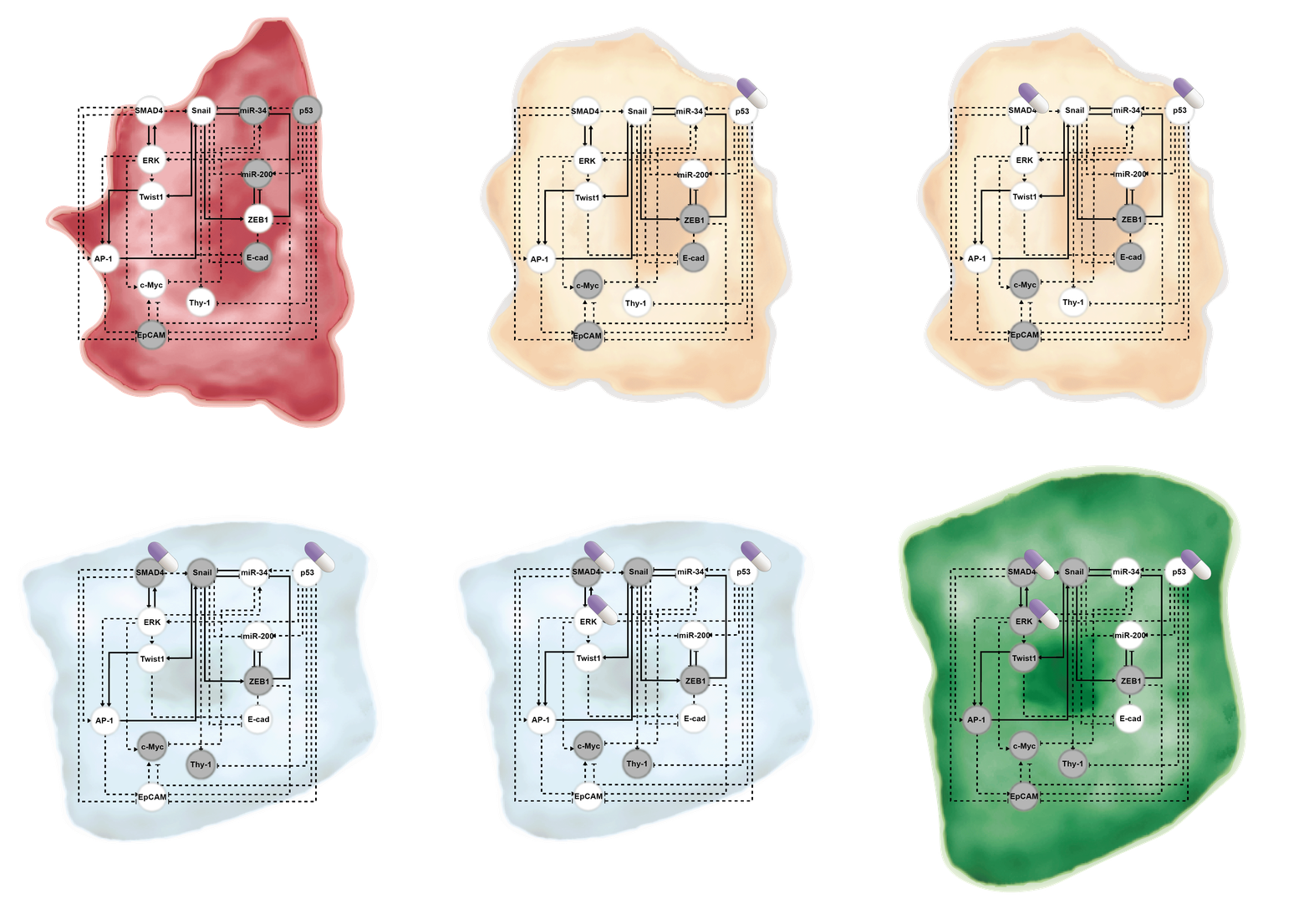 The network structure indicated inside the cell represents the core molecular regulatory pathways revealed through research. The red color above indicates a cell state capable of transitioning to mesenchymal cells. When the p53 node, represented by a pill icon, is activated alone, the state changes to an orange EMT hybrid cell. When both p53 and SMAD4 nodes are regulated together, the state changes to a blue EMT hybrid cell (the blue EMT hybrid cells resemble epithelial cells but still exhibit resistance to anticancer chemotherapy). Finally, when all the identified core molecular targets p53, SMAD4, and ERK are regulated, the cells transform into green epithelial cells that do not metastasize and respond well to anticancer chemotherapy. Image provided by KAIST.
The research team created a mathematical model of the molecular network of cells that can represent various cancer cell states appearing during the epithelial-mesenchymal transition (EMT) process, in which lung cancer cells change from epithelial cells (cells with polarity forming surface tissues without mobility) that lack metastatic ability to mesenchymal cells (cells without polarity possessing individual mobility) capable of metastasis. Through computer simulation analysis and molecular cell experiments, they identified key regulatory factors that convert the properties of cells from the mesenchymal state, which proliferates as malignant tumors invading adjacent tissues or cells and exhibits drug resistance, back to the epithelial state without metastasis.
In particular, during this process, they succeeded in fully reversing the cells to the epithelial state, which responds well to chemotherapy, while avoiding the unstable intermediate cancer cell state (EMT hybrid cell state) that had remained a challenge until now.
The research results were published in the international journal Cancer Research, issued by the American Association for Cancer Research (AACR) on the same day.
Cells in the EMT hybrid state, caused by incomplete transition during the EMT process of cancer cells, exhibit characteristics of both epithelial and mesenchymal cells, acquire high stem cell potential, and are known to have significant drug resistance and metastatic potential. The unstable cancer cell state (EMT) is very complex, and it has been extremely difficult to fully reverse cancer cells to the epithelial state, which lacks metastatic ability and drug resistance, while avoiding the EMT hybrid cell state that has high metastatic ability and drug resistance.
The research team established a mathematical model of the gene regulatory network governing the complex EMT, then applied large-scale computer simulation analysis and complex network control technology to identify three key molecular targets?‘p53’ (tumor suppressor protein), ‘SMAD4’ (a central molecule mediating representative signaling that regulates EMT, included in the SMAD protein group), and ‘ERK1/2’ (regulators involved in cell growth and differentiation)?that can reverse lung cancer cells in the mesenchymal state to the epithelial state lacking metastatic ability while avoiding the EMT hybrid cell state. They verified this through molecular cell experiments. Importantly, they demonstrated that under stimulated conditions similar to the environment within human cancer tissues, the mesenchymal state can be reversed to the epithelial state, highlighting the significance of their findings.
Abnormal EMT in cancer cells leads to various malignant traits such as cancer cell migration and invasion, altered responsiveness to chemotherapy, enhanced stem cell potential, and cancer metastasis. In particular, the acquisition of metastatic ability by cancer cells is a critical factor determining the prognosis of cancer patients. The newly developed EMT reversal technology for lung cancer cells is a novel anticancer treatment strategy that reprograms cancer cells to remove high plasticity and metastatic ability and enhances responsiveness to chemotherapy.
Professor Kwanghyun Cho said, "We succeeded in fully reversing lung cancer cells that had acquired high metastatic ability and drug resistance to an epithelial state lacking metastatic ability and sensitive to chemotherapy," adding, "We have presented a new treatment strategy that can improve the prognosis of cancer patients."
The research team previously proposed the reversible treatment principle that restores cancer cells to normal cells for the first time in January 2020 and published results showing the reversion of colon cancer cells to normal colon cells. In January last year, they succeeded in reprogramming the most malignant breast cancer cells into hormone therapy-responsive breast cancer cells. This research result is the third achievement in developing reversible technology that converts lung cancer cells with metastatic ability into cells lacking metastatic ability and with enhanced drug responsiveness.
© The Asia Business Daily(www.asiae.co.kr). All rights reserved.
![Clutching a Stolen Dior Bag, Saying "I Hate Being Poor but Real"... The Grotesque Con of a "Human Knockoff" [Slate]](https://cwcontent.asiae.co.kr/asiaresize/183/2026021902243444107_1771435474.jpg)
















