1.3 Million Ton Contaminated Water Tanks 1,066 Units... 30 Years of Discharge
Radioactive Substances Including Tritium... Concerns from Neighboring Countries
Environmental Groups "Government-Level Preemptive Measures Before Discharge"
[Asia Economy Reporter Yoon Seul-gi] Radioactively contaminated water from the Fukushima Daiichi Nuclear Power Plant is expected to be discharged into the ocean as early as this spring. The Japanese government maintains that it is safe "treated water" diluted to 1/40th, but opposition from neighboring countries and environmental groups continues as it is known that radioactive tritium is not removed even after treatment with the Advanced Liquid Processing System (ALPS).
Currently, the Japanese government states that most radioactive nuclides in the contaminated water scheduled for discharge have been removed by ALPS, and there is no safety issue. Discharge is expected to begin as early as this spring, with plans to reduce 62 radioactive nuclides, except for tritium and carbon-14, to undetectable levels through ALPS treatment and release the water via a 1 km underwater tunnel. The discharge will continue for about 30 years.
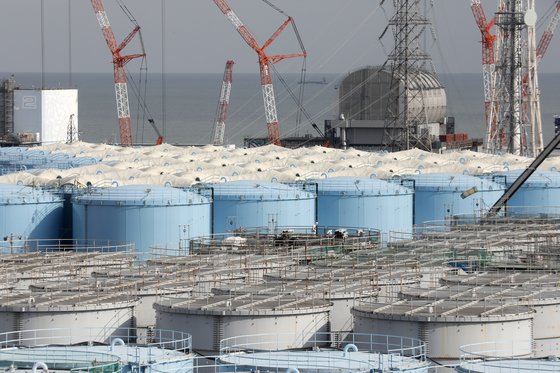
The Japanese government decided to discharge the contaminated water because there is no longer capacity to store it. Since the explosion accident at the Fukushima Daiichi Nuclear Power Plant caused by the Great East Japan Earthquake on March 11, 2011, it is estimated that about 130 to 150 tons of contaminated water, including groundwater and rainwater, are generated daily. Currently, Tokyo Electric Power Company (TEPCO) is storing 1.3 million tons of contaminated water purified by ALPS in 1,066 contaminated water tanks on the nuclear power plant site.
Neighboring countries such as South Korea and China are concerned that radioactive tritium will not be completely removed in the ocean discharge of contaminated water. Carbon-14, which is excluded from ALPS treatment, is also known to cause genetic mutations. Experts have pointed out that the radioactive nuclide data currently shared by TEPCO lacks scientific safety.
At a forum held on the 26th at the National Assembly by the Democratic Party’s Fukushima Contaminated Water Ocean Discharge Response Team, Professor Dalnoki Veress Pereng from the Middlebury Institute of International Studies in the U.S. pointed out that Japan tested only 9 of the 64 radioactive nuclides in the contaminated water and did not extract data samples during an excessively long gap period.
Professor Pereng said, "Only about a quarter of the contaminated water storage tanks were measured over 4 years and 3 months," adding, "There is no information on the combination of data samples from the storage tanks, and no information on high-level radioactive sludge (sediment) waste." Regarding ALPS, he criticized, "The lower limits for radioactive nuclides are set 3 to 4 times higher than usual," and "TEPCO has its own lower limits, making sample extraction biased, and measurements were not conducted for all tanks."
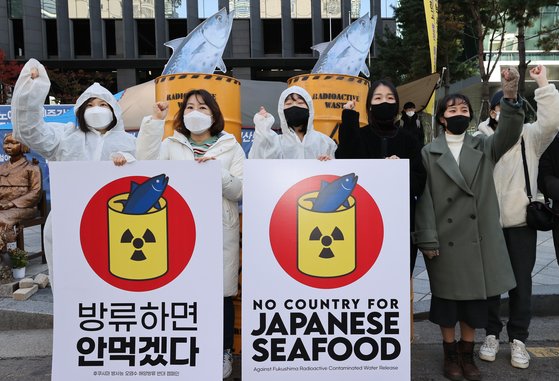 In 2020, members of civic groups such as the Citizen Radiation Monitoring Center and the Korean Federation for Environmental Movements held a campaign opposing the discharge of contaminated water into the ocean in front of the former Japanese Embassy in Jongno-gu, Seoul. Photo by Yonhap News
Environmental groups also oppose the discharge of contaminated water, stating that scientific safety has not yet been proven. They warn that fish exposed to radiation could adversely affect humans as well as the marine ecosystem.
Jean-Marie, a Greenpeace campaigner, appeared on KBS Radio’s Choi Kyung-young’s Strong Current on the 30th and said regarding the contaminated water discharge, "From the perspective of neighboring countries, this is the beginning of the problem," emphasizing, "In human history, contaminated water whose safety has not been proven has never been dumped."
He pointed out, "Radioactive substances do not become diluted just by mixing with water," and added, "When biologically concentrated until their half-life, they cause damage to marine life, ecosystems, and humans." He stressed, "Government-level preemptive measures are necessary before the ocean discharge of contaminated water."
Meanwhile, the government stated that it has demanded responsible responses from Japan regarding this matter. A Ministry of Foreign Affairs official said on the 27th, "Regarding international legal responses, we have been thoroughly reviewing Japan’s obligations under international law and dispute resolution procedures available under international law," adding, "We have continuously made efforts to understand related laws and facts while listening to various opinions, including those of reputable international law experts and scientists both domestically and internationally."
Regarding whether the government will discuss again with Japan the results of South Korea’s simulation of Fukushima contaminated water inflow, which is scheduled to be announced next month, the official said, "We continue to communicate with Japan and consistently convey our concerns."
© The Asia Business Daily(www.asiae.co.kr). All rights reserved.
![Clutching a Stolen Dior Bag, Saying "I Hate Being Poor but Real"... The Grotesque Con of a "Human Knockoff" [Slate]](https://cwcontent.asiae.co.kr/asiaresize/183/2026021902243444107_1771435474.jpg)

















