Transportation Costs Up 9.7% from Last Year
Seoul City Raises Bus and Subway Fares for the First Time in 7 Years and 6 Months
[Asia Economy Reporter Park Hyun-joo] Following this year's 'heating cost bomb,' public transportation fares nationwide, including buses, subways, and taxis, are also set to increase one after another. As public utility fees and public transportation fares closely related to citizens' lives rise, the perceived inflation rate for citizens is expected to continue soaring this year, following last year.
According to the Consumer Price Index statistics by expenditure purpose from the National Statistical Portal of Statistics Korea on the 30th, transportation costs rose 9.7% compared to the previous year. This is the highest increase in 24 years since 1998 (16.8%), when the effects of the foreign exchange crisis persisted.
Last year, international oil prices surged, causing the operation cost of personal transportation equipment (such as fuel prices) within transportation expenses to rise by 15.9%. This year, with consecutive increases in public transportation fares such as buses, subways, and taxis, the price index for transportation services (bus, subway, taxi, airline fares, etc.), which was only in the 2% range last year, is likely to soar.
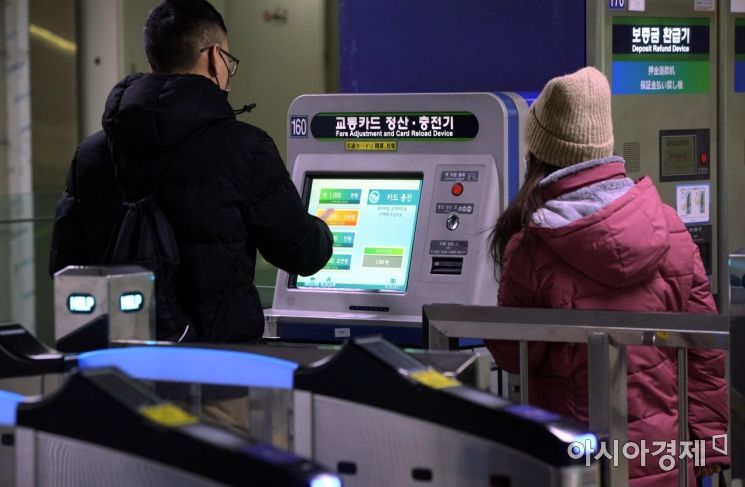 On the 29th of last month, foreign tourists are recharging their transportation cards at City Hall Station on Seoul Subway Line 1. Photo by Hyunmin Kim kimhyun81@
In fact, most of the 17 metropolitan cities and provinces nationwide have already decided or are seriously considering raising public transportation fares such as buses, subways, and taxis this year. In Seoul, it has already been confirmed that from 4 a.m. on the 1st of next month, the basic fare for medium-sized taxis will increase from 3,800 won to 4,800 won. The distance to which the basic fare applies will also change from 2 km to 1.6 km. The basic fares for deluxe and large taxis will also increase from 6,500 won to 7,000 won.
Additionally, Seoul City is pushing for a plan to raise bus and subway fares by 300 to 400 won for the first time in 7 years and 6 months. Currently, the general public transportation fares in Seoul are 1,200 won for city buses and 1,250 won for subways based on card payment.
If the increase is confirmed, subway fares will change from 1,250 won to 1,550 won based on card payment, and city bus fares will change from 1,200 won to 1,500 won. Cash fares will be 100 won more expensive than card fares, making subway fares 1,650 won and city bus fares 1,600 won. Seoul City plans to proceed with related procedures such as public hearings, city council opinion gathering, and price countermeasure committee reviews, aiming for a fare increase in April.
Other local governments are also in a mood to push for fare increases that have been suppressed so far. According to the National Urban Railway Operating Local Governments Council on the 27th, the total accumulated deficit of railway management institutions nationwide due to legally mandated free rides, continuous expansion of urban railway networks, and rapid demographic changes amounts to about 24 trillion won. Currently, several local governments including Busan, Gyeongnam, Daegu, and Ulsan are considering raising public transportation fares such as subways and buses.
© The Asia Business Daily(www.asiae.co.kr). All rights reserved.
![Clutching a Stolen Dior Bag, Saying "I Hate Being Poor but Real"... The Grotesque Con of a "Human Knockoff" [Slate]](https://cwcontent.asiae.co.kr/asiaresize/183/2026021902243444107_1771435474.jpg)
















