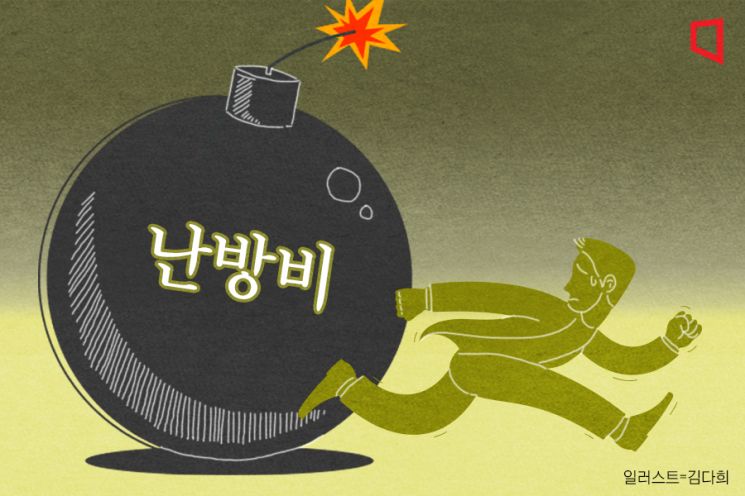
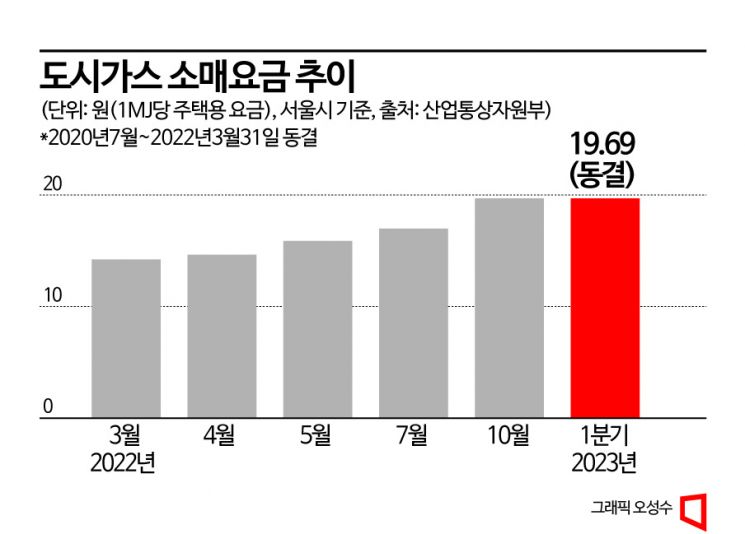
[Asia Economy Sejong=Reporter Dongwoo Lee] Voices are emerging that this winter's 'heating bill bomb' is a predicted crisis triggered by the long-suppressed issue of appropriate rate increases. Although liquefied natural gas (LNG) prices more than doubled due to the Russia-Ukraine war early last year, the previous Moon Jae-in administration froze gas rates for 21 months from July 2020 to April last year, which increased the perceived rate hike impact.
In fact, it is interpreted that the Moon administration hindered consumers' proper energy use as the gas rate decision process was influenced by politics, such as raising gas rates right after the presidential election in March last year.
Korea's Gas Rate Increase Rate Less Than Half of Major Countries
According to a summary of the energy industry and related ministries' situations on the 30th, the main cause of this heating bill crisis is that the residential gas rate increase of 5.47 won per megajoule (MJ) last year, combined with the cold wave, exceeded consumers' psychological expectations.
In 2021, international LNG prices, based on the Dutch TTF price, a European gas price indicator, rose from $6.1 per MMBtu (unit of heat) in March to $69.3 in September last year, an 11.4-fold increase. From March 2021 to April last year, the previous government had seven opportunities to adjust gas rates but kept them frozen.
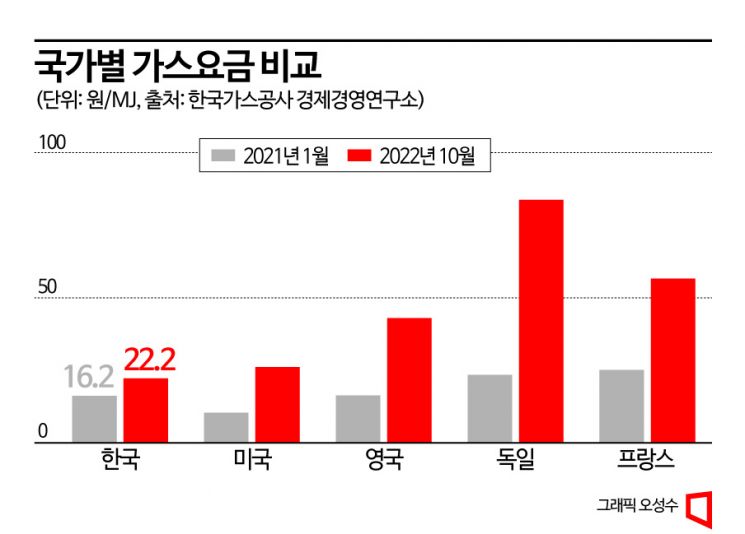
According to Korea Gas Corporation, Korea's gas rates increased by 37.0% from 16.2 won per MJ in January 2021 to 22.2 won in October last year. However, compared to major global countries like the U.S. (150.9%), the U.K. (163.8%), and Germany (257.6%), which raised gas rates by more than double on average during the same period, Korea's increase was considerably low.
The problem is that consumers did not feel the four gas rate hikes (April, May, July, October) since last April, but the cold wave this winter increased heating use, amplifying the shock of the rates. If gas rates had been raised gradually over the past two years, each household could have controlled the rate shock through demand adjustment.
Increased LNG Usage...Gas Corporation Deficit Grows
It is also analyzed that the increased LNG usage due to the previous government's nuclear phase-out policy ultimately increased the national burden. This is because nuclear power usage was reduced, and the use of renewable energy and LNG, which have higher generation costs, increased. The domestic import price of LNG reached a record high of about $1,470 per ton in early October last year. Compared to the same period in 2021, when LNG was priced at $570 per ton, this is about a 2.5-fold increase.
This directly increased the burden on Korea Gas Corporation, which supplies LNG to households. The unpaid bills of the gas corporation, which supplied gas at a loss, increased from about 200 billion won at the end of 2020 to 1.8 trillion won at the end of 2021, and further rose to about 9 trillion won by the end of last year. The government plans to resolve the gas corporation's unpaid bills by raising rates by 8.4 to 10.4 won per MJ this year and aims to clear the deficit by 2026, but even this is challenging.
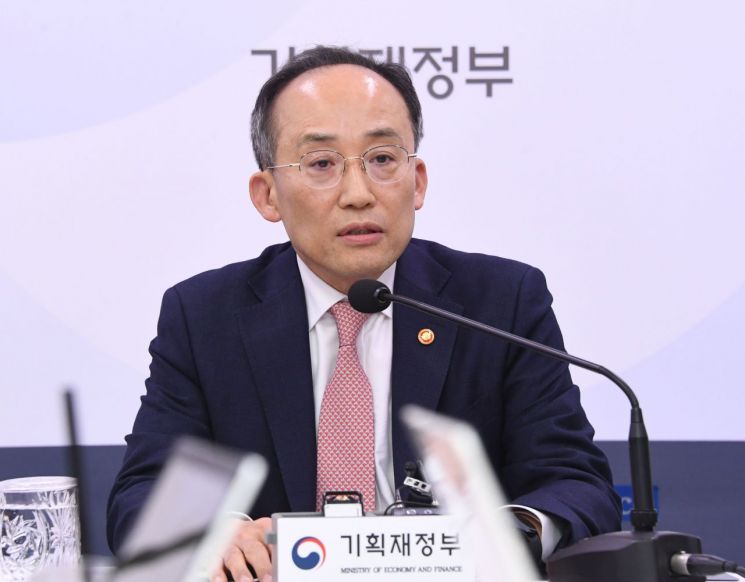
For now, the government was seriously considering a gas rate hike in the second quarter of this year but is stepping back due to the heating bill crisis. Deputy Prime Minister and Minister of Economy and Finance Choo Kyung-ho said right after the gas crisis, "Public enterprise deficits have accumulated, and this is clearly a factor for rate increases, but on the other hand, people are struggling greatly with heating costs. We will review appropriate rate adjustments at the right time and level."
Government Rejects Supplementary Budget, Political Pressure for Supplementary Budget Discussion
As the heating bill crisis expands, voices in the political sphere are growing louder to urgently allocate funds for heating support. This comes just one month after the main budget for this year was finalized.
Jo Kyung-tae, a presidential candidate from the People Power Party, said the day before, "The political circle and government should immediately prepare an 'emergency supplementary budget for heating support'." He argued that if 6.4 trillion won is allocated for emergency heating support for all citizens temporarily during winter, it would be possible to provide 100,000 won per month for three months to everyone. Lee Jae-myung, leader of the Democratic Party, also fueled the call for a 30 trillion won supplementary budget to support low-income households and stimulate consumption.
The reason is that the burden of heating cost increases affects vulnerable groups more. According to the Statistics Korea Household Trends Survey, as of the first quarter of last year, the fuel expenditure ratio for the bottom 20% income households was 11.8%, while it was only 2.0% for the top 20% income households.
However, the government draws a line on the supplementary budget. It insists that the supplementary budget ultimately burdens the public and must be approached cautiously. Deputy Prime Minister Choo emphasized, "It was just the other day that a 640 trillion won budget was passed, and we have just started executing it, so making a supplementary budget now does not even fit the 'ABC' of fiscal management." Instead, the government plans to temporarily double the support amount for 1,176,000 vulnerable households this winter from 152,000 won to 304,000 won.
© The Asia Business Daily(www.asiae.co.kr). All rights reserved.



















