Many Still Wearing Masks
Because They Are Not 'Completely Voluntary'
[Asia Economy Reporter Byun Seon-jin] Around 7:45 a.m. on the 30th, among the 50 to 60 people waiting for the Seoul Subway Line 2 at Sillim Station, there were hardly any citizens without masks. Office worker Yoon (37) said, “Since you have to wear a mask as soon as you board the subway anyway, and everyone else is wearing one, I just wore it because I thought I would stand out if I didn’t.” Indian international student Shaam (29) waited for the subway at Sillim Station for about 10 seconds without a mask, looked around, then took a mask out of his bag and put it on. Shaam said, “They said from today (the 30th) that we don’t have to wear masks, but it doesn’t seem much different from before.”
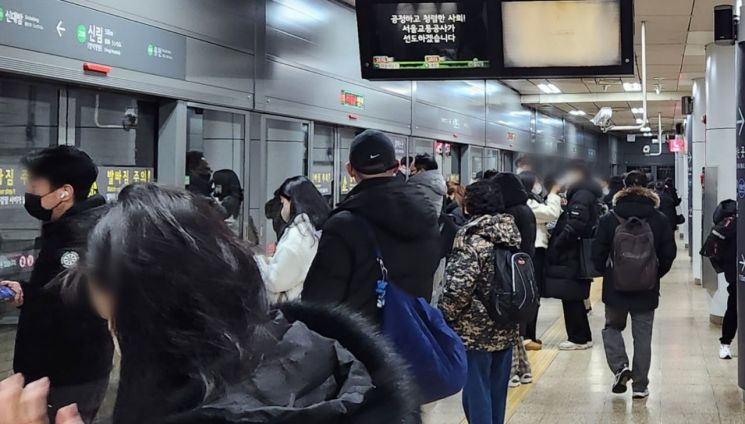 Around 7:45 a.m. on the 30th, among the 50 to 60 people waiting for the subway at Sillim Station on Seoul Subway Line 2, almost no citizens were seen without masks. Photo by Byeon Seon-jin sj@
Even though the indoor mask mandate was lifted after 2 years and 3 months, many people still do not intend to take off their masks immediately. From this day forward, mask-wearing is left to individual discretion in most facilities, but since people have lived with masks as if they were part of their bodies for three years, many still choose to wear them. Additionally, masks are still required in some places such as public transportation and hospitals, and some places set separate mask-wearing rules even though they are not mandatory facilities.
First, in public transportation modes closely connected to citizens’ daily lives?such as subways, buses, taxis, airplanes, and passenger ships?masks must be worn, so many say they do not feel that the indoor mask recommendation has truly taken effect. While masks are not required in waiting areas such as escalators and elevators leading to public transportation, the mask-wearing obligation applies the moment one boards, meaning people effectively have to wear masks while riding. The obligation means that if caught not wearing a mask, a fine of 100,000 KRW will be imposed as before.
The mask mandate remains in infection-vulnerable facilities requiring protection of high-risk groups (such as nursing hospitals, long-term care institutions, mental health promotion facilities, and welfare facilities for the disabled) and medical institutions (hospitals, clinics, pharmacies). In infection-vulnerable facilities, residents and caregivers in private spaces with bedrooms may remove masks. Masks must be worn in medical institutions, and the mandate also applies to hospitals and clinics located inside companies, department stores, and marts. Even in places without a mask mandate such as cafes, restaurants, convenience stores, and gyms, if they are located within infection-vulnerable facilities or medical institutions, the mask mandate applies.
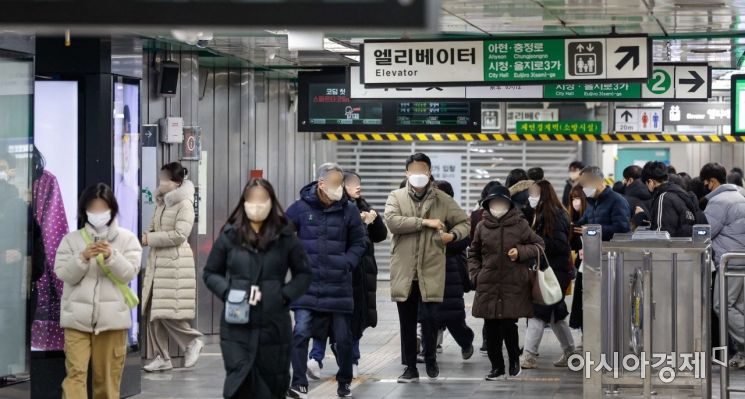 Except for some facilities, indoor mask-wearing shifted from mandatory to recommended on the 30th. Citizens are seen wearing masks while moving at Sinchon Station on Subway Line 2 in Seodaemun-gu, Seoul. Photo by Jinhyung Kang aymsdream@
Although companies, academies, gyms, and concert halls are not indoor mask-mandated facilities, if they are ‘3C (Closed spaces, Crowded places, Close-contact settings)’ environments, they can establish separate quarantine rules. Local governments may also independently set guidelines to make mask-wearing mandatory. The health authorities view the shift from mandatory to recommended indoor mask-wearing as meaning that fines will not be imposed in facilities where the mandate no longer applies. Basic quarantine rules such as wearing masks and handwashing to prevent COVID-19 infection remain valid.
When the indoor mask mandate is lifted to ‘complete voluntary’ including exception facilities, the number of people not wearing masks is expected to increase. For this to happen, the COVID-19 crisis level, which has been maintained as ‘Severe’ since February 2020, must be downgraded to ‘Alert’ or ‘Caution,’ or the legal infectious disease classification of COVID-19, currently level 2, must be lowered to level 4. The World Health Organization’s (WHO) announcement on whether to lift the COVID-19 Public Health Emergency of International Concern (PHEIC), scheduled for this day, will be a turning point for complete voluntary mask-wearing.
© The Asia Business Daily(www.asiae.co.kr). All rights reserved.













