Goal to Train 150,000 Semiconductor Innovation Talents Over 10 Years
[Asia Economy Reporter Sunmi Park] The government is injecting funds into the semiconductor specialized graduate school support project. Starting this year, it will provide 9 billion KRW annually and 15 billion KRW over five years to three universities to cultivate advanced semiconductor professionals. The supported semiconductor specialized graduate schools aim to train about 5,000 master's and doctoral students and will begin educating new students from the second semester of this year.
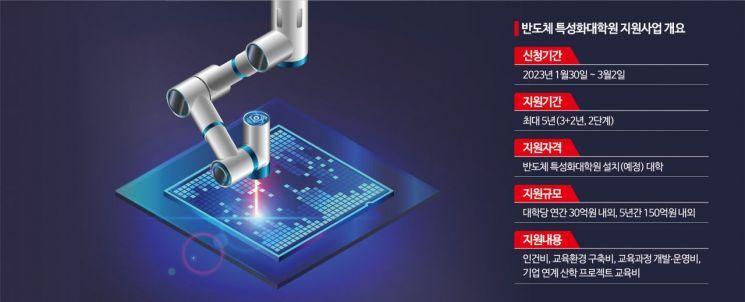
On the 30th, the Ministry of Trade, Industry and Energy announced an integrated notice regarding the designation and support application for specialized graduate schools to nurture master's and doctoral talents in the semiconductor industry. The application period is from today until March 2. This marks the first step in the designation and support of specialized graduate schools under Article 37 of the “Special Measures for Strengthening and Protecting National Advanced Strategic Industry Competitiveness Act (National Advanced Strategic Industry Act),” also known as the Semiconductor Special Act. It is a follow-up measure to the “National Advanced Strategic Industry Specialized Graduate School Promotion Plan” approved by the National Advanced Strategic Industry Committee in November last year.
The Ministry of Trade, Industry and Energy will accept applications from universities that have established (or plan to establish) semiconductor specialized graduate schools meeting conditions such as operating master's and doctoral degree programs, securing full-time faculty and admission quotas, and building educational environments. Three universities will be selected through evaluation. Selected institutions will receive support for personnel expenses (including student personnel costs), educational environment construction costs (education and research equipment, etc.), curriculum development and operation costs, and industry-academia project education costs linked with companies. The support scale is about 3 billion KRW per university annually, up to 15 billion KRW over five years.
The semiconductor specialized graduate schools will accept new students and start education from the second semester of this year to train about 5,000 master's and doctoral talents. The curriculum will actively utilize industry experts as faculty and focus on industry demand-based research and development (R&D) projects. Post-management such as recruitment matching and employment consulting for graduates will also be promoted.
Last year, Korea's semiconductor exports reached a record high of 129.23 billion USD. Semiconductors have become a core future industry and a national security asset. However, the workforce is severely lacking. The Korea Semiconductor Industry Association estimates that the current number of semiconductor industry workers in Korea is only 176,509, and an additional 127,000 will be needed over the next 10 years. To increase semiconductor personnel to over 300,000, it is essential to cultivate professional personnel with bachelor's, master's, and doctoral degrees demanded by the industry. The government's move to support the semiconductor specialized graduate school project reflects the industry's voice that additional growth is difficult due to the shortage of core semiconductor talents.
In July last year, the government announced a plan to nurture more than 150,000 semiconductor innovation talents by 2031 in the “Semiconductor Talent Cultivation Plan.” This includes designating universities with excellent semiconductor education capabilities as semiconductor specialized graduate schools and applying bold financial support and regulatory exemptions regarding faculty qualifications, course duration, and teaching methods. Additionally, when establishing or expanding semiconductor-related departments, if the faculty securing rate is met, the enrollment quota can be increased, and a “contract quota system” allowing temporary enrollment increases in existing departments without establishing separate departments will be introduced starting this year.
Meanwhile, the Ministry of Trade, Industry and Energy plans to closely analyze the supply and demand status and prospects of master's and doctoral personnel in not only semiconductors but also secondary batteries and displays, which are designated as national advanced strategic technology fields, together with related industries and experts, and will promote pilot designation of one to two specialized graduate schools next year. Furthermore, a large-scale support project to continuously expand specialized graduate schools in national advanced strategic technology fields will be planned. The goal is to designate about 20 universities over four years from 2023 to 2026.
© The Asia Business Daily(www.asiae.co.kr). All rights reserved.