[Why Have School Uniforms Become Outcasts?]
'Free Uniforms' That Are Free Yet Not Free
School-Managed Purchases and Lowest Price Bidding
Both Parents and School Uniform Industry Dissatisfied
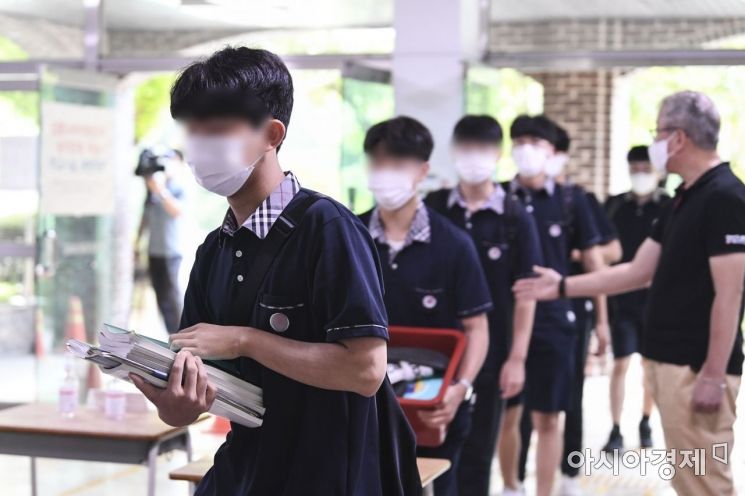
[Asia Economy Reporter Kim Bo-kyung] School uniforms are often neglected. When searching for 'school uniform' on internet portal sites, countless controversies such as parents' complaints, collusion among suppliers, and delays in uniform delivery repeat every year.
The government is implementing a free school uniform system to reduce the burden of education expenses, but because the education offices and local governments share the budget, the support fund of 300,000 won has been frozen for years. Parents complain because they have to pay out of pocket when buying extra uniforms or when their children grow and need new ones. Uniform suppliers unanimously say they are on the brink of collapse due to the price ceiling set by education offices and the lowest-price bidding system. Regarding the school uniform issue, the Ministry of Education passes responsibility to city and provincial education offices, and the education offices pass it on to each school, so the recurring problems every year remain unresolved. How did the free school uniform policy become one that satisfies no one?
"I am a parent of a freshman at Uijeongbu Technical High School. How does the education office select uniform suppliers? Do they take bribes? Do they spin a roulette? Uniforms are not cheap, so are they trying to profit by providing only one set and making extra charges? If you don’t respond properly, I will conduct a survey among middle and high school parents and file a national petition."
"Why are we forced to buy uniforms from only one place? Shouldn't consumers be able to choose from multiple stores? My child was happy to be assigned to middle school, but the exclusive uniform store caused sadness and frustration, which makes me very angry."
"Every time I visit the store, I wonder why uniforms have to be so expensive. The exclusive seller charges over 50,000 won for tops and over 70,000 won for bottoms."
These posts were uploaded on the Gyeonggi Provincial Office of Education’s website free bulletin board. They are filled with parents’ complaints about school uniforms. The main complaints from parents are that they must purchase uniforms from designated suppliers and that the uniforms feel expensive.
"Do schools receive kickbacks from uniform suppliers?"
Schools neither receive kickbacks from uniform suppliers nor spin a roulette. Jeong Hyun-jeung, secretary-general of the Parents Loving Schools Association (Haksa-mo) and chair of the uniform investigation committee, said, "The selection of uniform suppliers is conducted transparently and fairly," adding, "There has never been any corruption between schools and suppliers."
The reason parents face restrictions in choosing uniform suppliers is due to the 'School-led Uniform Purchase System.' Each school signs a contract with a uniform supplier once a year to purchase winter and summer uniforms. Schools post bidding announcements on the government-operated procurement platform, Nara Market, and only the selected suppliers can deliver uniforms to the respective schools. This system, implemented since 2015, operates in over 5,100 middle and high schools nationwide. Therefore, freshmen must buy uniforms at the designated supplier’s store.
The school-led uniform purchase system dates back to 2013. During the Park Geun-hye administration, the Ministry of Education announced the 'Uniform Price Stabilization Plan' under the pretext of stabilizing prices for low-income families and reducing education expenses. The Ministry instructed the 17 city and provincial education offices nationwide to set price ceilings for uniforms reflecting consumer price inflation rates. Every February or March, officials from the education offices gather to decide the next year’s uniform price ceiling. Subsequently, all middle and high schools conduct electronic bidding to purchase uniforms below the ceiling price.
Lee Sang-don, director of the Education Welfare Policy Division at the Ministry of Education, stated, "The Ministry participates in discussions on the uniform price ceiling but does not intervene in the decisions made by education offices." He explained that the Ministry does not heavily influence the ceiling price decisions, leaving it to each city and provincial education office to judge according to local conditions. Furthermore, the Ministry leaves the decision to adopt the school-led uniform purchase system to the discretion of each school principal.
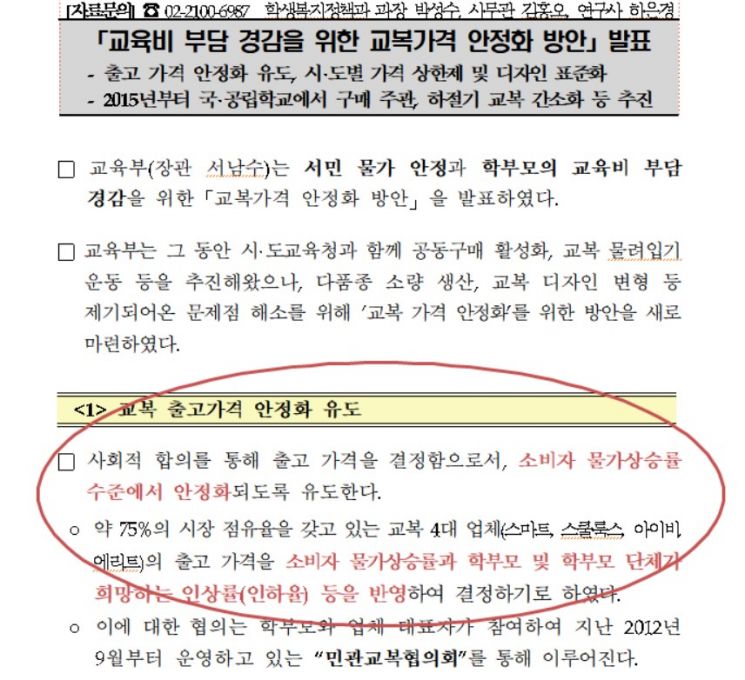 The Ministry of Education's uniform price stabilization plan announced in 2013. The uniform wholesale price was decided to be determined by reflecting the consumer price inflation rate and the desired increase rate of parents.
If the price ceiling is set, why does the controversy over expensive uniforms continue?
To hear explanations about the controversy over high-priced uniforms, we met Park Chang-hee, secretary-general of the Korea Student Uniform Industry Association, representing the domestic uniform industry. Park began by saying, "The term 'free school uniform' is incorrect. It should be called uniform support."
The free school uniform policy started as a flagship project by then-Seongnam Mayor Lee Jae-myung in 2016 and is now implemented nationwide.
"The uniform support fund is 300,000 won per student. This covers four pieces of winter uniform and two pieces of summer uniform. Parents must pay for extra shirts or blouses themselves."
Although it is called free school uniform, if the purchase cost exceeds 300,000 won, parents must pay the difference, causing dissatisfaction. Also, children may need new uniforms as they grow during their school years. Suppliers do not unfairly inflate prices for extra uniforms. Park said, "Strictly speaking, it is not 'free'." He added, "Both ruling and opposition parties chant free school uniforms during mayoral and superintendent elections, but the system has not been properly established."
Until this year, the uniform support fund nationwide has mostly been frozen at 300,000 won per student for three years. (Ulsan and Gwangju provide 250,000 won, and Gangwon Province 312,000 won.) Since the budget for uniform support is shared between education offices and metropolitan or local governments, it is practically difficult to increase the support fund. For example, Ulsan’s uniform support budget is divided as 60% by the education office, 30% by the city, and 10% by the county or district. In Gyeonggi Province, the education office covers 50%, the province 25%, and cities/counties 25%, with varying ratios by region.
Parents are angry, the industry is on the brink... What is the problem?
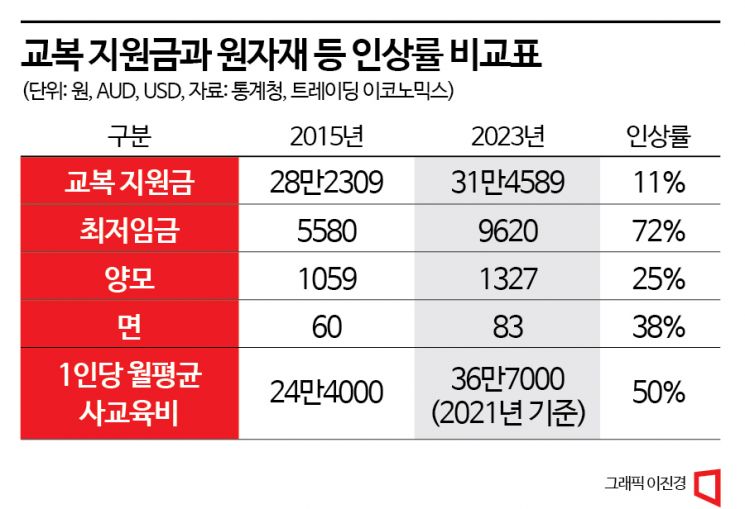
The industry demands a realistic price ceiling and an increase in support funds. Last year, the average uniform price ceiling set by city and provincial education offices for this year was 314,589 won. Compared to 2015, when the school-led uniform purchase system began, it has risen 11% over eight years. Since the ceiling was originally set considering only consumer price inflation, it has increased by only about 1-2% annually, without accounting for rising raw material costs and labor expenses. Meanwhile, the minimum wage has increased by a whopping 72%, and prices of major imported raw materials used in making uniforms have surged. Compared to January 2015, as of January this year, wool rose 25%, and cotton 38%. During this period, the average monthly private education expenses per person in Korea increased by 50%.
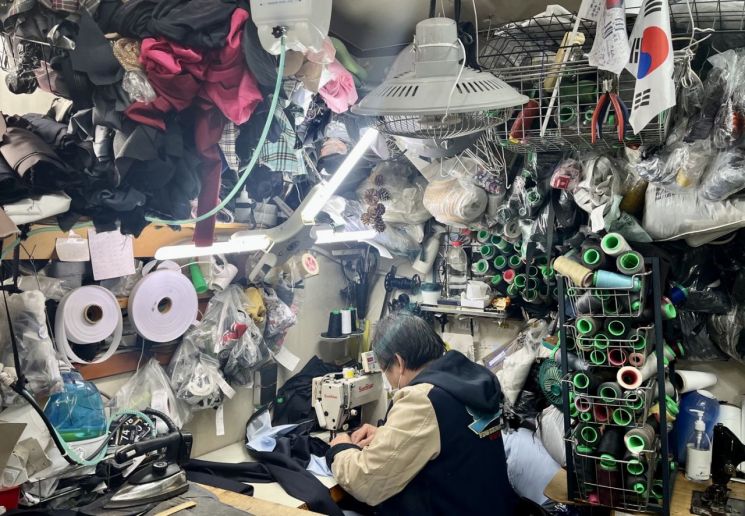
With the uniform support fund not rising and the price ceiling set by education offices, uniform suppliers complain they are suffering a double burden. The days when the so-called four major uniform brands?Elite, Smart, Ivy Club, and School Looks?were famous for using popular advertising models are long gone. Now, small business owners running brand dealerships and general small-scale operators all say they are on the brink of collapse.
Uniform suppliers say they have no choice but to engage in 'self-destructive' competition. This is because the supplier offering the lowest price is selected if the uniform quality has no defects. To verify this claim, we visited the Nara Market website operated by the Public Procurement Service. Typing 'school uniform' in the search bar brought up a string of bidding announcements posted by various middle and high schools. We looked into the Busan area, where competition is overheated. In October last year, School Looks Student Uniform won the bid for Centum High School in Busan at 175,000 won. Elite, which offered 191,000 won, and Smart Haeundae, which offered 198,000 won, lost. These suppliers compete fiercely on price to not miss the once-a-year bidding opportunity.
Gu Young-hwan, who has operated an Oxford Student Uniform store in Suwon for 33 years, claimed, "The government and politicians are sacrificing powerless uniform suppliers under the pretext of reducing education expenses." He predicted, "Under the current structure, where it is difficult even to pay rent and staff salaries, the uniform industry will struggle to survive." Most business owners running uniform suppliers are in their 60s and 70s, and since they are no longer at an age to change careers, they barely maintain their businesses. He worried, "In ten years, half of the technicians designing and manufacturing uniforms will disappear, and we will rely on overseas production. We might have to dress our children in uniforms labeled 'Made in China.'"
© The Asia Business Daily(www.asiae.co.kr). All rights reserved.
![Clutching a Stolen Dior Bag, Saying "I Hate Being Poor but Real"... The Grotesque Con of a "Human Knockoff" [Slate]](https://cwcontent.asiae.co.kr/asiaresize/183/2026021902243444107_1771435474.jpg)


















