[Asia Economy New York=Special Correspondent Joselgina] Michael Minihan, a four-star general in the U.S. Air Force, warned that the United States and China could go to war in two years over the Taiwan issue, sparking heated controversy in the political arena. While a key Republican figure immediately expressed agreement, a key Democrat rebutted, saying "it is unlikely to happen."
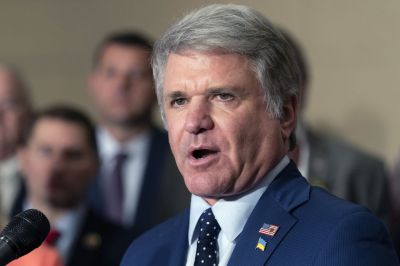
Michael McCaul, chairman of the House Foreign Affairs Committee from the Republican Party (Texas), appeared on Fox News Sunday on the 29th (local time) and expressed agreement with General Minihan's remarks, saying, "I hope he is wrong, but unfortunately, I think he is right." Earlier, General Minihan of the U.S. Air Mobility Command stated in a memo to troops that he had a "gut feeling that (the U.S. and China) will fight in 2025," and emphasized the need to prepare for a potential conflict between the U.S. and China due to China's invasion of Taiwan.
In response, Chairman McCaul agreed that China's influence on the 2024 Taiwan presidential election could make Taiwan's reunification with mainland China a reality. He said, "In my judgment, if they (China) do not win the election, we will see a military invasion," adding, "We must be prepared for this (military invasion)." He assessed that the likelihood of military conflict between China and Taiwan in the Indo-Pacific region is high.
Speculation about a Chinese invasion of Taiwan has been ongoing. However, following the warning from an active-duty four-star U.S. general and the remarks from the House Foreign Affairs Committee chairman, the gravity of the situation is considered different from before. In particular, he claimed that "if President Joe Biden shows weakness, the likelihood of this happening is very high," and also argued that the Biden administration's chaotic withdrawal from Afghanistan had repercussions on Russia's invasion of Ukraine.
However, immediately after, Representative Adam Smith (Washington), the Democratic ranking member of the House Armed Services Committee, appeared on the same broadcast and directly refuted these remarks. While acknowledging that anything can happen and the military must be prepared, Smith stated that "(war with China) is not inevitable, and it is highly unlikely."
He also criticized General Minihan, the originator of the remarks, saying, "Military generals must be very cautious about what they say." He pointed out the need to recognize the weight carried by statements from an active-duty four-star general. He added, "The U.S. will not go to war with China, so we should not tell the world that the U.S. will go to war with China." The U.S. Department of Defense also drew a line, stating that General Minihan's remarks are his personal views and not the official position of the Department of Defense regarding China.
There are growing views that remarks related to Taiwan, which the Chinese leadership under Xi Jinping considers most sensitive, could become a trigger for further escalation of U.S.-China tensions. Some argue that the statements about the possibility of a U.S.-China war may have been made to gain a favorable position in negotiations ahead of U.S. Secretary of State Tony Blinken's planned visit to China next month.
Already, there have been intense reactions within China. The Global Times, a state-run media outlet affiliated with the People's Daily representing the Chinese authorities, criticized General Minihan's remarks as "provocative and reckless" and said they "will deepen strategic distrust and harm bilateral relations" as soon as the remarks became known.
© The Asia Business Daily(www.asiae.co.kr). All rights reserved.
![Clutching a Stolen Dior Bag, Saying "I Hate Being Poor but Real"... The Grotesque Con of a "Human Knockoff" [Slate]](https://cwcontent.asiae.co.kr/asiaresize/183/2026021902243444107_1771435474.jpg)
















