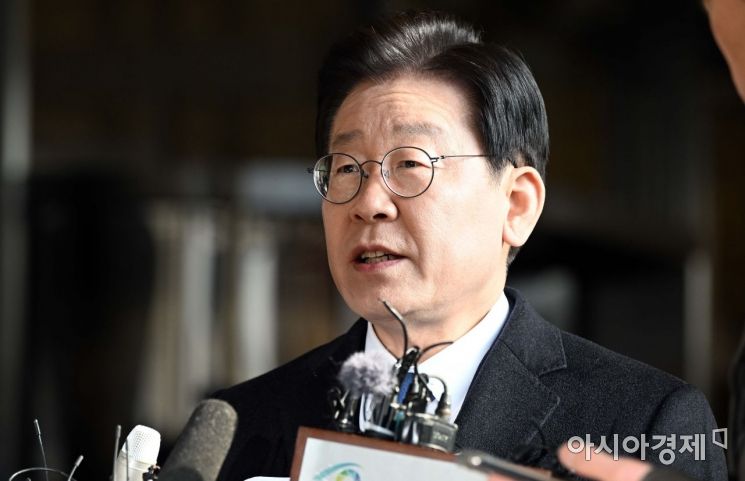
 Lee Jae-myung, leader of the Democratic Party of Korea, is speaking as he appears at the Seoul Central District Prosecutors' Office in Seocho-gu, Seoul on the 28th to undergo prosecution investigation related to the Daejang-dong development preferential treatment allegations. Lee is accused of leaking internal secrets of Seongnam City or Seongnam Urban Development Corporation to private developers as the final decision-maker of the Wirye and Daejang-dong development projects during his tenure as mayor of Seongnam, enabling them to gain enormous profits. Photo by Kim Hyun-min kimhyun81@
[Asia Economy Reporter Kim Hyung-min] At 10:30 a.m. on the 28th, Lee Jae-myung, leader of the Democratic Party of Korea, appeared at the Seoul Central District Prosecutors' Office for questioning. Until then, the prosecution and Lee’s side had been in constant conflict over the summons date and the number of interrogations. Even the day before the summons, the exact date and number of interrogations were not clearly communicated. This is considered unusual. Even when former presidents like Lee Myung-bak and Park Geun-hye, as well as other high-profile figures, were summoned for investigation, such incidents did not occur. The prosecution usually coordinated or communicated appropriately to match the notified date. In contrast, Lee appeared for questioning an hour later than the prosecution’s requested time of 9:30 a.m. on the 28th. The second round has already begun. The prosecution requested Lee to appear once more for questioning, but Lee seems unlikely to comply, alleging that the prosecution deliberately delayed the first interrogation.
According to multiple legal insiders, this is a "clash of positions." The prosecution and Lee’s side have distinctly different claims and perspectives regarding the investigation into the Wirye and Daejang-dong development corruption cases. Therefore, both sides want the summons to proceed in a way favorable to themselves. This is where the intense conflict between the two parties lies.
Prosecution: "Routine Local Corruption Investigation... Interrogation as Usual"
Regarding the 'Wirye and Daejang-dong development corruption' case, suspected to have been led by Lee, Minister of Justice Han Dong-hoon and the prosecution have repeatedly described it as "a typical corruption case where local vested interests and private developers profited." They have also expressed that Lee is viewed merely as a suspect in a corruption case, neither more nor less.
This stance was evident during Lee’s summons on the 28th. From the notification of the summons schedule, the Seoul Central District Prosecutors' Office initially told Lee to appear on the 27th and 30th. This followed the usual practice of summoning suspects on weekdays. Investigations on Saturdays or Sundays are considered a favor to accommodate the suspect’s livelihood. Lee rejected this notification, responding, "I will come on the 28th. I am busy with party leader duties on weekdays."
On the day Lee appeared, the Seoul Central District Prosecutors' Office reportedly skipped the customary tea time with senior prosecutors, which is usually offered as a courtesy when a prominent figure is summoned. The interrogation was not conducted by the deputy chief or chief prosecutors. In the morning, Deputy Chief Prosecutor Jeong Il-kwon (Anti-Corruption Investigation Division 1) questioned the Wirye New Town case, and in the afternoon, Deputy Chief Prosecutor Nam Dae-joo (Anti-Corruption Investigation Division 3) interrogated the Daejang-dong case. This contrasts with the Suwon District Prosecutors' Office Seongnam Branch, which offered tea time and had a chief prosecutor conduct the questioning during the 'Seongnam FC sponsorship' case summons on the 10th. The interrogation lasted 12 and a half hours.
There is cautious speculation that the prosecution may file a detention warrant for Lee. Even if the National Assembly rejects the arrest consent motion, it is widely believed that the prosecution will proceed with the application. If the prosecution views Lee not as the leader of the main opposition party but simply as a suspect in a corruption case, filing a detention warrant is a standard procedure given the scale of embezzlement and the nature of the charges.
Lee: "Political Oppression Against the Main Opposition Leader... Investigation Is Different"
On the other hand, Lee claims the prosecution’s investigation is "political oppression against the leader of the main opposition party" and is responding accordingly. He argues that the Wirye and Daejang-dong development projects are legally sound public interest projects and that he is being investigated because he is the leader of the main opposition party. Therefore, he contends that the prosecution’s investigation of him is inherently special. In a 33-page statement submitted to the Seoul Central District Prosecutors' Office, he asserted that the Wirye and Daejang-dong development projects are without issue and sharply criticized the prosecution, saying, "The prosecution should conduct investigations, not politics." After the interrogation, he emphasized that "the prosecution deliberately delayed the investigation by repeatedly showing documents," and "the prosecution is aiming to indict me," highlighting that the investigation is focused on the individual rather than the case.
His refusal to accept the summons schedule can also be interpreted in this context. The prosecution requested that he appear twice on weekdays, but Lee’s side rejected this and demanded a single interrogation during the weekend, leading to the summons on the 28th. As the leader of the opposition party and a member of the National Assembly, his duties are heavy, making it difficult to attend interrogations on weekdays or even twice. This demand is seen as politically motivated. It is unusual to refuse the prosecution’s notified dates for this reason, and Lee’s side is aware of this. A prosecution official said that Lee did not provide any specific reason for requesting the 10:30 a.m. interrogation on the 28th. Considering this context and circumstances, it is currently highly likely that Lee will refuse the prosecution’s request for a second interrogation. Even if summoned, he may again request a weekend rather than a weekday.
Following the Seongnam FC case, Lee also published the full statement on his social media account after the Wirye and Daejang-dong investigations. This is interpreted as a strategy to instill in the public the perception that the prosecution’s investigation of him is different from the norm. Analysts suggest this is a move to send a message that the prosecution is fabricating charges against him and to preemptively respond to various media reports originating from the prosecution.
© The Asia Business Daily(www.asiae.co.kr). All rights reserved.
![A Woman Who Jumps Holding a Stolen Dior Bag... The Mind-Shaking, Bizarre Con of a "Human Knockoff" [Slate]](https://cwcontent.asiae.co.kr/asiaresize/183/2026021902243444107_1771435474.jpg)

















