'NATO-style Nuclear Sharing' Claims
"'No Plan to Acquire Nuclear Weapons' Is Yoon Administration's Message"
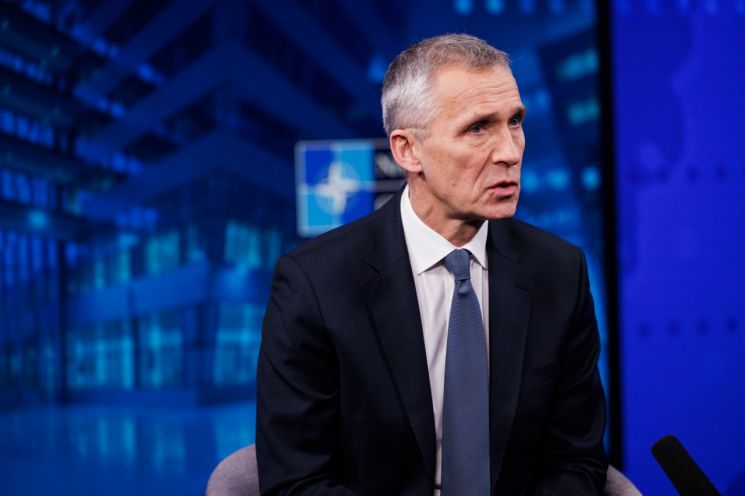 Jens Stoltenberg, Secretary General of the North Atlantic Treaty Organization (NATO), is giving an interview to Yonhap News Agency at NATO headquarters in Brussels, Belgium, on the 27th (local time), one day before departing for Korea.
[Asia Economy Reporter Kim Daehyun] Jens Stoltenberg, Secretary General of the North Atlantic Treaty Organization (NATO), who is visiting Korea for the first time in six years, recently emphasized regarding some claims about a 'NATO-style nuclear sharing' plan amid the North Korean nuclear crisis that "the Yoon Seok-yeol administration's clear message was that there are no plans to acquire its own nuclear weapons."
On the 27th (local time), the day before departing for Korea, Stoltenberg gave an interview to Yonhap News at the NATO headquarters media center in Brussels, Belgium, stating, "Extended deterrence by the United States has been functioning for years, and this is a way to guarantee deterrence without additional nuclear proliferation." The implication is that 'extended deterrence' is the way to resolve the North Korean nuclear issue.
He said, "This issue is for South Korea and the United States to decide, but nuclear non-proliferation remains one of NATO allies' important goals," adding, "Our practical goal is a world without nuclear weapons, but as long as nuclear weapons exist, NATO will be maintained as a nuclear alliance. It would be more dangerous if NATO allies did not exist while China, Russia, and North Korea possess nuclear weapons."
Regarding Russia's invasion of Ukraine, he diagnosed, "In this war, the Russian private military company Wagner Group, which plays a significant role, received ammunition and missiles from North Korea," and added, "North Korea is not only a threat to the Indo-Pacific region but also a threat to global security."
As for areas to strengthen cooperation with Korea, he cited cyber threats, arms control, and technology sectors. Stoltenberg explained, "In terms of arms control, NATO allies share concerns about South Korea's worries over North Korea's reckless missile and nuclear programs and tests, so this is particularly relevant."
He evaluated President Yoon Seok-yeol's attendance at the NATO summit held in Madrid, Spain, last year as the first Korean president to attend, calling it a 'historic event.'
Furthermore, he said, "I am very much looking forward to welcoming President Yoon at the NATO summit this July" and added, "Although our countries are different and geographically distant, we have a very close relationship when it comes to 'values,' and this is also true in facing democratic freedoms as well as common threats and challenges."
Meanwhile, Stoltenberg stated that he plans to strengthen cooperation with Korea to respond to global threats, including China. He said, "Security issues are increasingly interconnected," and "What happens in the Indo-Pacific is important to Europe and NATO, and vice versa." He further elaborated, "I firmly believe that cooperation between Korea and NATO must be strengthened, and this is the most important message of this visit."
He also analyzed, "China is investing heavily in new modern military capabilities," adding, "It is rapidly and significantly expanding long-range missiles capable of reaching the territory of all NATO member countries, as well as its nuclear capabilities." Additionally, "NATO remains and will remain an alliance within North America and Europe, but we need to address these global threats and challenges, including the challenges posed by China."
He further noted, "Authoritarian leaders worldwide, including China, are closely watching the Ukraine war," and "If Putin wins this invasion war, it sends a message to Putin and other authoritarian leaders that they can achieve their goals by using brutal force and violating international law." He also mentioned, "Taiwan is certainly one example."
Stoltenberg, who took office in 2014, is likely to lead NATO until September due to a one-year extension of his term last year amid the impact of the Ukraine war. His visit to Korea is the first in six years since the Moon Jae-in administration in 2017 and the third visit by a NATO Secretary General in history.
© The Asia Business Daily(www.asiae.co.kr). All rights reserved.
![Clutching a Stolen Dior Bag, Saying "I Hate Being Poor but Real"... The Grotesque Con of a "Human Knockoff" [Slate]](https://cwcontent.asiae.co.kr/asiaresize/183/2026021902243444107_1771435474.jpg)
















