[Asia Economy Reporter Kim Daehyun] A company was imposed value-added tax for allegedly conducting false transactions related to recruiting 'ttaigong (Chinese proxy buyers)' services to evade taxes, and although it filed an appeal lawsuit, the court did not accept it.
According to the legal community on the 30th, the Seoul Administrative Court Administrative Division 2 (Presiding Judge Shin Myunghee) recently ruled against the plaintiff, Company A, in the first trial of the value-added tax imposition cancellation lawsuit filed against the Namdaemun Tax Office.
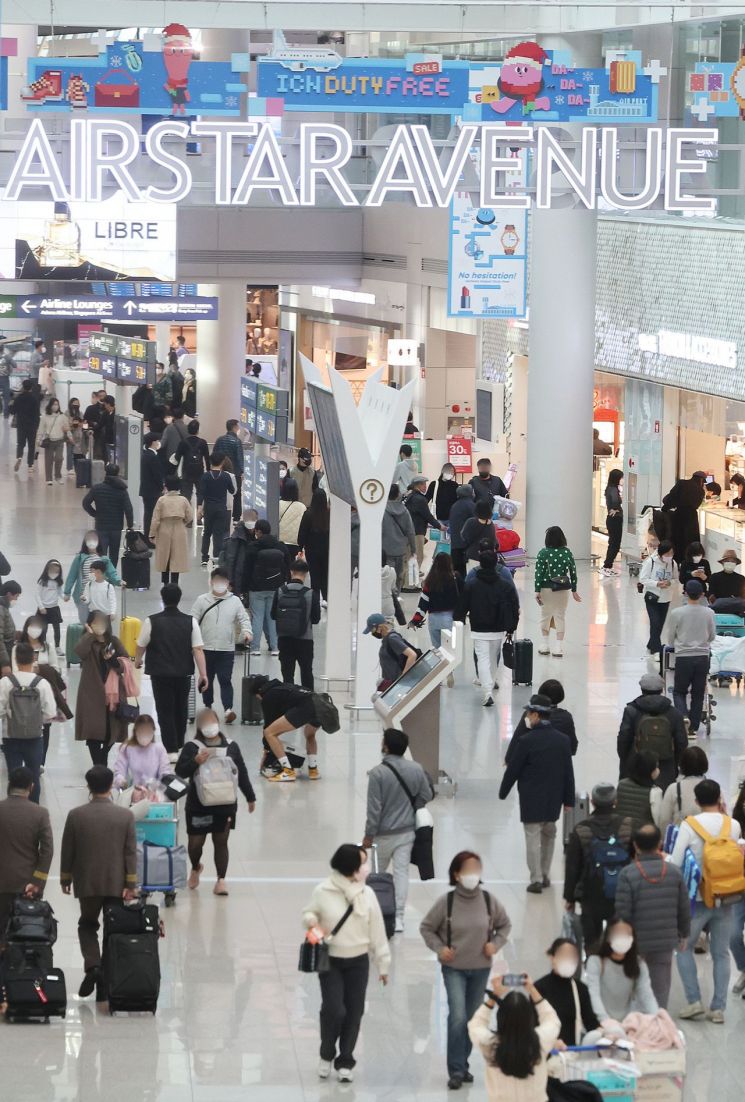 On December 11 last year, passengers were moving in the duty-free area of Terminal 1 at Incheon International Airport. The photo is unrelated to the article content.
 [Image source=Yonhap News]
Previously, domestic duty-free shops have signed service contracts to pay commissions to travel agencies that bring ttaigong to duty-free shops after China's 'THAAD retaliation' in 2016. The upper-level travel agencies that contracted directly with the duty-free shops subcontracted the services to smaller travel agencies, and even smaller travel agencies received re-subcontracts.
The tax authorities judged that A company conducted 'fictitious transactions' without actual goods or services transactions in the first quarter of 2019 and imposed value-added tax of about 1.04 billion KRW. This was based on the judgment that Company A falsely exchanged sales tax invoices worth about 18 billion KRW with the top three travel agencies and purchase tax invoices worth about 17.7 billion KRW with four lower-level travel agencies.
The plaintiff, Company A, which filed the administrative lawsuit, argued, "As a mid-level travel agency that could not directly contract with the duty-free shop, we did not perform the recruitment service ourselves but received it from lower-level travel agencies and paid commissions. We provided services to upper-level travel agencies and received commissions."
The first trial court rejected Company A's claim, stating that there is no evidence to recognize that the contracted services were actually provided.
The court first stated, "The lowest-level travel agencies that directly pay payback commissions to ttaigong cannot receive deductions and end up bearing only high sales tax amounts. The company that actually recruited the ttaigong is the starting point of the service, and the lower-level travel agencies are conceptually fictitious companies created by other companies to transfer VAT from the company that actually recruited the ttaigong, so-called 'bomb companies.'"
Furthermore, "To conceal the purpose of tax burden avoidance, a certain commission is paid, and fictitious companies are inserted in the middle of the transaction structure, making the transaction relationships very complicated. The court said that it is necessary to examine ▲ the contents of services performed by specific travel agencies and adjacent upper and lower travel agencies ▲ the contract contents and fulfillment status between travel agencies and sales/purchase parties ▲ the issuer, location, and circumstances of tax invoices ▲ the establishment background and representatives of the travel agencies.
Based on this, the court pointed out, "The plaintiff, a mid-level travel agency, did not receive the list of ttaigong recruited by the lower-level travel agencies, nor did it provide it to the upper-level travel agencies," and "It only performed the task of settling commissions calculated proportionally to duty-free shop sales and cannot be seen as actually providing or receiving services." It also added, "Contrary to the contract, most travel agencies did not set commission rates in writing."
Company A appealed the first trial court's decision.
© The Asia Business Daily(www.asiae.co.kr). All rights reserved.
![Clutching a Stolen Dior Bag, Saying "I Hate Being Poor but Real"... The Grotesque Con of a "Human Knockoff" [Slate]](https://cwcontent.asiae.co.kr/asiaresize/183/2026021902243444107_1771435474.jpg)
















