"Legal Amendments Needed to Restore Balance of Power Between Labor and Management"
[Asia Economy Reporter Oh Gyumin] The Korea Employers Federation (KEF) announced a report titled "Problems and Improvement Directions Due to the Complete Prohibition of Replacement Labor" on the 27th.
KEF argued that the current law's complete prohibition of replacement labor further deepens the imbalance in labor-management relations tilted towards labor unions. They also viewed it as causing the prolongation of strike periods. They judged that the complete ban on replacement labor leads to longer strikes and excessively restricts the employer's constitutionally guaranteed freedom of operation and business.
They cited statistics showing that over the past 10 years, the average annual work loss days due to strikes in South Korea (work loss days per 1,000 wage workers) was 39.2 days, which is 200 times that of Japan and 8.7 times that of Germany, indicating that South Korea has the highest strike frequency compared to advanced countries. They also presented research results showing that when replacement labor is prohibited during strikes, the strike duration is extended by about 58.6% compared to cases where replacement labor is allowed.
KEF claimed that it is difficult to find countries that completely ban replacement labor like South Korea. Even if restricted, they believed that limiting only certain forms such as dispatch labor protects the three labor rights while also safeguarding the employer's operation and property rights.
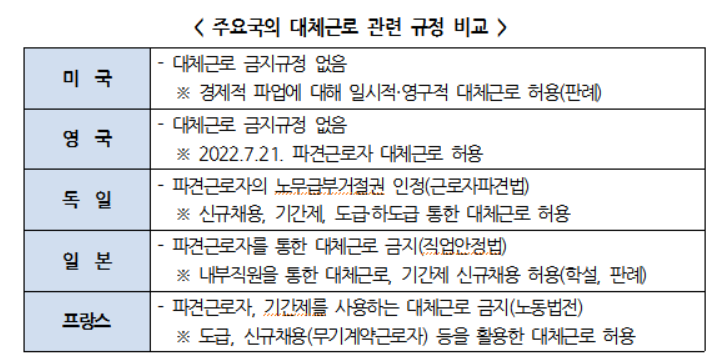
In the case of the United Kingdom, only the deployment of dispatched workers was prohibited under dispatch regulations, but this was amended, and from July last year, replacement labor has been fully permitted.
Lee Dong-geun, KEF's Senior Vice President, stated, "South Korea's labor-management relations competitiveness is at the lowest level globally, and the number of labor disputes and work loss days due to strikes are among the highest worldwide," adding, "The main cause of the continued adversarial and rigid labor-management relations is laws and systems that cause an imbalance of power between labor and management."
He continued, "Recently, the three labor rights such as the right to organize and the right to collective action have been greatly strengthened, but the level of protection for employers' counter-rights does not meet global standards," emphasizing, "Taking foreign legislative examples and the changes in the UK as an opportunity, South Korea also needs to fully permit replacement labor to restore the balance of power between labor and management."
© The Asia Business Daily(www.asiae.co.kr). All rights reserved.
![Clutching a Stolen Dior Bag, Saying "I Hate Being Poor but Real"... The Grotesque Con of a "Human Knockoff" [Slate]](https://cwcontent.asiae.co.kr/asiaresize/183/2026021902243444107_1771435474.jpg)












