24% of Mid-sized Companies Have Peter Pan Syndrome
"Miss Policy Benefits, Have Considered Returning to SMEs"
[Asia Economy Reporter Jeong Dong-hoon] As companies grow larger, government support decreases while tax burdens and regulations increase, leading to a persistent reluctance among companies to grow, known as the so-called ‘Peter Pan Syndrome.’ This is why the industry has high expectations for the government’s recently announced ‘Growth Promotion Strategy for Mid-sized Enterprises.’
According to a survey conducted by the Korea Chamber of Commerce and Industry on the 26th targeting 300 domestic mid-sized companies that graduated from small and medium enterprises (SMEs) within the last 10 years, 77% of the respondents reported that they have felt or are currently feeling the impact of policy changes such as reduced support and increased regulations after graduating from SME status.
When these companies were asked whether they had ever considered reverting to SME status to continue enjoying the policy benefits available to SMEs, 30.7% answered ‘yes.’ This means that 23.6% of companies exhibit what is called ‘Peter Pan Syndrome.’
The most regrettable and burdensome policy change felt after graduating from SME status was ‘increased tax burden’ (51.5%). This was followed by ‘reduction in SME policy financing’ (25.5%) and ‘increased regulatory burdens such as subcontracting transaction regulations’ (16%).
The Korea Chamber of Commerce and Industry stated, “The domestic corporate tax system has a four-tier progressive tax structure, and many tax systems differentiate according to company size, so tax burdens inevitably increase sharply when becoming a mid-sized company. It is necessary to review the incentive structure to ensure the growth ladder functions smoothly.”
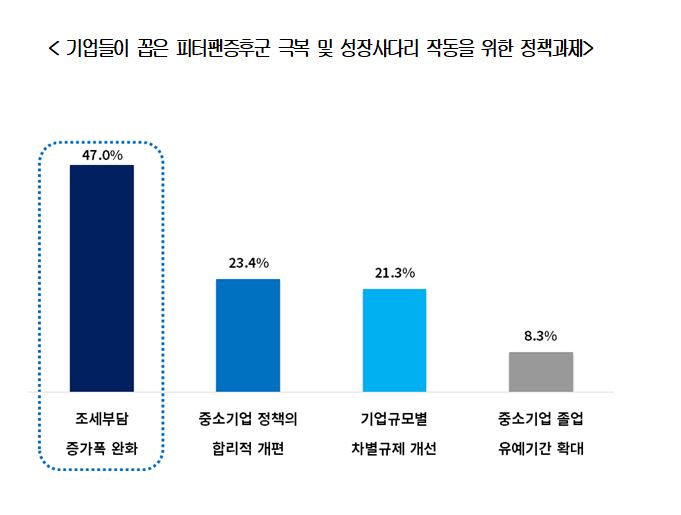
In fact, when asked about the most necessary policy to overcome ‘Peter Pan Syndrome’ and activate the growth ladder, the majority of companies chose ‘mitigation of the increase in tax burden’ (47%). This was followed by ‘rational reform of SME policies (from survival/protection-oriented to growth/productivity-oriented)’ (23.4%), ‘improvement of discriminatory regulations by company size’ (21.3%), and ‘extension of the SME graduation grace period’ (8.3%).
The top policy task needed to grow into a large company was also ‘mitigation of the increase in tax burden’ (38.7%).
"After graduating from SME status, investment (30%) and carbon neutrality efforts (26%) increased"
Mid-sized companies have been positively impacting national economic development and sustainable growth by increasing future investments and efforts toward ESG and carbon neutrality after graduating from SME status.
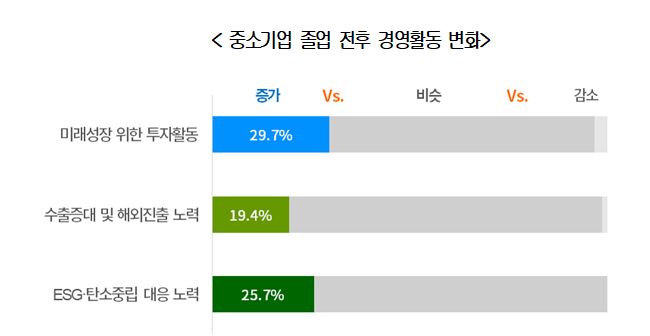
Regarding changes in investment activities for future growth such as R&D and facility investment after graduating from SME status, the majority of companies responded ‘about the same’ (67%), while 29.7% said ‘increased,’ indicating that company growth positively influences investment.
Responses to changes in efforts toward ESG and carbon neutrality were also ‘about the same’ (74.3%) and ‘increased’ (25.7%), respectively. For changes in efforts to increase exports and expand overseas, responses were ‘about the same’ (79.3%), ‘increased’ (19.3%), and ‘decreased’ (1.4%).
Meanwhile, changes in industrial trends such as digital transformation, ESG, and supply chain restructuring still act more as burdens than opportunities for mid-sized companies. More than half (56%) of companies perceive these industrial trend changes as burdens, with <‘considering it a burden and actively responding’ 21%, ‘considering it a burden but not responding’ 35%>, exceeding the response rate of companies that see them as opportunities (44%). <‘considering it an opportunity and actively utilizing or planning to utilize’ 11.7%, ‘considering it an opportunity but not utilizing’ 32.3%>
Average 15 years to graduate from SME status... ‘Disadvantages’ outweigh ‘advantages’ after graduation
Meanwhile, the average period from company establishment to graduation from SME status was found to be 15 years.
Regarding ‘improvements after graduating from SME status,’ responses were ‘enhanced corporate status’ (57.3%), ‘easier external financing’ (11.7%), ‘easier recruitment of talented personnel’ (7.7%), and ‘improved negotiation power in transactions’ (2%). However, 20% responded that there were ‘no improvements.’
When asked to comprehensively consider the advantages and disadvantages after graduating from SME status, the most common answer was ‘no difference’ (48.7%), followed by ‘disadvantages are greater’ (38.7%), which exceeded ‘advantages are greater’ (12.6%).
Woo Tae-hee, Executive Vice Chairman of the Korea Chamber of Commerce and Industry, said, “Building a growth ladder is a necessary and sufficient condition for sustainable national economic growth, including future investments and ESG/carbon neutrality.” He added, “If the government’s recently announced support plans for mid-sized companies’ exports, R&D, and new business investments are implemented without delay, it will greatly help the growth ladder function.” Vice Chairman Woo also emphasized, “However, efforts to continuously alleviate the tax and regulatory burdens, which are the most burdensome for SMEs and mid-sized companies, are hoped to continue.”
© The Asia Business Daily(www.asiae.co.kr). All rights reserved.


















