Misconceptions About Peace, Compression, and Dimples
Lost Balls, External Temperature, and When to Replace Golf Balls
A golf ball is the only piece of equipment used for every shot. It accompanies the golfer through all 18 holes during a round. It is the key factor that influences performance. The game results vary depending on the brand and model of the golf ball. You need to choose a product that matches your playing style. Amateur golfers often have misconceptions about golf balls. Here are the misunderstandings and truths about golf balls.

Many believe that the more pieces a ball has, the better it is. The number of pieces refers to how many layers the golf ball has. Recently, this has been used as a marketing strategy. 3-piece or 4-piece products are perceived as high-performance or expensive balls. This is incorrect. A golf ball is not necessarily better just because it has more pieces. Even balls with the same number of pieces do not perform identically. You need to check what development purpose the golf ball was designed for.
There is a relationship between swing speed and compression. Weekend golfers choose golf balls based on compression. They mistakenly believe that "low or high compression golf balls travel farther." The performance of a golf ball is influenced by a combination of factors such as core size and material, the number and type of intermediate layers, cover material and thickness, and dimple design. Additionally, differences arise depending on the golfer's swing speed, spin rate, and launch angle. Compression is a single value indicating how hard or soft the ball is. It affects the feel and preference of the golfer more than performance.
There is a difference between new balls and lost balls. Lost balls cannot be verified for the environment in which they were recovered. If a golf ball has been underwater for a long time or has suffered severe damage, its performance deteriorates. Research shows that lost balls have 22.3% less spin and 14.4% less distance.
It is a misconception that there are separate balls for amateurs and tour players. People think tour players have much faster swing speeds than amateurs because they only compare driver shots. Golf balls are the same for both pros and amateurs. Also, female and male players all use the same balls.
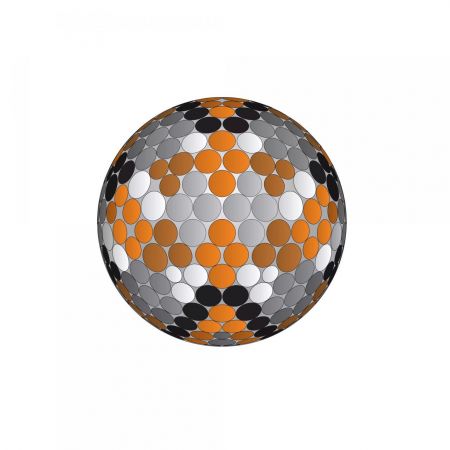 For dimples, it is important to arrange them consistently based on the axis of symmetry rather than the number.
There are also misunderstandings about dimples. Dimples affect the flight of the golf ball. The higher the dimple coverage, the lower the air resistance. Generally, people tend to think that the more dimples a ball has, the better it is. However, what matters is the consistent arrangement of the dimples. If you try to fill a golf ball with a diameter of 4.3 cm with too many dimples indiscriminately, the axis of symmetry disappears. Dimples must be arranged symmetrically on both sides based on the axis of symmetry to produce consistent performance.
Golf balls are somewhat affected by external temperature. Exposure to cold temperatures actually reduces distance. Compared to warm air, cold air is denser. Both lift and drag forces acting on the golf ball change. The temperature of the golf ball itself also affects the resilience of the ball's material. If you play in cold conditions, it is advisable to alternate between different balls on each hole. Balls not in use should be kept in a jacket or pants pocket to maintain temperature.
Golf balls can be used for several years if stored at room temperature without specific external stimuli. However, temperature changes must be monitored. Exposure to extreme cold winters or hot summer weather reduces performance. Even if the ball looks fine, prolonged submersion in water also causes performance differences. Due to the nature of the materials, golf balls should be stored in places not affected by humidity at room temperature. It is not advisable to store them in places with severe temperature changes or exposed to direct sunlight, such as inside a car.
When to replace a golf ball during a round. Even small scratches caused by hitting clubs or obstacles affect performance. Tour players frequently change to new balls during a round even if the ball is not damaged. On average, they replace one ball every three holes.
There are performance differences among golf balls. Consistency affects golf results. To reduce performance variables, it is best to use one product for all shots. This is called One Ball Play. It is important to choose a golf ball that delivers the best performance in terms of both performance and consistency.
© The Asia Business Daily(www.asiae.co.kr). All rights reserved.


















